The Thing Missing From My Life

Short answer? Paperclay. Long answer follows.

back_wall_030516

I settled in to finish the long back foundation wall, literally before the storm and power went out. Above you see the carton materials wrapped from the left side wall and primed in Ceramcoat “Mudstone”, then the beginnings of the long traverse using various parts of egg carton. Then I noticed something.

A while ago, our thoughtful reader and observer Barbara W. had sent me a mold from Woodland Scenics. Although sized as “boulders” it occurred to me that at 1:12 scale they would make excellent rubble, the kind I was using in the foundation.
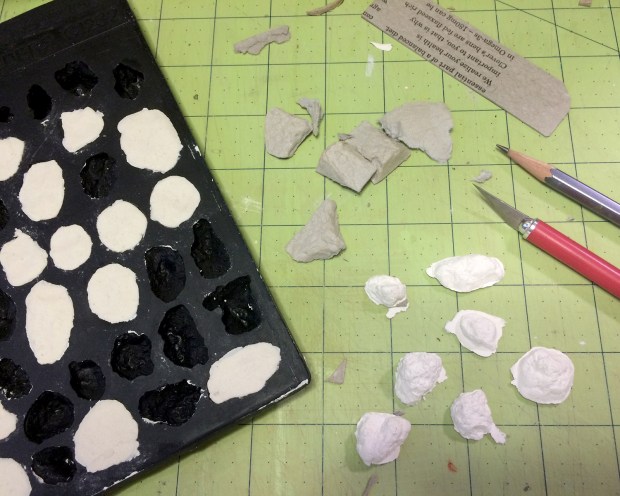
paperclay_rocks_030516.jpg

I reviewed my on-hand options and chose a pouch of Creative Paperclay. I had never worked with this material before, though it was on my list. I chose some of the larger boulder forms and filled the mold. I forgot about it until I started the back wall foundation masonry. Then I noticed that the molded boulders had a similar texture to the carton materials I was using. Like, really similar.

The dried paperclay is a remarkable material. It is extremely stable and lightweight, easy to trim, and as I was soon to find out, paints very well.
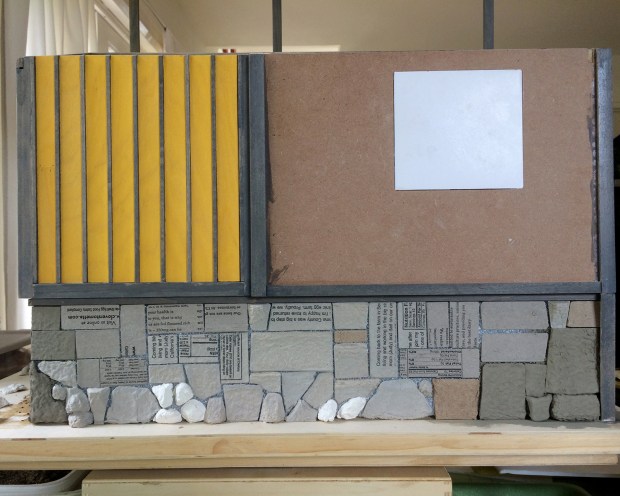
back_wall_rocked_030616.jpgI reloaded the mold with the full set of rocks in paperclay to use around the rest of the foundation, and finished out the back wall with the few that had already dried (those in white), along with egg carton and packaging forms. It seems to take two or three days for the paperclay to dry thoroughly.
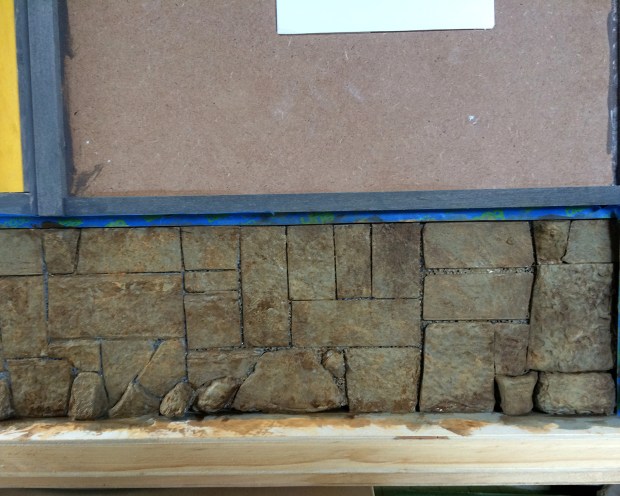
back_wall_washes_030616

I applied the same set of acrylic layers and washes as the interior foundation.
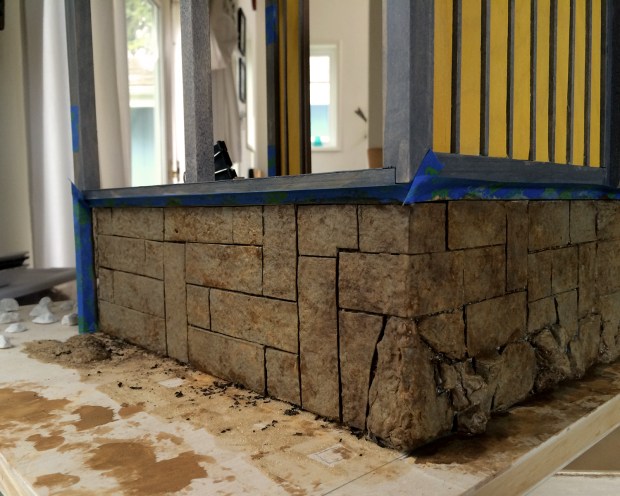
corner_030616.jpg

Here’s a dramatic corner shot.

back_wall_030616

And the entire finished back foundation wall.

back_moss_030616

Although there is additional touch up and detailing to add, this needs to dry thoroughly. I could not resist gluing in some moss, though, to make it come alive. Thanks, BW, for the gift of the mold and allowing me to discover paperclay. The fun has just commenced.

Hide one’s light under a bushel

bushels_022216

I wound up making six bushel baskets from Kris Compas’s tutorial. I used one-inch wood circles that I had on hand for the base, and after the second basket, redrew the pattern so all the uprights were like fringe, instead of individual slats. (The pattern is up on 1inchminis. There’s also a version to print multiples. Yay no measuring.) By the fifth or sixth basket I was getting a nice bulbous curve by shaping it over the top of a two-ounce acrylic paint bottle. Coopering the top rim was also much easier on the paint bottle form.

I’m working mostly on the new project now, but the in-progress Argo Wool Works Showroom is a nice bright place to sit and think and plan, with a cup of tea. (The ladders are by Sir Thomas Thumb, to be used to display hanging goods. I also splurged with the 2015 contest award and bought a scythe o_O)

Now I have to go make a 12:1 cup of tea :)


Gratitude, Framing

Thank you all for your hearty congratulations and encouragement along the way. I really was surprised to win again, and a bit overwhelmed. When I got this comment from Bennie:

comment_020216

Something clicked with “I watched it evolve from beginning to end!” Sharing our work as we did has created a genuinely supportive community for both sharers and viewers, something I value. For me, there are elements of vulnerability and trust in posting imperfect works-in-progress, in letting you see unedited glimpses of my messy studio, my naked un-manicured fingers. One of my motivations is to spark your creativity, as a maker or a viewer. Inspiring appreciation, fostering delight, is another. So thank you for dropping by. Really truly.

The light today is crazy, brilliantly sunny then dark and gray. But I was glad to arrive at this point in the new build:

framing01_020216

I got enough pieces from a second kit to be able to get a basic (and square) frame up, and determine with only minor maths the additional posts and casings that need to be built. Starting with the porch support post (finally).

framing02_020216

Next, I’ll knock it all flat again to finish the interiors and exterior cladding, then reassemble with omg glue.

A peek at the side wall progress:

interior_020216

Now back to bricking.


What?!

rancor_020116

Well that was a surprise. I am wide-eyed proud to announce that the Sea House Warming Hut placed third —of more than 100 entries! — in the 2015 HBS Creatin’ Contest. (More contest results here.) Thank you for being curious and caring enough to watch and comment on my meandering mini odyssey; heartfelt congratulations to everyone who participated.

Tiny rancor is more than happy to share my five three minutes of fame :)

In other fun news, I just signed on to this 28-day challenge sponsored by Creative Live. It’s free of cost, and results are shared on Instagram (I’m nancy_k_enge). Check it out!

Aubergine, Overlook

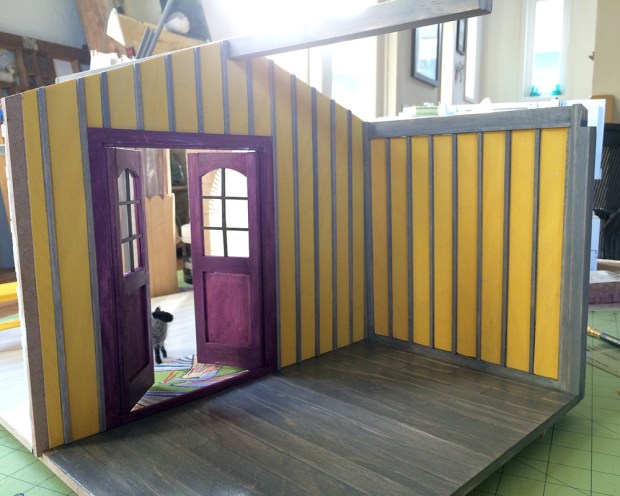
Using the kit’s doors, stained aubergine, with the mullions painted oxidized lead black.

www.nancyland.com

Yesterday I took a picnic lunch (not pictured) to Thornton Overlook, just north of Pacifica. So pleasant to sit outside with mild sea breezes and a majestic view. The Sea House Warming Hut is not far from here, in case a chill fog sets in :)

www.nancyland.com

Looking south, with Pedro Point rocks in the distance.

Inner Walls

brickwork_012216

The interior walls of the 2016 build are exposed brickwork, which will be whitewashed, with star-shaped tie irons from Old Mountain Miniatures. The bricks are all salvage from the 1906 San Francisco earthquake. More than this is not known.

2016 Build: More Messing

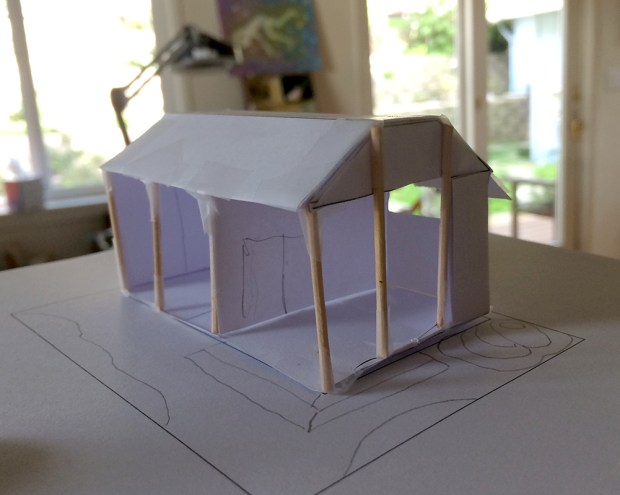
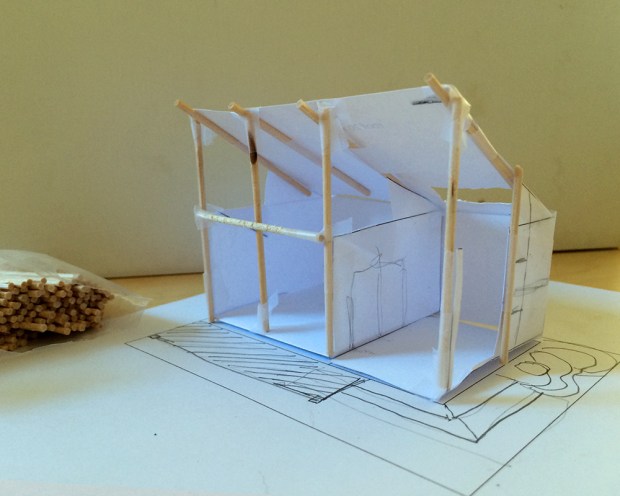
Here are two more janky models of build ideas.

www.nancyland.com

I’m really interested in this one, with the slanted roof balanced by a very large triangular dormer (is that the right term?) opening the main room ceiling. I envision zinc vertical panel roofing, a windowed front, and old oak beams, rafters and posts. Lots of reclaimed and re-purposed building materials.

www.nancyland.com

This one, right away I want to add three or four feet to the overall height. And skylights in the main room and a tall fireplace surround on the far wall. Still liking the idea of a semi-enclosed porch and entry way. This roof has an extension running along the back; why I’m not really sure. No deck, leaving more room for landscaping on the project base.

But what I’m really obsessed with now is prefab modular homes, specifically the work of Blu Homes. Feast your senses and design sensibilities. I expect you’ll be seeing a lot of their ideas coming through this next build.


2016 Build: Messing Around

www.nancyland.com

Enjoying sketching and roughing out little idea models for the lamentable 2016 HBS contest base kit. The concept above is very similar to 2012’s MiniTown Loft, my first-ever build, which became Loft No. 1961. For visualizing ideas I work in points and picas (six picas = one inch), because I am a graphic designer and picas are our native measurement system. And, one pica = one foot translates very handily for working in 1:12.

After building — and subsequently giving away, but not before I crated it and moved it across the US — one monster A-frame, I now confine my projects to 20 x 26-inch (51 x 66 cm) hollow core birch-ply drawing boards, with a turntable attached to the underside. They’re sturdy, lightweight, have a nice finished edge, and are reasonably priced. The size restriction helps me plan the site landscaping, which I enjoy as much as building the structure and furniture.

Another thing I’ve realized is that I like to keep a representative amount of recognizable original elements from the base kit. Not sure why. The contest rules are deliciously wide open, so maybe that allows me the freedom to embrace some pre-defined design limitations, and parameters of practicality. Plus, it’s just so amazing to see what everyone comes up with :)

As a wonderful kickoff for this project, a dear family member, who is a custom cabinetmaker, asked me if I wanted any of this stuff that his shop was tossing out:

www.nancyland.com

These four-foot lengths of oak (cut to 1/4 x 3/8- and 9/16-inch, quite near standard dimensional scale lumber sizes :)

www.nancyland.com

and all these veneer scraps, if you can call three- and four-foot lengths scrap. Only one is labeled (upper left, teak) but they look to be perhaps alder, koa, purple heart?, mahogany?, red oak, birch, spruce… I have a labeled sample kit somewhere, I’ll have to cross-reference to identify. Then he casually mentioned he’d be glad to look out for and save me miniature-suitable wood scraps! I see a yummy wood giveaway in the future to share this bounty. Many, many thanks, T. Happy boxing day.