how the leopard got its spots

the leopard and the snakey beast

the leopard and the snakey-beast

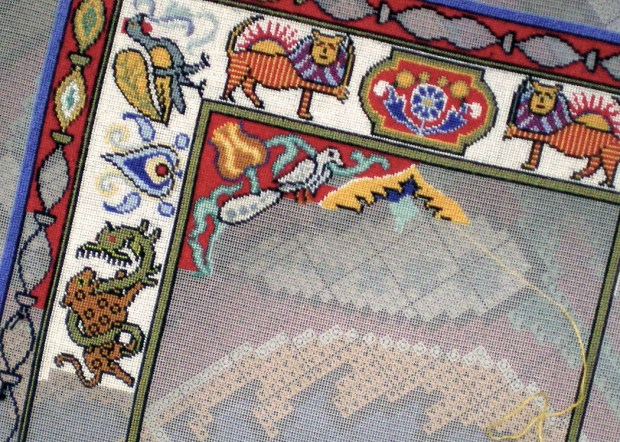
This motif was one of the most agreeable to stitch, and watching it emerge was very satisfying. I changed the snakey-beast’s colorway with two shades of olive green and gave it a red eye. The leopard’s eye is the same bright olive because the two are regarding one another, entwined, and I kept thinking about Paul Schrader’s 1980s film Cat People, and hearing Giorgio Moroder’s soundtrack and David Bowie’s voice singing “…I’ve been putting out the fire, with gasoline…” So now you have an eensy insight into why this is my favorite motif thus far.

The leopard’s spots were worked by my third-grade self, when “How the Leopard Got His Spots” from Rudyard Kiplings’s Just So Stories was one of my best beloved books.

Before this, I thought the striped lion was my favorite animal, with its Nepalese flag-reminiscent rising sun and its music Yeah Yeah Yeah’s Gold Lion. Curiously, I learned that until 1962, both emblems of that flag had faces; they were removed for “modernization”. Natalia’s chart has faces on its suns which I chose to omit. Me and Nepal, thinking modern. And the Gold Lion lyric, “Gold lion’s gonna tell me where the light is / Take our hands out of control” is an interesting concept to consider when making tiny stitches.

infinite ways to make mistakes

as if I needed more opportunity

as if I needed more opportunity

Tiny rug progress! I am still *loving* stitching this. It’s really cost-effective therapy: I have to concentrate so intently, few other thoughts slip in like, Really? We’re driving across North America with three cats and a giant dog in a 31-foot long so-called recreational vehicle? By choice?

I’d like to able to say my purity of focus prevents mis-stitchery mistakes, but that is profoundly not so. I’m rather amazed at all the many ways I make them. And although I’m learning as I proceed, inventing tricksy cross checks and multi-stranding, new mistakes creep in despite my diligence. Some are caught soon enough, and I can de-stitch the messups, but some are insidious and aren’t detected until far, far too late.

When that happens, I usually just go to bed.

And thus a whole realm of stitchery and pattern adjustments opens up, and I ponder and puzzle the most graceful way to move forward. With 2,401 tiny stitches per square inch of basis, one might think I have lot of options. But pattern and symmetry are both demanding taskmasters, and the challenge becomes how to fail slightly less obviously, and to not let the tiny errors compound.

I totally fail especially at symmetry; my brain fingers invent ways to diverge on not one but both sides of the pattern. And where motifs repeat, I must decide whether to intentionally try and recreate my, um, adjustments or go for the original pattern again. Thereby introducing further potential mistakes variations.

It’s humbling.

So this is about four of the 20 chart pages completed. Mostly. Impressive, ne?

summer coping with liger

pheasant chicken ? and rising sun lion tiger with sword?

pheasant chicken ? and rising sun lion tiger with sword?

The liger motif is what drew me most to the “Animals” rug pattern. I chose not to include the silly face on the sun, but everything else about the creature I love: the vaguely Egyptian mane, the jaunty red and yellow stripes, and the sword ? or staff ? held upright in its paw. I think of it as the cheerful beast who cuts through illusions, allows us to perceive reality, and makes our house sell for full asking price tomorrow. Actual width of the two-motif stitched area is 2.5 inches (6 cm) and represents about 1.5 chart pages of 20. Twenty. I’ve plenty of time and opportunity to perceive reality. Yay!

3 > 2

3 strands Gütermann silk on 28 count canvas

3 strands Gütermann silk on 28 count canvas

Two strands of Gütermann silk provided somewhat scanty coverage, and although three strands is a bit dense, I’m keen on the increased color options. And I like to imagine the satisfying, luxurious feel of walking with tiny bare feet on a thick silk rug.

I am sub-optimally charting the design in Illustrator as I stitch. Actually, I’m doing a fine, if tedious, job of charting, it’s just that Illustrator is not really optimized for this purpose. It was adequate for the Modern Cross Stitch Bodoni charts, but those were the letterforms only, with no backgrounds, on 14 count canvas.

This has led me to explore actual charting software. I’m messing around with a demo copy of Ursa’s MacStitch right now, and it seems pretty cool. There are tools to draw with, or you can import an image file and it will translate and map it into a chart of your specifications. I’ve yet to determine if the time investment in learning a new program vs. working with one I know so well will balance the number of designs I’m likely to actually produce. Given my… serial enthusiasms history.

so of course

messing around with modern rug design

messing around with modern rug design

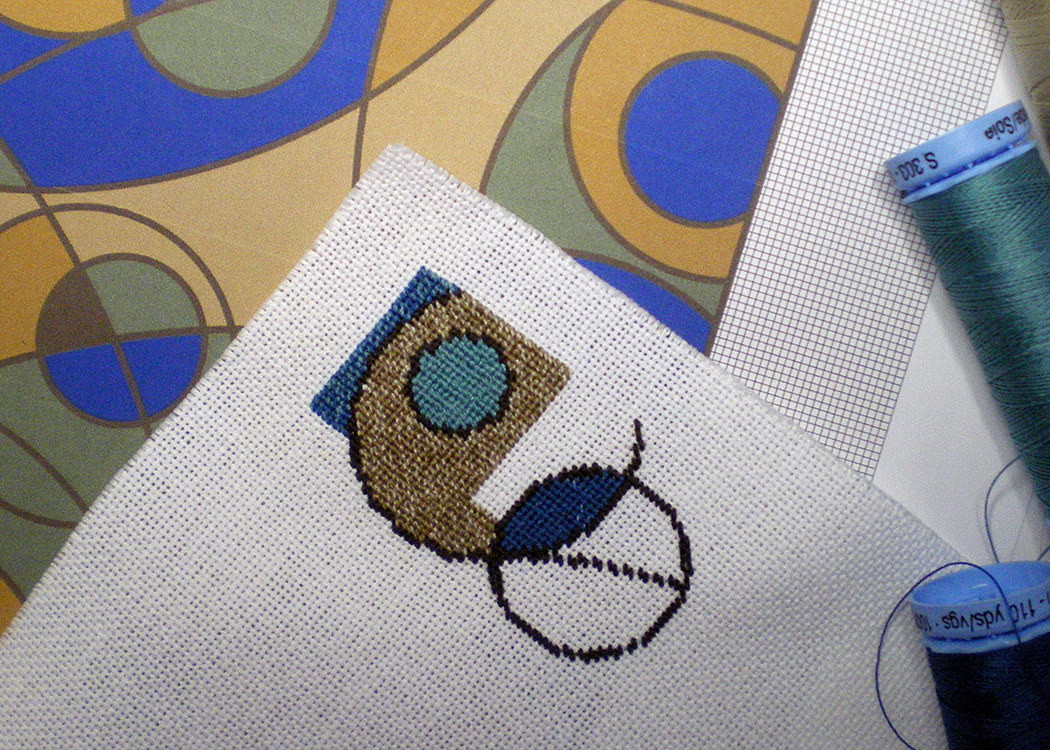
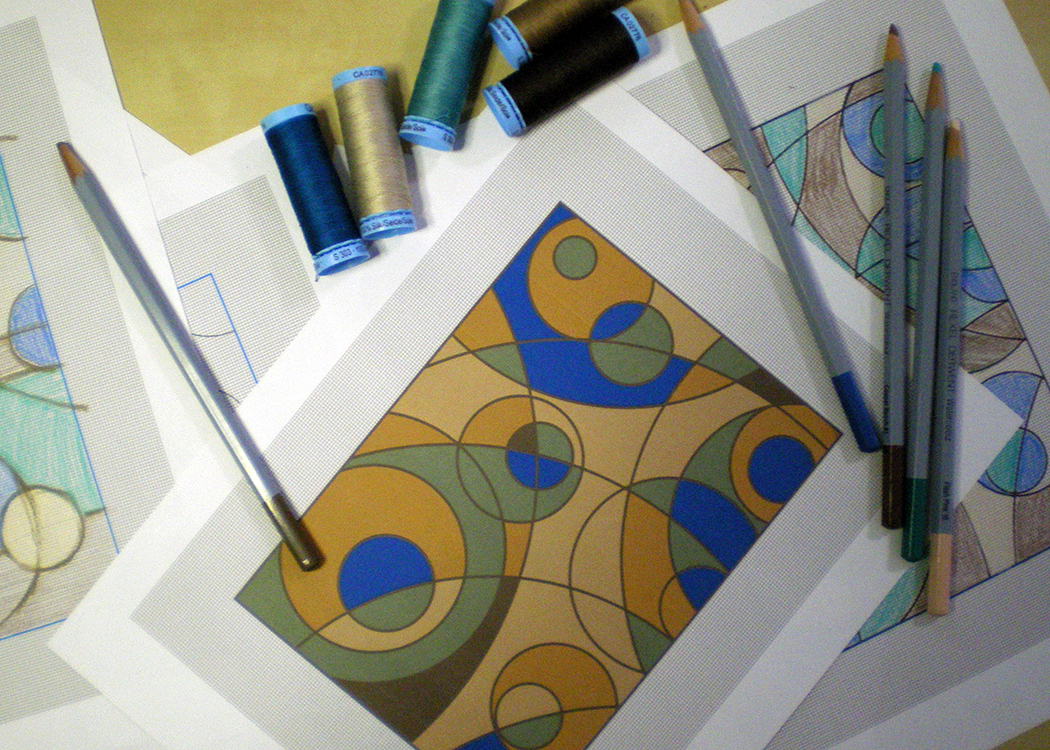
So now that I’m all obsessed with miniature needlework, I’ve been searching for some modern design charts. I haven’t found any yet, so I started sketching up one of my own. I also want an easier project to work on, so I got some 28-count evenweave canvas and picked out some silk thread from the minimal selection of colors available at the local fabric store. This will be a 5 x 7 inch (12.7 x 17.78 cm) rug, so on 28-count that will be… 140 x 196 stitches. Ha! Compared to the 49-count silk gauze, should be relatively fast and easy.

where warp and weft intersect

a corner outer border

a corner outer border. I decided not to keep track of the time spent, for obvious reasons.

Working on this tiny rug is like entering another dimension (not that scary Twilight Zone episode one.) It is interesting training my eyes to see not only the tiny holes of the silk mesh, but where warp and weft intersect. Threaded needle goes through the openings, but the actual stitch is made diagonally. It’s a different set of pattern recognitions depending on the direction in which I am stitching, both vertically and horizontally and right to left or left to right. Seriously, where to stab the needle and where to lay the stitch looks different each way. Thread makes a difference, too. Silk fits the holes perfectly and slides through easily; cotton is fatter, fuzzier and tends to untwine itself more.

Progress: I’m making it.

an outer corner border in relation to all the rest of the rug

the outer corner border in relation to all the rest of the unstitched rug. I know.

my new best friend

this threader saves minutes of aggravation

this threader saves minutes of aggravation

So, I’ve begun stitching what now seems like a gigantic rug. The stitches are even tinier than I imagined, nearly impossible. Six rows cover .125 inch (3mm). Mistakes have been made, and quite a few of them picked out and re-stitched, though not all. The difference between a correct diagonal stitch and an incorrect horizontal one are barely discernible. (Invoking two of the Four Ps: Perfectionism and Patience.) I have learned silk thread is far more forgiving than cotton. I have taught my non-dominant, under-hoop hand to stab the needle fairly accurately up through the mesh, which seems to speed up the rate of progress. I have stitched, and then removed, an entire corner motif outline because I counted incorrectly and was two rows off. Beginning to get the feel of needle placement in the mesh. Suspecting I may have, um, over-estimated my abilities with this as a first project. Doing it anyway.

15 minutes into it

http://www.scarletsailsminiatures.blogspot.com/

large chart for a tiny rug

The “Animals” rug kit I got from Natalia Frank has been breached. It is intimidating. This is the chart, the map from which I will stitch. It is 20 pages. O_O The chart alone is a thing of beauty.

http://www.scarletsailsminiatures.blogspot.com/

palette of silk and cotton thread, and silk gauze

The colors are gorgeous, subtle and rich. The silk gauze, sturdier than I expected, feels like it will hold up to the thousands of stitches it will eventually carry.

The first step (apparently) is to frame the edges of the gauze with a sturdier fabric, to both stabilize and extend its size to fit the 12-inch hoop I’ll be using (probably until the end of time).

a drop hollows out the stone

Exquisite miniature rug by Natalia Frank

Exquisite 1:12 miniature rug by Natalia Frank

I’ve ordered this needlework rug kit from Natalia Frank, a miniaturist and needlewoman of remarkable talent and skill. To try to get your mind around what she does — and what I want to do — know that the final piece measures 5.73 x 8.12 inches (14.5 x 20.6 centimeters). It is stitched on 49 count silk gauze, which translates to 49 x 49 tiny stitches per square inch of gossamer fabric (281 x 398 stitches do the math). With a single strand of DMC embroidery thread. (Regular embroidery floss is six strands twisted together.) I’m starting with the finger and eye exercises suggested on her blog.

I am excited about this project for so many reasons, like for instance you can only work on it for 20 or 30 minutes at a time or you’ll go blind, and that you don’t need a whole studio to do it in, and that Natalia has The Four Ps. That’s one more P than mine: Perfectionism, Procrastination, Paralysis. Hers are Practice, Persistence, Patience, Perfection. Her definition of Perfection is that no one is, which we all need to be reminded of from time to time. And she quotes Ovid, Gutta cavat lapidem (A drop hollows out the stone.) Thinking I like her Ps way more than mine. I’ll keep you apprised of my progress, and do check out her work.