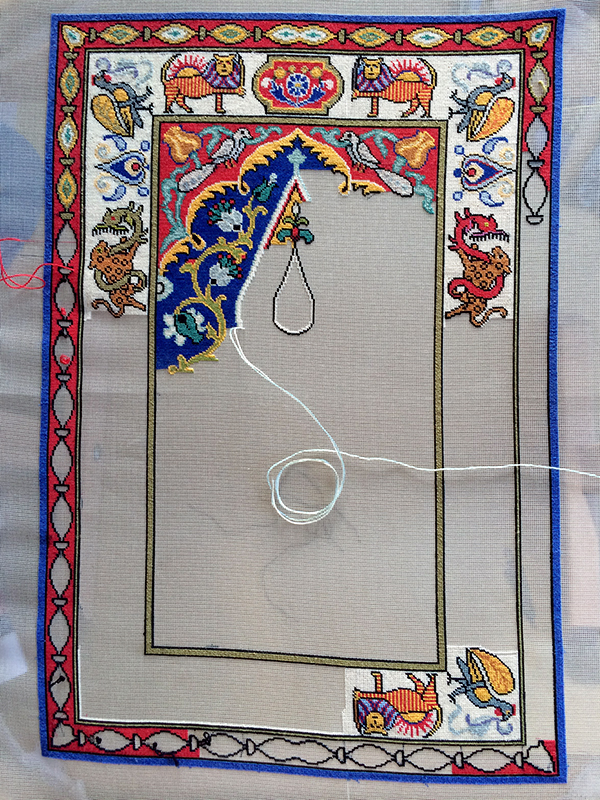
Animals rug: all four corners

The perimeter is secured

The perimeter is secured

The Animals rug has been my project of choice lately, interspersed with work on the Great Green Room, the new build for the HBS contest, and ongoing additions to the Sea House Pavilion. Miniature needlepoint stitching is tremendously absorbing and satisfying, and I’ve been searching out pattern books from the library and used bookstores.

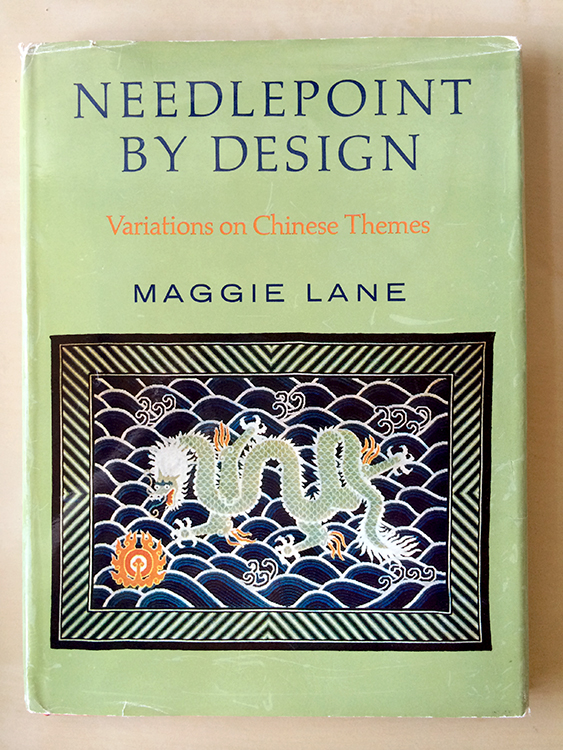
I got this from the downtown Santa Cruz Friends of the Library bookshop, primarily for the cover:
“…a modern breakthrough book in the technique of the ancient, joyful, and beautiful craft of needlepoint.” from the 1970 foreword by Clare Booth Luce

“…a modern breakthrough book in the technique of the ancient, joyful, and beautiful craft of needlepoint.”
from the 1970 foreword by Clare Booth Luce

Needlepoint by Design by Maggie Lane, 1970. As it turns out, the cover design is not included in the book, but there are several other motifs graphed — a fish, a stag beetle, a tortoise, a frog — that I look forward to incorporating in something, some day. Well worth the US$4 price.

Then there is this, Needlepoint Designs From Oriental Rugs by Grethe Sorensen, published in 1983:

“Perhaps, unencumbered by outer distractions, the mind’s eye turns inward to the world of color, shape and symbolism to which human imagination first awoke.” Grethe Sorensen, 1981

“Perhaps, unencumbered by outer distractions, the mind’s eye turns inward to the world of color, shape and symbolism to which human imagination first awoke.” —Grethe Sorensen, 1981

This book. This book is luscious. There is a great history and discussion of design elements, rich full-page photography, and well-drawn charts. I am daydreaming a simplified version of the cover’s outer border, without the squiggly bits, as part of the next major rug after Animals is done.

Spec’s: 49-count silk gauze, 281 x 398 stitches — well now a bit more (5.75 x 8.125+ inches, 14.57 x 20.63+ cm); DMC cotton and Gütermann silk. Original design by the fabulous Natalia Frank.
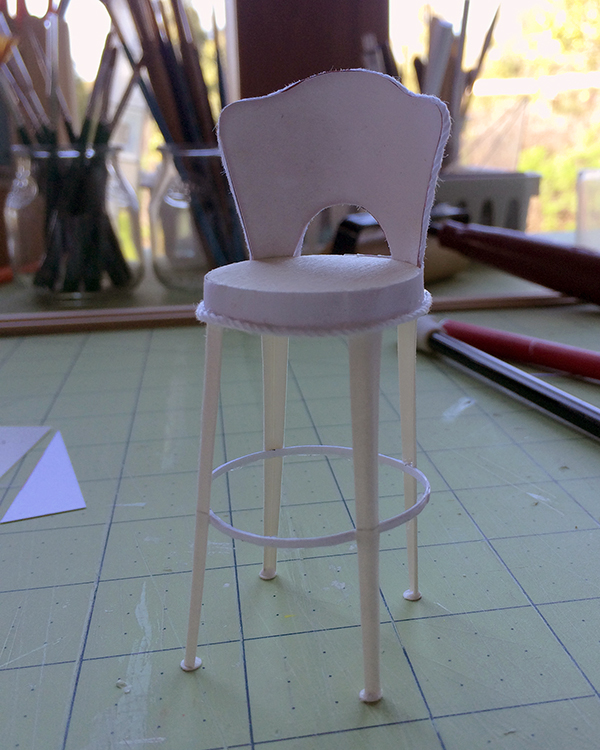
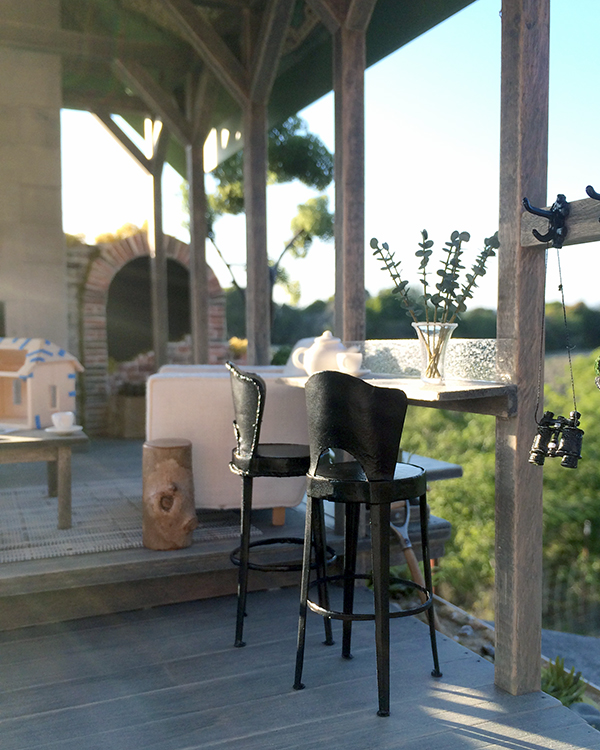
Vintage stools for the Sea House Pavilion

Metal stool (unpainted) made from cardstock, wood and string from a tutorial by Kris Kompas

Metal stool (un-metal, unpainted) made from cardstock, wood and string, from a tutorial by Kris Compas

Kris Compas over at 1inchminis has a great tutorial this month for a vintage metal stool. I love this design!

They work well in the Sea House Pavilion. I am not happy with the thread detail to simulate a rolled metal edge — I couldn’t get it to look like anything other than fussy thread — but without it they look a bit plain. More exploration of materials is called for.

New vintage chairs for the Sea House Pavilion. Come sit and watch the sun go down.

New vintage chairs for the Sea House Pavilion. Come sit and watch the sun go down.

I also made a pattern for a slightly modified seat back, so I’ll be able to experiment more. And order new spray paint. Check out this range of colors from Liquitex!

Thanks, Kris!

the great green room: bed

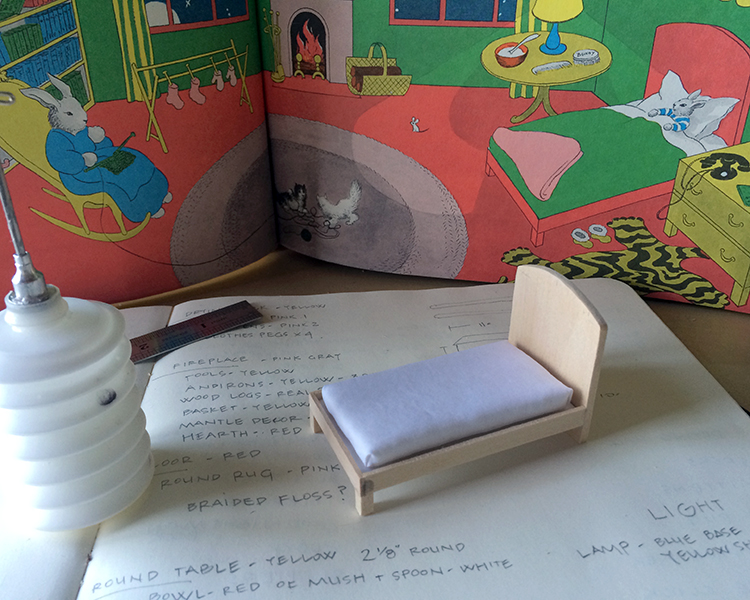
Beginning Bunny’s bed

Beginning Bunny’s bed

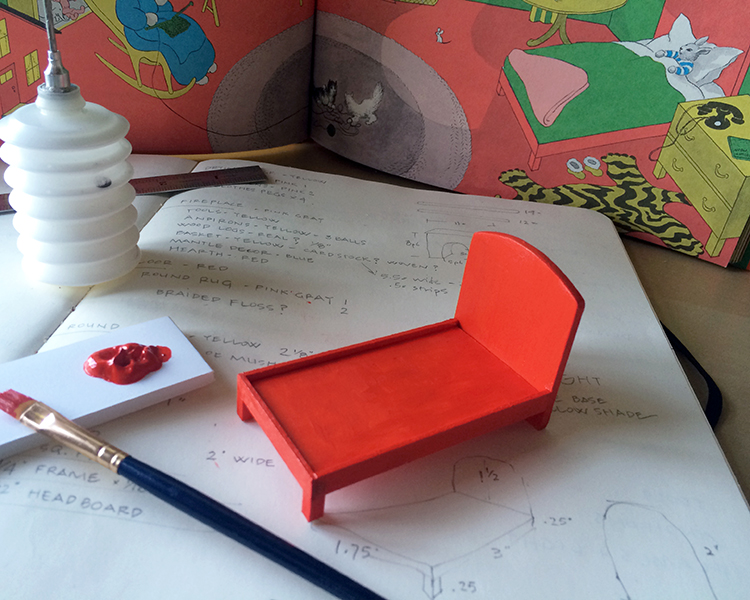
I love the simplicity of the bed in the great green room. I used 1/4 x 1/16-inch basswood for the sides, and 1/8-inch for the legs and headboard. I cut the base and the mattress of 3/16-inch foam core.

Once again, there are many options translating an illustration into a 3-D object, and my first instincts are not necessarily the best solutions. The mattress has a layer of Thermolam for loft, cut just to the size of top + sides and glued. This is covered by a layer of old fine cotton sheeting that I must have folded and mitered the corners of a dozen times each, trying to reduce bulk but still suggest comfy bed.

First coat of vermillion

First coat of vermillion

Sand, paint, wait to dry, sand; paint, wait. Sand. Fix broken glue joint. Wait. Paint. Learn that the tiny blotch of stain from the Sea House Pavilion that you thought was just a smudge or something will show through paint no matter what and of course it’s on the side facing out. Decide that you can live with that. Mostly.

The “dressed” bed and tiny placeholder Bunny frame

The “dressed” bed and tiny placeholder Bunny frame

I used green felt for the coverlet, again cutting and gluing to just cover the sides and barely wrap to the bottom of the mattress. The pink blanket looks deceptively simple, but I went through several iterations before arriving at a passable solution. The mattress assembly is still loose for now. It and the pillow will be mashed and glued into place once Bunny is complete.

Current thinking is to needlefelt Bunny’s head and paws. I got my new order of fabric for the curtains and jammies printed on cotton.

Next up is the dresser and table. Then curtains. Then… the one million other details.

Birthday love

josh_salesin_030814

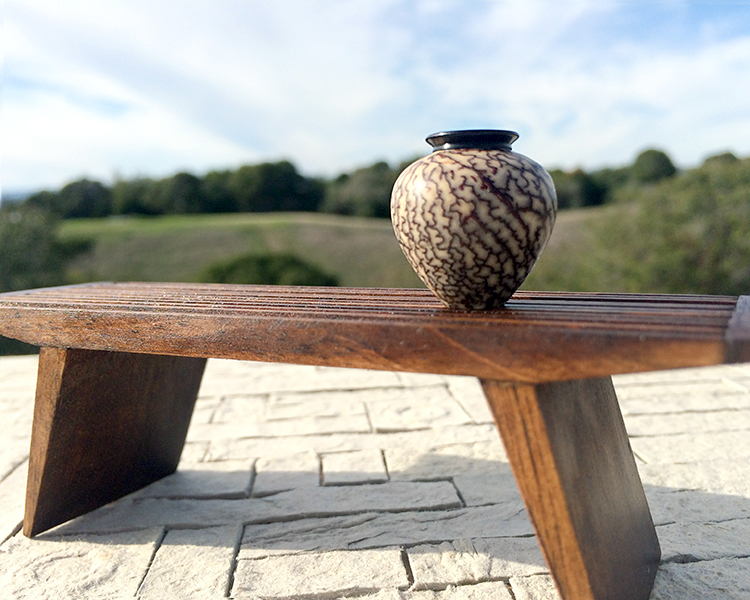
Miniature palm nut vessel by Joshua Salesin. .875 inch (22 mm) tall (shown on a 1:12 scale Peter Tucker bench)

A longtime colleague and friend, the multi-talented Joshua Salesin gifted me one of his exquisite miniature vases, this one made from a palm nut, turned on his 175-year old lathe. I am so honored.

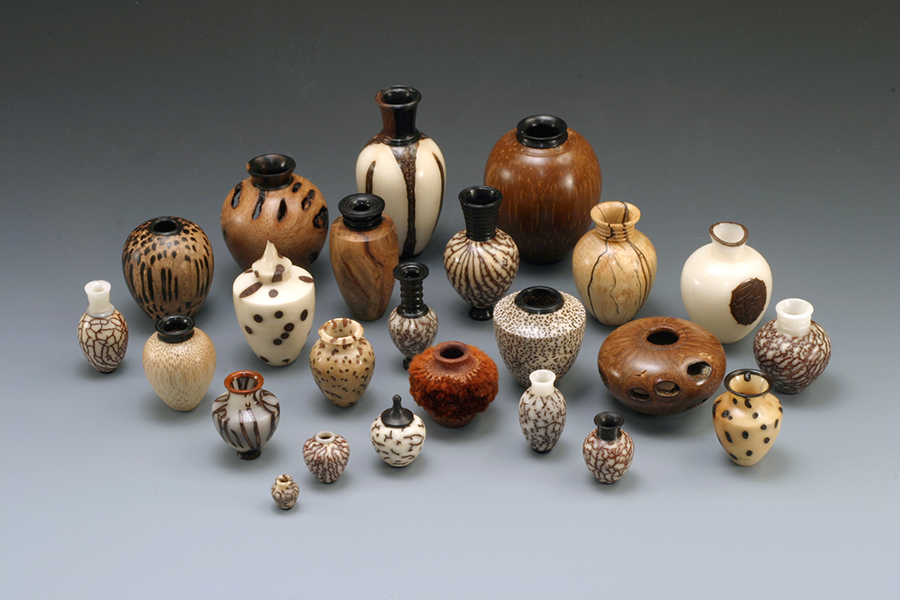
Here are some of his wee vessels made in 2005. The largest is about 2.5 inches (6.35 cm).

Miniature wood vessels by Joshua Salesin, 2005

Miniature wood vessels by Joshua Salesin, 2005

Read about his process and techniques, and see the broad range of his superb and very original work at www.joshuasalesin.com.

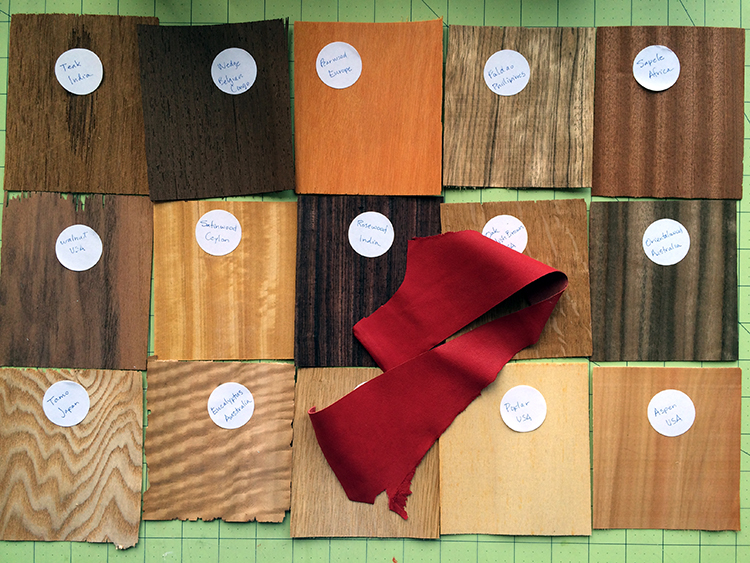
Another old friend, Tauna Coulson, also ridiculously multi-talented, raided her stash and presented me with a bag of amaze. She knows me so well! (Unsurprising, as we shared office space for many years.) Among the miniature builders-pertinent stuff was a ribbon-tied set of 15 wood veneer samples, and a piece of the softest, most-perfect-shade-of-red leather:

tauna_030714

Such treasures!

The gift of vocabulary (and leather)

Superfun surprise letter!

Superfun surprise letter!

Squeeeee! Some days the mail is extra-fun.

Last week I came across a post on Pat Sweet’s Bo Press Miniature Books about shagreen. I sort of thought I knew what shagreen was until I came to the observation “Stingray is such a strange leather.”

Wait, what?

Some time later, after reading up on both (and related) items, and with new-found appreciation, I thanked Pat for enriching my world. I had not known that they make leather from fish. Then she told me they make leather from all kinds of things, “If you can skin it, you can tan it.”

And then she sent me this!

The first black piece is polished ray skin; the yellow is unpolished; the celadon-colored bit is more traditional ray (which used to be called shark skin); the green triangle: also ray.

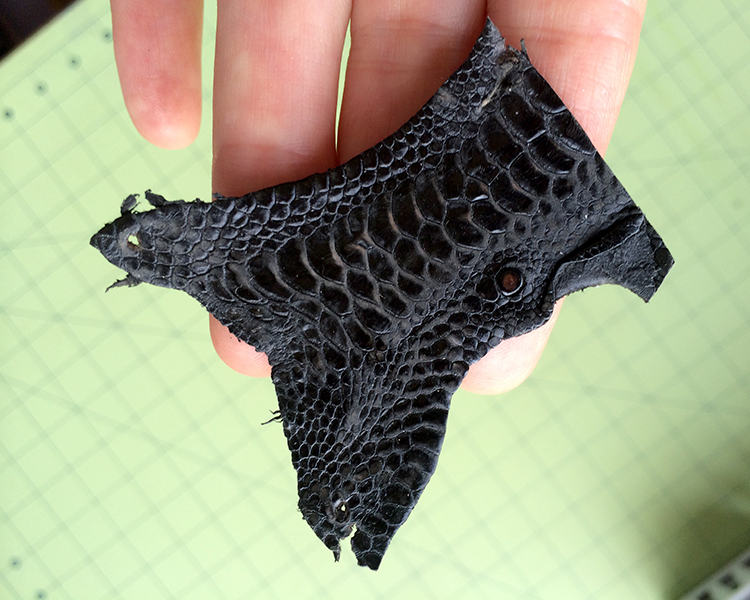
The lower black piece is chicken foot leather.

O_O

Here’s a closer look, because it is so fabulous and horrible:

Pat says this is chicken skin leather. I think it might be dragon.

Pat says this is chicken skin leather. I think it might be dragon.

Anyway, I have to go continue celebrating my birthday. We will be seeing more of these extraordinary materials. Each will become a part of something fabulous. Thank you, Pat Sweet, for sharing this treasure with me! And do check out her work. You will be glad you did.

ps: The shagreen dots are calcified papillae.

animals rug: turning the third corner

We have turned the third corner!

We have turned the third corner!

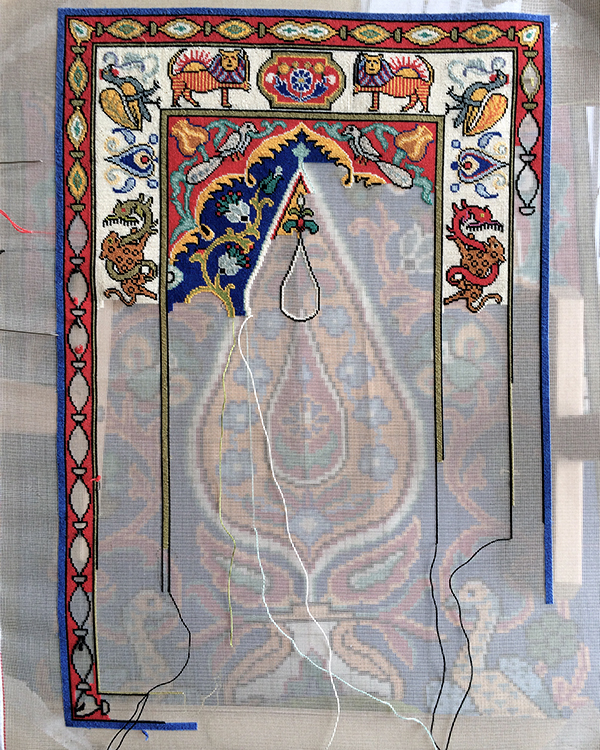
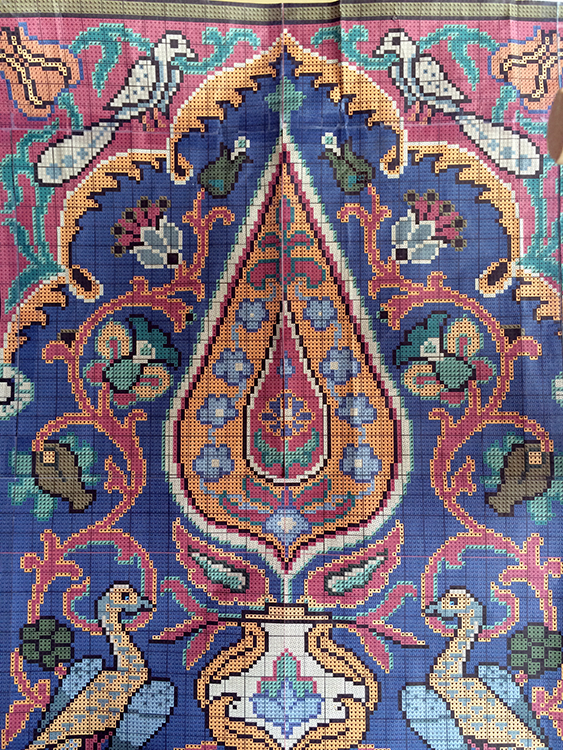
Been spending quality time with the Animals rug again. And with progress comes change. I had been in a quandary over the outer border, and finally solved it by adding an entire additional motif to the length. I had also not been satisfied with the design of the bottom center panel, so adding just a bit to the overall length will allow me to flip the whole yellow flamey curlique border with the spotted doves and poppy pods around and put that in on the bottom, replacing the various sun and flower motifs of the original design. It will fit behind and under the larger birds’ tails. And on the outer border, I’ll flip the horse, elephant and the two stripey lions around, so in effect we have birds and animals coming and going. Or something. Makes sense to me.

This is the portion of the center panel I’m working on now:

The upper part of the Animals rug center panel

The upper part of the Animals rug center panel

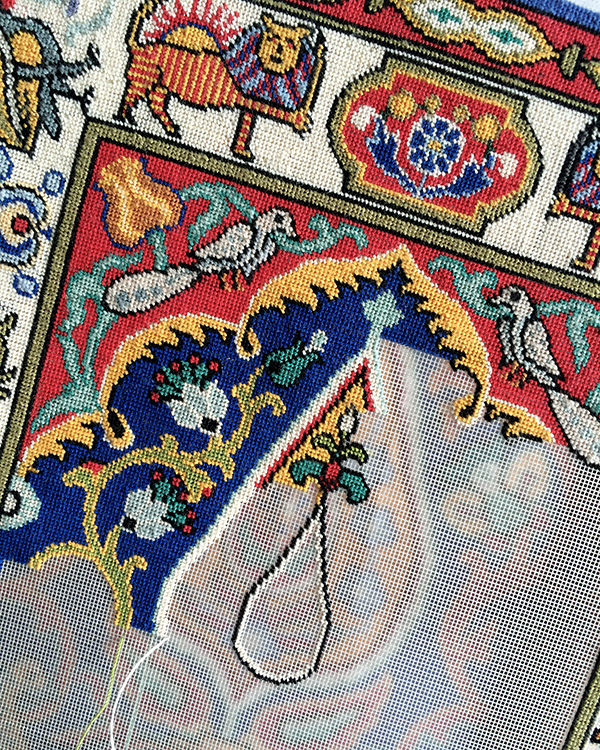
And you can see I’ve made some other changes to the colorways and pattern as well.

Center panel detail with a few pattern and color changes

Center panel detail with a few pattern and color changes

Spec’s: 49-count silk gauze, 281 x 398 stitches — well now a bit more (5.75 x 8.125+ inches, 14.57 x 20.63+ cm); DMC cotton and Gütermann silk. Original design by the fabulous Natalia Frank.
the great green room: fabric fail

In which I learn the hard way that polyester is not well suited for miniature draperies.

In which I learn the irksome ways my fabric is not well suited for miniature draperies.

I had been quite pleased with the “silky faile” fabric choice I made from Spoonflower for the draperies in the Great Green Room. Turns out the “faile” part is prophetic. For although the weight and feel is just right, polyester is not at all suitable for crafting miniature drapes. I should have known, having read numerous curtain tutorials, but somehow I was only thinking the “silky” part. Polyester resists both glue and bonding strenuously. So after sighing a lot, I’ve re-ordered it to be printed on basic 100% combed cotton. It’s what Mr. Hurd would have done. *sigh*

And while I was at it, I re-ordered the blue-and-white striped pajama fabric as well, because “performance knit” is also 100% polyester. At least I tweaked the width and color of the stripe on that one, so it’s not a total do-over.

My new tiny Clover iron works really well, though.

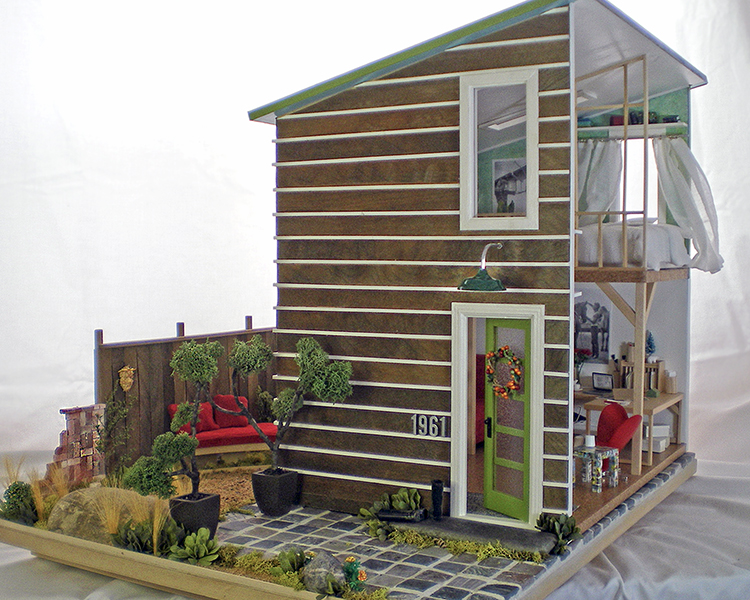
Loft No. 1961

Loft 1961, my entry in the 2012 HBS Creatin’ Contest

Loft No. 1961, my entry in the 2012 HBS Creatin’ Contest

Way back in early 2012, I happened across a photo of a Brinca Dada dollhouse, and everything changed. Over the next few weeks I obsessively researched this awe-inspiring world and rapidly determined that building modern miniatures was the one thing missing from my life. And so it began.

My entrance into the realm was via HBS’s MiniTown Loft kit. I had no idea how to build a dollhouse, and totally learned by doing (and undoing, and re-doing). I read everything I could find, and followed the tutorials faithfully. Over the months of the build, I acquired more tools and supplies and ideas. Soon I started hearing whispered stories and catching glimpses of tiny rooms with perfect furniture. I started staying up late.

And I found a community of other people devoted to scale modeling and the pursuit of wee perfect things, eager to share what they are doing and how they are doing it.

The door is open, come on in

The door is open, come on in

Loft No. 1961 went through a few incarnations, until I realized it was the studio of a woman writing a book about her father’s death. Lots of storage was required for reference and research materials, as well as artifacts and mementos. Big desk. An uncluttered bed to sleep in if the work went late, with an open window. A couch to think on.

A good place to work

A good place to work

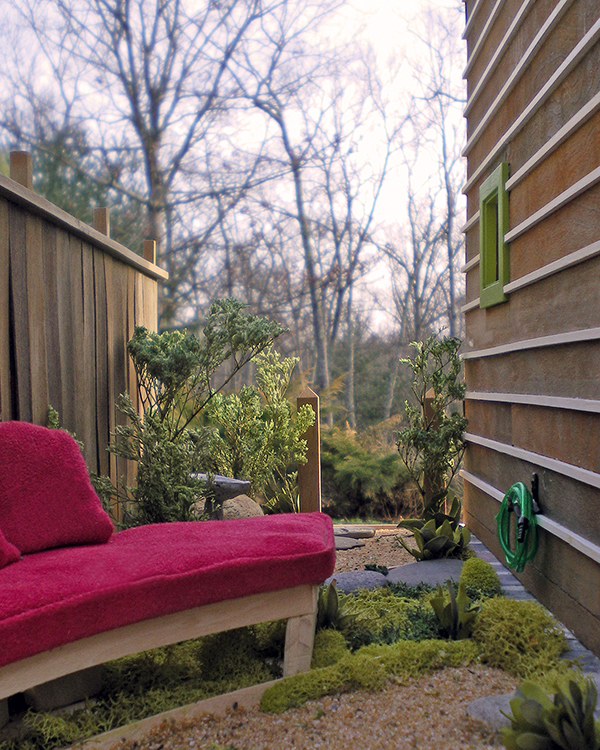
A garden to sit in, to smell the salt air and watch the fog blow through, and warm your face in the sun.

Build a little secret garden in your soul

Build a little secret garden in your soul

I built and rebuilt intuitively. I remember clearly the moment I grasped the concept of scale. Not that I always achieved it, but that it was the goal, as well as the quest.

I was so happy to win a first-time entrant’s award and recognition (as well as the sweet cash that could only be spent on more miniatures :) Someone else saw what I saw in my build! And they liked it!

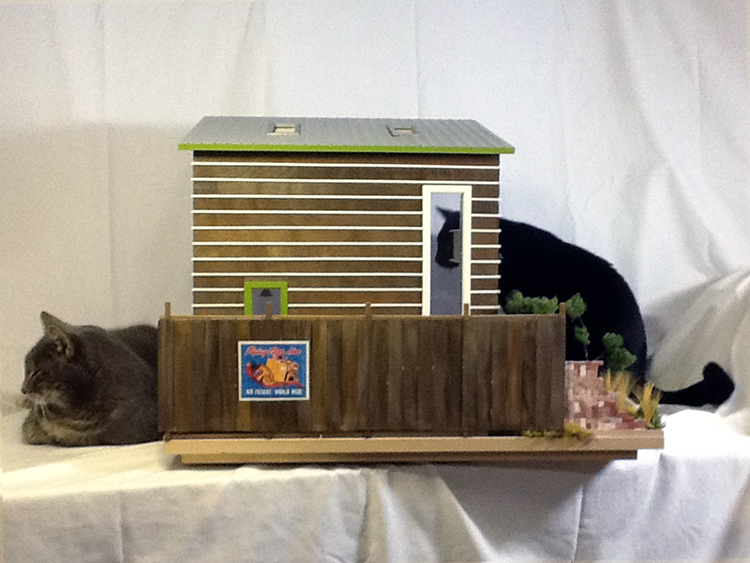
Finally, who among us miniaturists do not have versions of this photo?

Napoleon and Albie approve!

Napoleon and Albie approve!

the great green room: tiger skin rug

In the great green room is a tiger skin rug, but it is not said goodnight to

In the great green room is a tiger skin rug, but it is not said goodnight to. Discuss.

The tiger skin rug has deviled me from the start. First of all, the whole idea makes me very sad. Then there is the truncated illustration, and as always, ineffable questions of interpretation and medium.

My first solution is literal; my task is but to replicate. As with the fishing bunny picture frame, I fiddled with tracing it in Illustrator and Photoshop, but determined that a freehand interpretation was truer to the spirit of the great green room, and WCHWD.

I hated it. It’s black Sharpie on a yellow microfiber cleaning cloth. It may be too soon to depose it, before I’ve got the rest of the bedside pieces made, but when I look at it, I flinch. I put it on the backburner of things to consider.

Time is running short of the mid-March completion date. I thought, perhaps go literal a different way, and I bought a quarter-yard of a tiger skin print fabric.

Printed tiger skin?

Printed tiger skin?

I didn’t even have the heart to cut it out and ponder edge treatment.

I had always considered doing a needlepoint version of the rug because, hey, I love needlepoint, but I am also keenly aware of the time constraints. And also, WWCHD? There are a few miniature tiger skin rug charts out there, but when I happened across Susan McBaine’s Miniature Needlepoint Rugs for Dollhouses, something went, um,  something inside.

tiger3

The design has an integrity seemingly missing from other charts I have seen. And if I’m going to depart from pure re-creation of Mr. Hurd’s illustration, there has to be a compelling — or whimsical — reason.

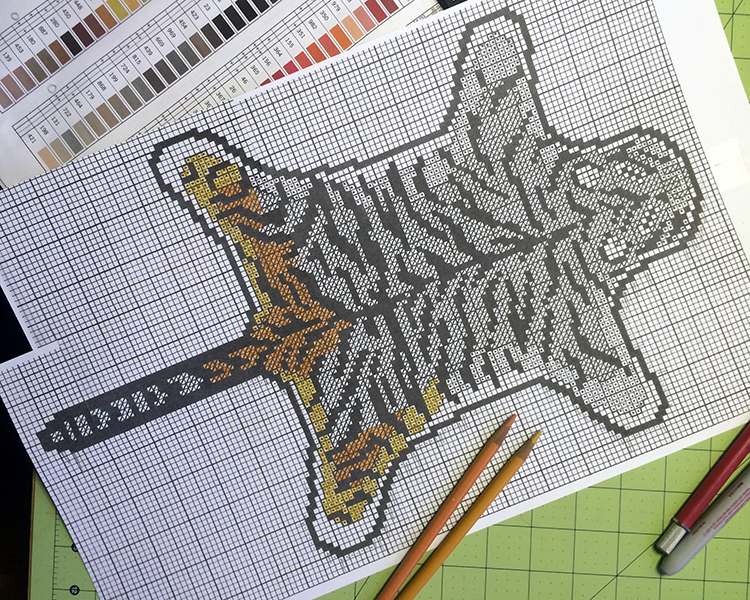
Trouble is, the charts are drawn by hand and smudgily printed in black-and-white (the book was published in 1976, a simpler time), and reading them is harder than stitching on the 49-count silk gauze I will use. My solution: photocopy and enlarge it, then color in with Prismacolor pencils. Very 8-bit :)

Bigger and more colorful!

Bigger and more colorful!

I think I’ll have an easier time stitching from this chart. It’s 150 stitches wide, which translates to 1.5 inches (38 mm) on 49-count, which is a bit wee. I need to order the two tiger-colored threads (I have the black and ecru) from Red Rock. What to do, what to do?

back to the animals rug

Tiny stitching has resumed

Tiny stitching has resumed

Spending quality time with the Animals rug again. It had been supplanted by work on the Sea House Pavilion, then (and now) by the Great Green Room and the Baluchi prayer rug.

The center design is absurdly complex. Whereas the borders have independent motifs, the interior is all tangled up together, and I have a dozen threads going at once, which of course jumble themselves every other stitch no matter how cleverly I try to keep them out of the way. Part of the challenge, I guess.

Still. I love working on this rug and seeing it come to life. I may have coined a new term to describe those who do miniature needlework: needlepointilist :)

The reality check: 49-count silk gauze, 281 x 398 stitches (5.75 x 8.125 inches, 14.57 x 20.63 cm); single strand of DMC cotton and Gütermann silk. Design by the fabulous Natalia Frank.