Into what have I gotten myself?

Fifty (50!) 6×6-inch blank panels

Earlier this month I was delighted/surprised to be accepted to the 17th Annual Sanchez Art Center 50|50 Show, in which 50 artists complete 50 small works in 50 days. (I’ll just let that sink in a bit. It’s both a lot and a little at the same time.)
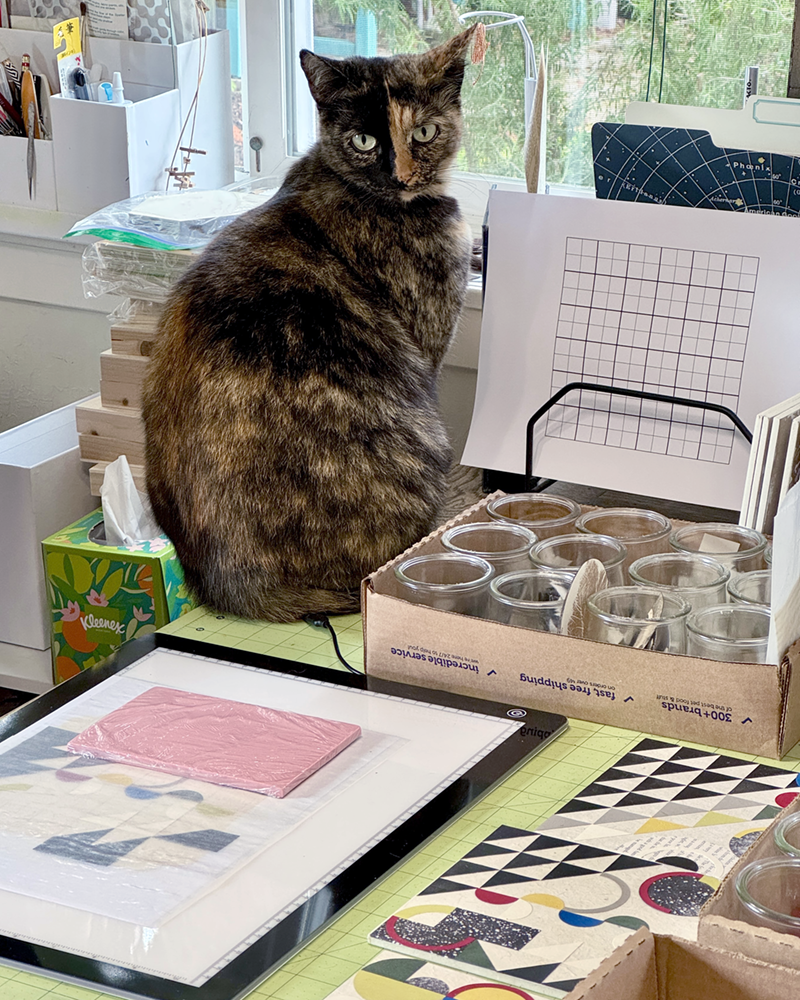
Maxine surveys the new mayhem on the studio table

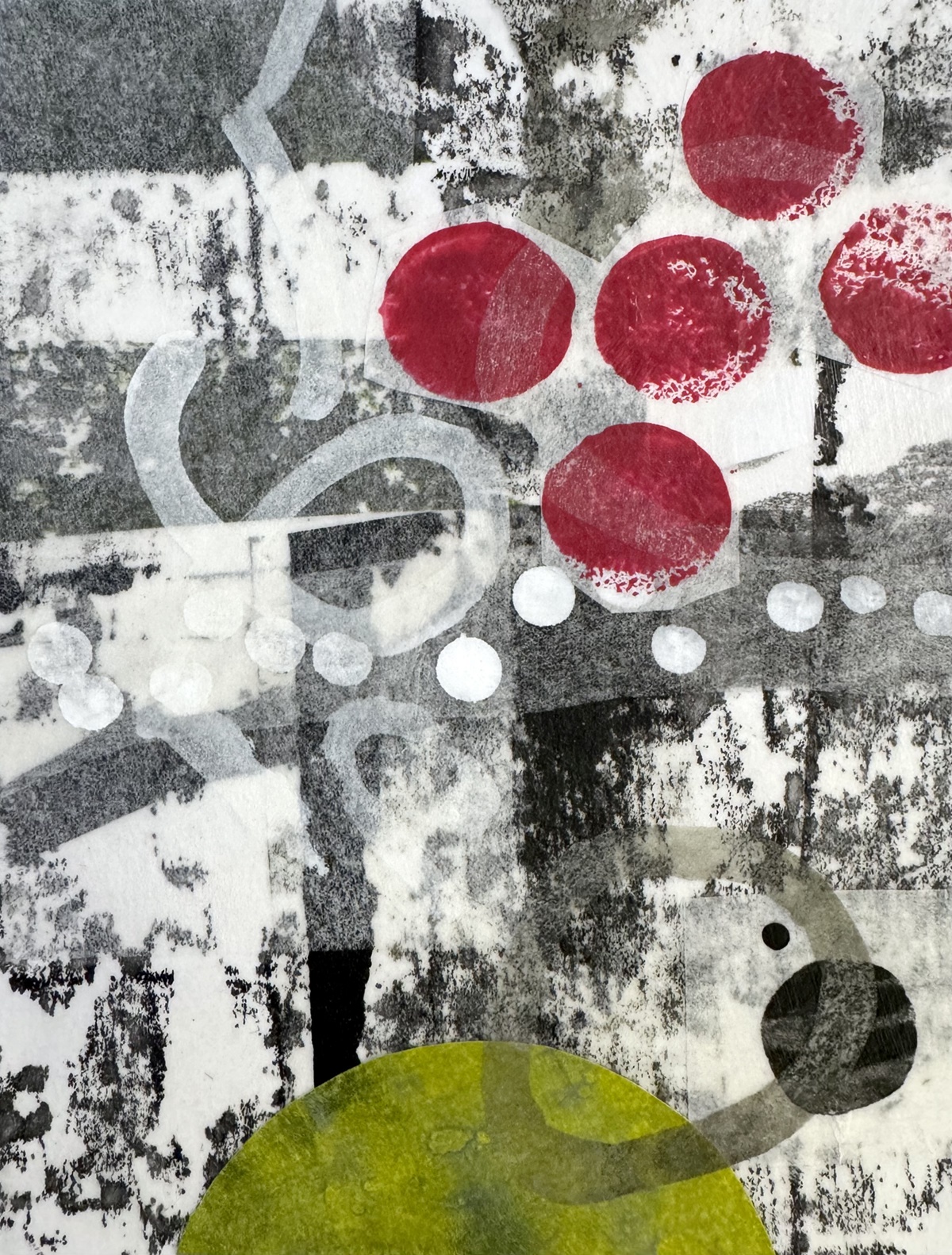
In the weeks leading up to the call for entries, I worked on ideas for proof of concept — Can I do fifty of this? Is it sufficiently interesting and compelling? Will I wish I was never born? I finally arrived at an exploration of abstract geometric collage — well suited to the size and scale of the project and of deep historical and personal significance. Working through a dozen or so test pieces, I refined my materials and techniques until I heard that still, small voice announcing, “Yes, this is good. You can do this.”

Prototypes in progress, solid, printed and found papers on handmade lokta

Then, I had to write the dread Artist’s Statement — a standard part of any entry process — and one of the most challenging things I’ve ever had to do. I made it excruciating, but! I persevered. Here’s what I arrived at (in fear and loathing) as the submission deadline was approaching:

“Constructed with awareness, but not with calculation, led by high intuition, and brought to harmony and rhythm.”  
— Piet Mondrian, 1916

Awareness, intuition, harmony, rhythm… How many ways can circles, squares and triangles be assembled to create compositions that flow, balance and fit in the space allowed?
In these collage works, cut papers — color, mono printed and found — are manipulated and arranged to create balanced, rhythmic patterns and correspondences that please and satisfy our curious pattern-seeking sensibilities.
In exploring abstract geometric collage, evidence of the — my! — maker’s hand is evident in tiny misalignments; they are forgiven and unintentionally lend an animation to the work. When multiple compositions are hung together, new patterns emerge. Possibilities remain endless.

Once I got over myself and that hurdle, I realized two things: first, artist statements are not carved in stone for all eternity and can and should be revised at will, at any time. Second, I’m pretty sure most people are not as mean, judgmental or paralyzing as my inner critic. And so, merrily, we rolled along.

Front deck setup for panel priming, ten at a time
A new LED light pad makes accurate placement possible

Wish me luck, inspiration and endurance, friends! These panels are (thus far) fun and satisfying to build! They make your eyes dance (in a good way)! The show opens Friday, 05 September, and runs through Sunday, 05 October. If you’re in the SF Bay Area, do consider stopping by the Sanchez Art Center to enjoy this exhibition of 50 artists’ works!
Carrying On

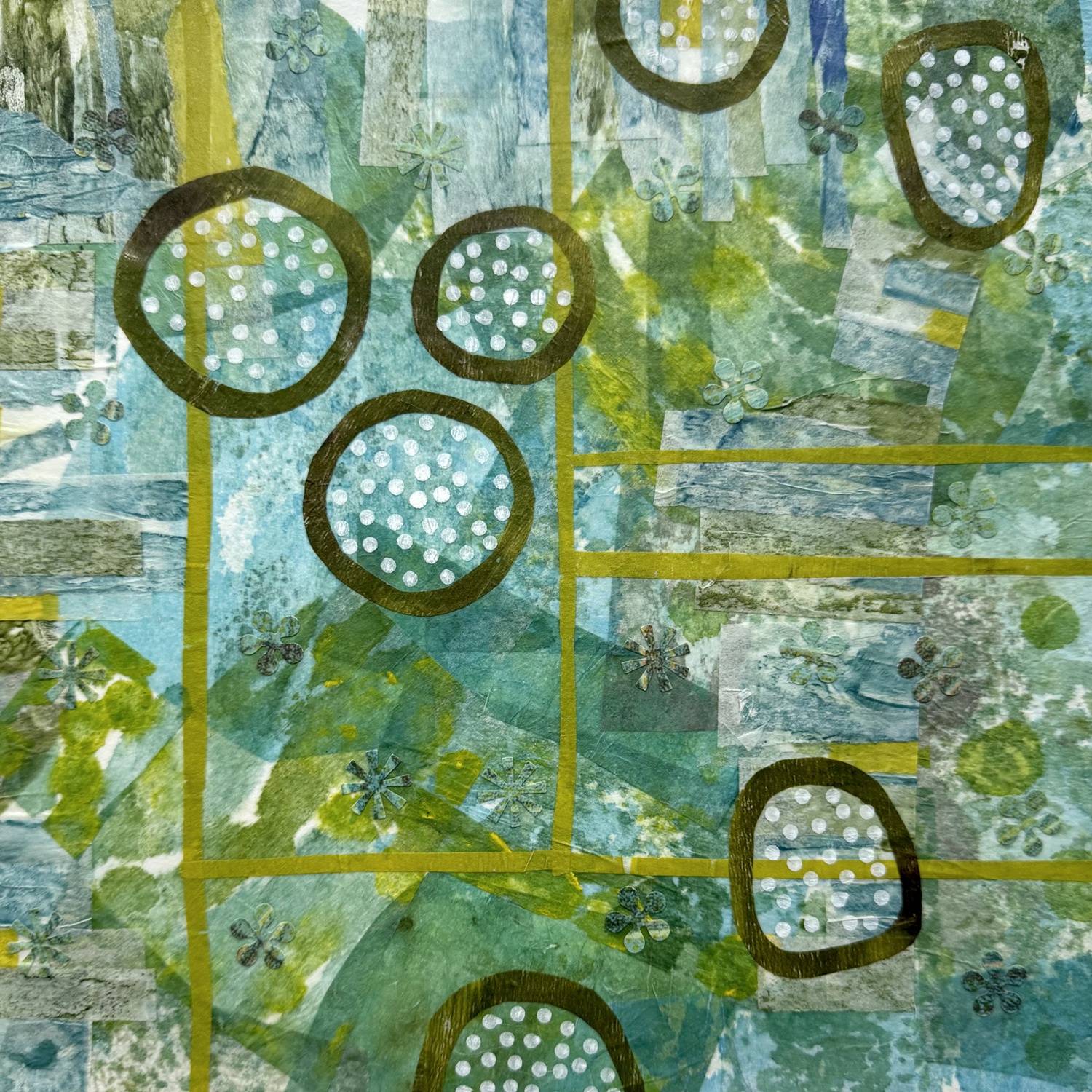
Memory of a Grid. Posca dots and punch-cut asterisks, painted tissue paper, found paper, 10×10 inches

I’m learning to come back to a piece and listen.

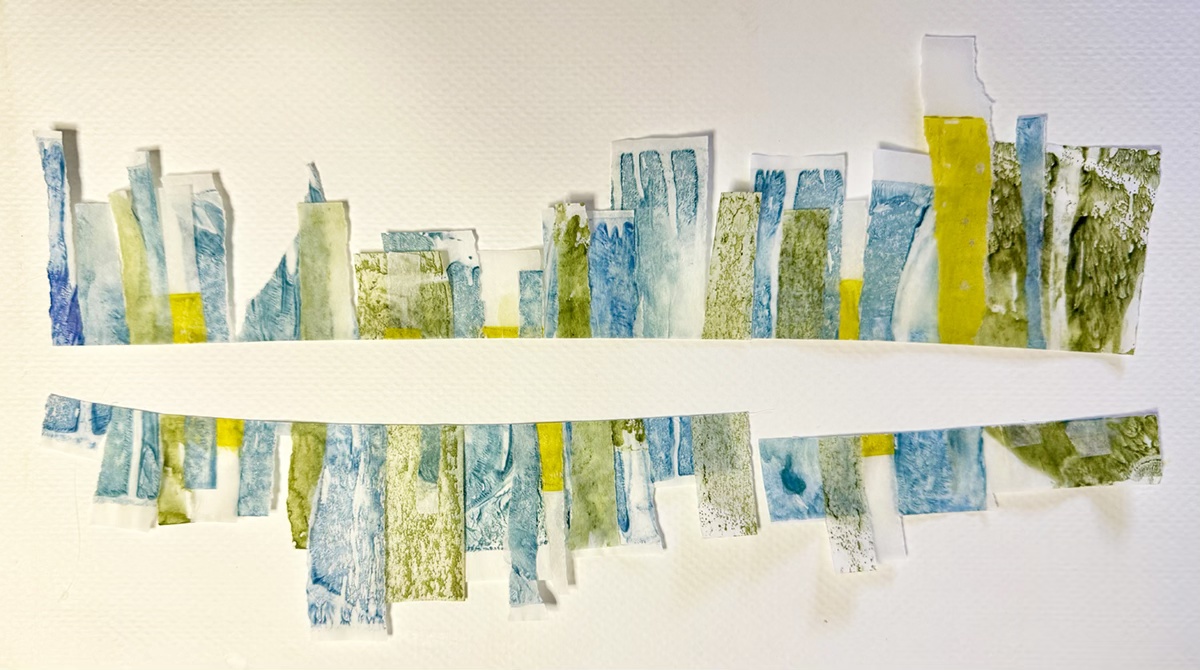
These are offcuts from a later collage, and proved to be missing parts for the Grid Memory composition. See if you can spot them in the finished piece! Also beautiful in their own right.
This one, made in early October, was a surprise winter holiday card, 4.5 x 6 inches

I was getting frustrated with my results and overwhelmed with choices working at larger sizes. I found freedom in smaller sizes and more rapid iteration.

Snippet. Screen-printed/painted tissue papers, 5 x 7 inches

And I also found freedom and joy in slicing up the larger unsuccessful pieces for the smaller compositions, like this snippet. It’s empowering to deconstruct a work that’s just not. Or just throwing! it! away!

Crazy, beautiful collage cat Maxine (actual photograph, not a collage, real cat)

(Just realized there’s not nearly enough cat pictures in this post)

Cheers to you all, and best of vision in all your endeavors

Thanks for reading along and feeling my pain in adult learning and artistic expression. May your winter holidays be loving and bright, full of good coffee and rational and/or goofy conversation and companionship. 2025 coming right up!

Small Studio Remodel Progress

Sense is being made in the new Studio Inki space

Mostly a lot of standing and staring, and getting distracted going through the many bins of collected miniature treasure, but I’ve constructed my dream standing-height work surface along the back wall, and assembled a pair of paper storage units from Melvins Miniatures, very satisfying. Alpha Stamps has a set of mini rulers and triangles that make the work surface more functional and desky. Having fun printing out scaled versions of my collages and mounting them on boards to hang and/or display on an easel. Adorable! The exquisite leather cowboy boots are vintage, handmade way before everything was 3D printed; sadly artist unknown to me. One of my paper bags serves as a temporary trash bin. (I’ll have to throw a lot of paper scraps on the floor around it for realism.) The pumpkins are one of the first miniature things I ever made that I was happy with, from wads of plastic film bound tightly with thread and covered in small shreds of tissue paper and acrylic medium. Potted yuccas and succulents are production samples from the MMS+S kit days, all in Braxton Payne terra cotta pots. And the vintage Kunstlerschutz Wagner flocked pig is an old dear friend who’s come to live in the studio to keep us all company.

Retrospective: Sea House Leadlights

Albie oversees receipt of Serendipity Shed base kits, 16 August 2019

I thought it might be interesting to review building highlights of the Sea House Leadlights studio office, from start through submission. (Can’t really say “completion” because things never stay done ‘round here.) There are links back to original posts — if any were made — with more details. I wasn’t very bloggy :)

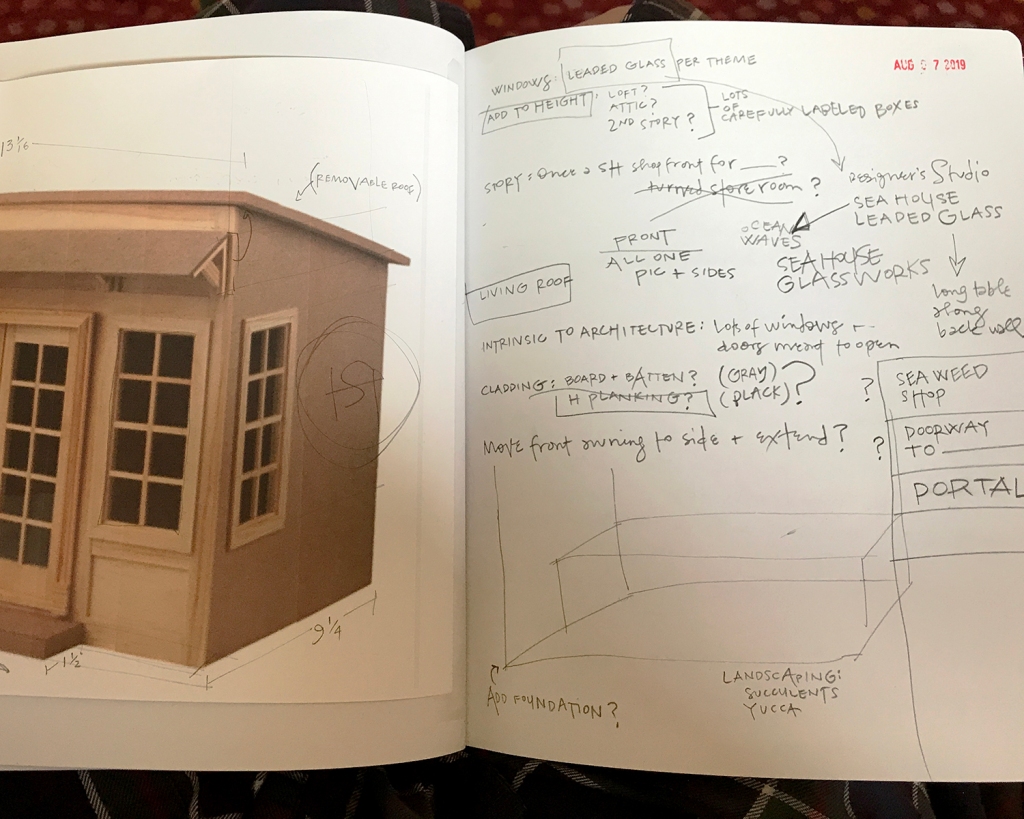
First ideas

I spend a lot of pages thinking, sketching, dreaming, considering and working out dimensions and story.

The starry floor in process

The first floor idea, though fun to design, paint and assemble, did not work well in the space. So it goes.

Two base kits mashed together

Height was added to the starter kit with parts from a second. I like to retain recognizable elements of the kit, so the roof angle and footprint, as well as door and lower window placement remained unchanged.

Loft wall detail

I glued cold press 140 lb. watercolor paper to the walls for texture before painting, and added a whitewashed aged brick back wall in the loft.

Adding siding to the new front
Half-loft installed, supported by faux beams

I opted to make the front façade removable as well as the roof… this makes it so much easier to photograph the interior.

Bench tops and bottoms

I cut the built-in benches from 1/16-inch basswood on the Cricut Maker. These were glued together and supported with 1/8-inch dividers.

Interior space begins to come together
Tree Frog green was the only possible finish color, with black leather cushions

I thought and sketched about the window designs for some time. The Pavilion is bubble-themed; the Conservatory celestial… for the Leadlights design studio I went Egyptian Deco. Mostly sort of.

Sea House Leadlights front doors and front/side windows
Sea House Leadlights upper window

The upper window is a stylized scarab. Very.

The “leading” designs for the windows are cut from lead black cardstock, glued front and back to the plexi, then framed in black on the exterior (and tree frog on the interior). I like to see wood grain, so I use a 1:1 ratio of acrylic paint and staining medium.

The scarab window at night

If one looks straight on, the window frames the bricked loft wall and the old Sea House logo. With sacred scarab wings.

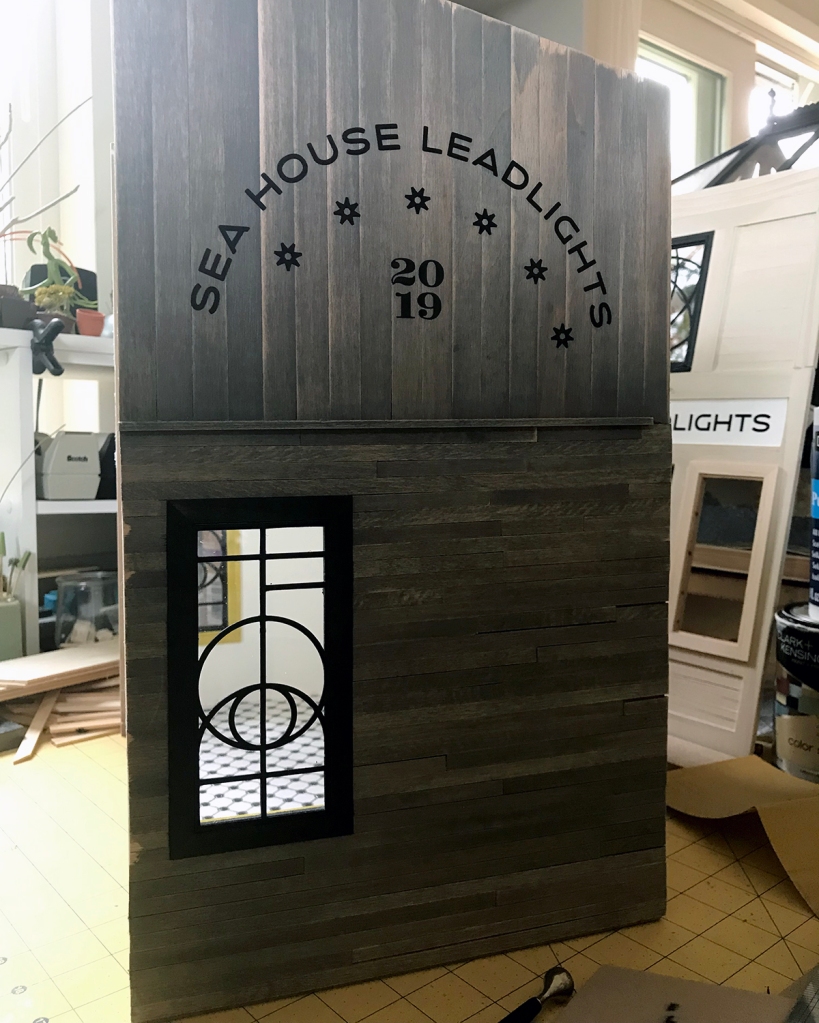
Side building signage

I — or rather the Cricut Maker — cut the signage from matte black vinyl. The stars in the design are meant to resemble anchor plates used to reinforce old buildings. I love them.

In this backlit photo, the vinyl letters appear to float off the side of the building. It’s not quite so unnatural-looking in person, but knocking back the synthetic smoothness is on my eternal learn-to-do list, to find ways to tone down the material. (Transferring wee letters and figures is a fiddly, fussy business, especially onto an uneven surface, and I am not eager.)

Side sign
View from above

Here’s a roof’s-eye look at the progressing build. The holes are drilled for the LED light fixtures that will illuminate the work space below. (The wiring to be concealed beneath a custom rug and other stuff stored in the loft.) A narrow shelf beneath the scarab window on the removable front might support batteries if I ever add lighting to the front. Floor tiles gleam softly with scuff-resistant utility. Leather window seats beckon.

To be continued…

Sea House Leadlights Interior, Roof; Scarlett

Hello Sea House Leadlights office

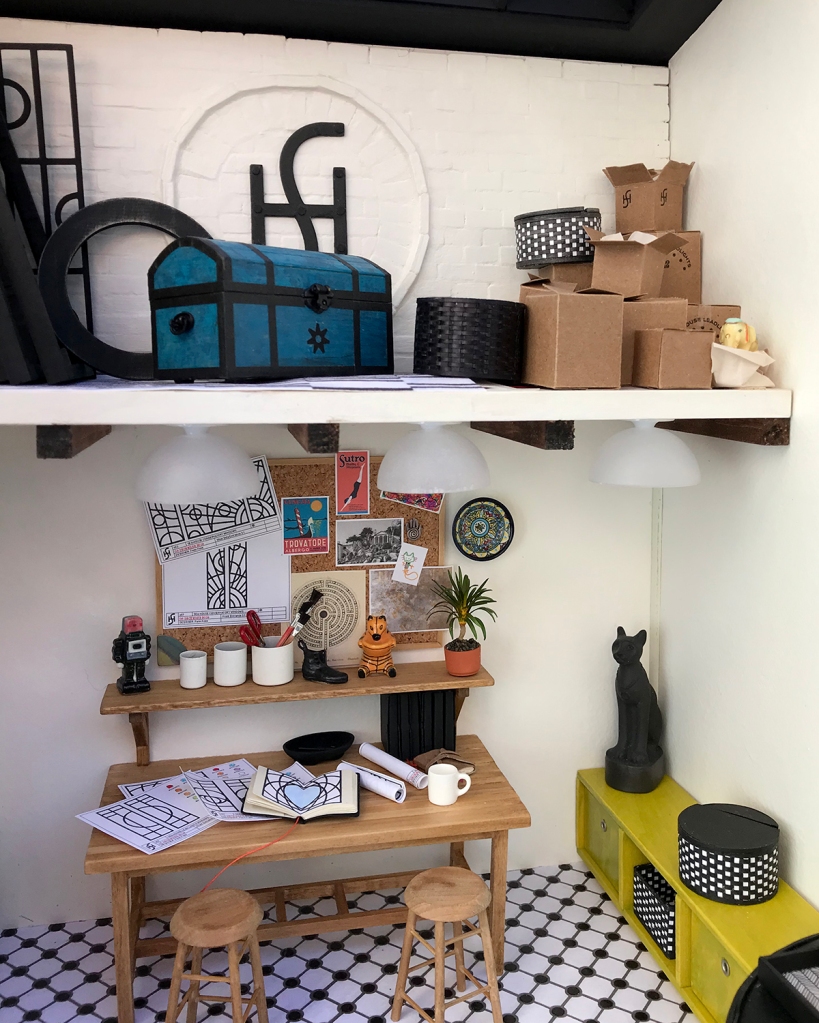
The entrance to the Sea House Leadlights office is up a few stairs and across the deck to the left of the fireplace. A set of leaded glass doors opens into a snug but functional design studio.

Details: Terra cotta pot by Braxton Payne. Basswood deck and siding stained with Minwax Classic Gray. Pumpkins made from tissue paper and thread. Boulders sculpted from air dry clay painted with acrylic washes and sealed with ultra matte varnish. All succulents, yucca and other plants hand colored with W&N Promarkers. Many are prototypes; some available as kits at Modern Miniature Succulents + Sundries.) 

Desk and bulletin board

Beneath the half-loft a large tabletop desk has plenty of room to roll out plans and inspiration. Low built-in cabinets with black leather cushions provide more seating, storage and level surfaces for tea trays.

Details: The ceiling lights are 12V modified for warm white LEDs. Bulletin board is made from cork sheet framed with basswood stained to match. Sketchbooks made from my kits at MMS+S. Various meaningful artifacts including original leaded glass designs for other Sea House buildings, and a drawing of a cat by my then 4-year old daughter. Fèves, prized vintage Monopoly shoe, and an anodized earring from the 1980s.

The white-washed brick loft stores window frames, tools, Sea House memorabilia and miscellaneous treasure — as well as the switch (lift the black basket) and battery pack (hidden in a custom box) for the LED lights.

Details: Oh yeah, the baskets and boxes are also available as kits at MMS+S.

A gazebo-style roof welcomes natural light. (I’ll detail more of that happy construction in another post.) I made the 1:144 scale basswood model of the source kit for the original Sea House Pavilion, built some years ago. The Egyptian cat is a porcelain fève. Best of all is the vibrant painting by Jim Tracey that commands the studio — also another post.

Finally, of course, Scarlett. Here she has somehow managed to fluidly infiltrate an impossibly small entrance to the Sea House Sea Rise Pavilion loft (my ongoing remodel of the original 2013 build.) I swear she does these things just to remind me she can.

Oh, how she makes me laugh.

Sea House Conservatory, Pacifica, Santa Cruz

Sea House Conservatory, in progress, February 2019

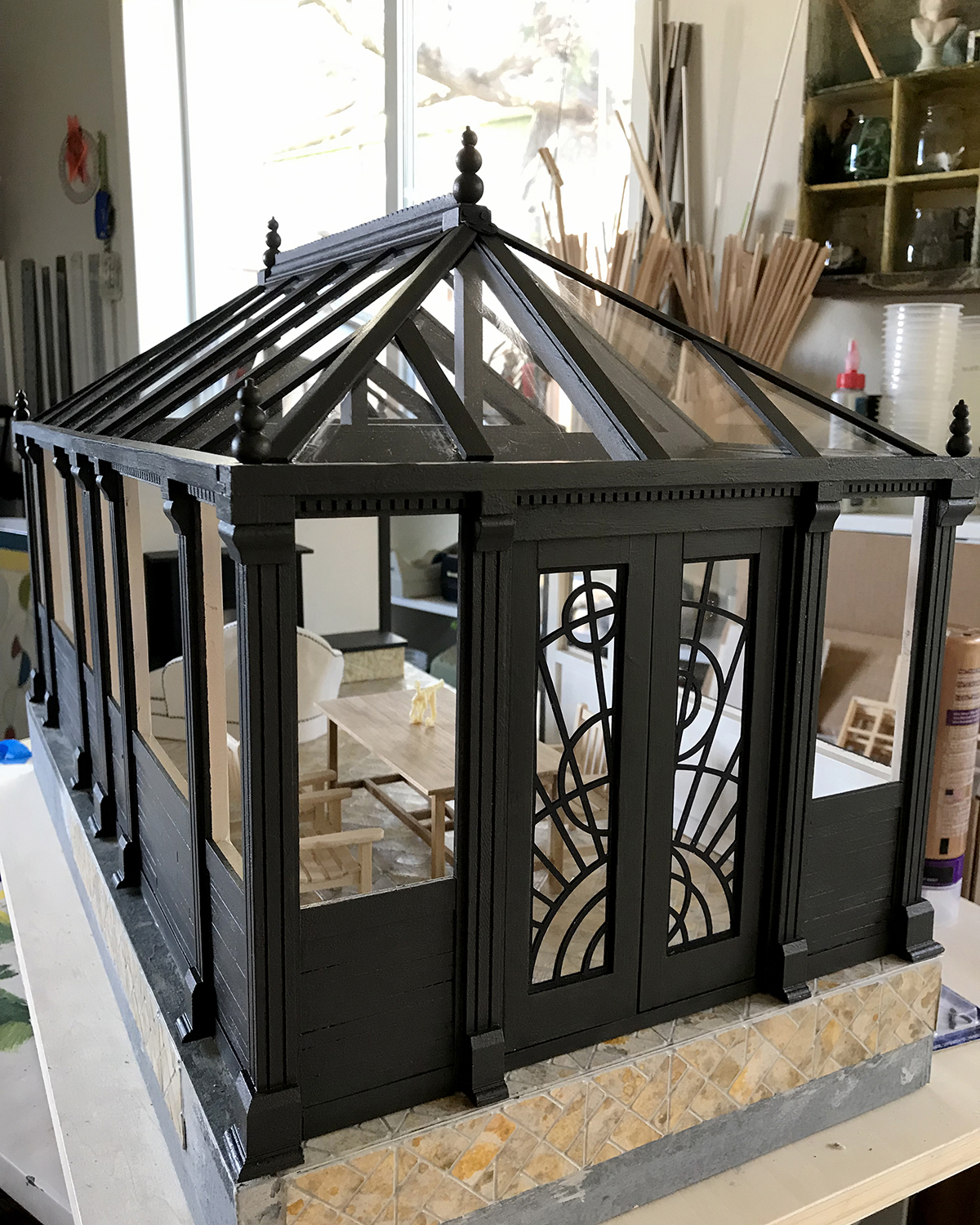
The Sea House Conservatory removable plexiglass and faux iron beam roof is assembled. It is supported by iron pillars and wood siding painted N-C16 Midnight Stroll by Clark+Kensington. I made new finials from wooden beads and toothpicks.

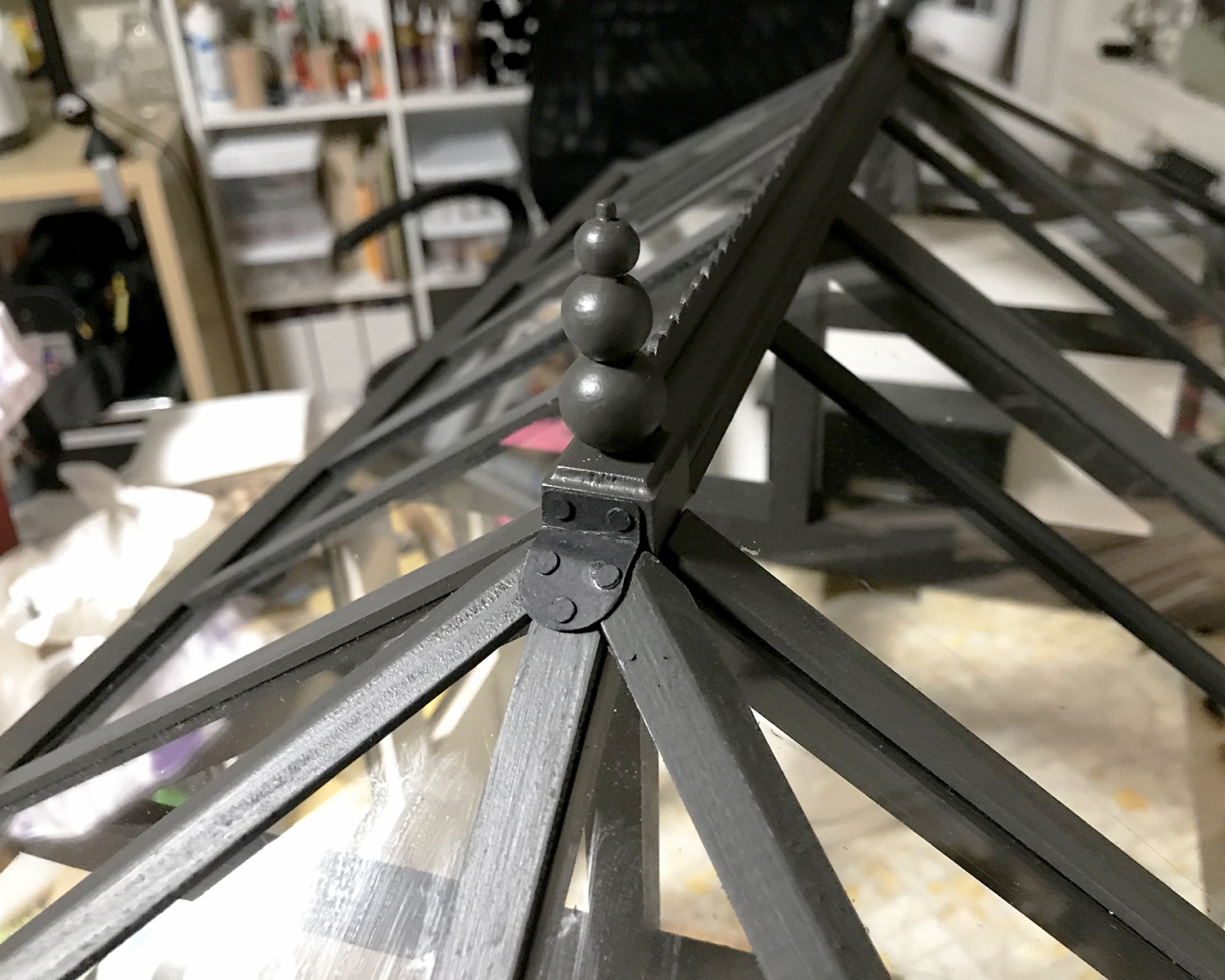
Brackets join and support the faux iron roof beams

Where the two corner beams met the center beam and roof ridge there was an inelegant gap, so I cut iron brackets and bolts from two layers of black card stock, to reinforce both the roof structure and the illusion :)

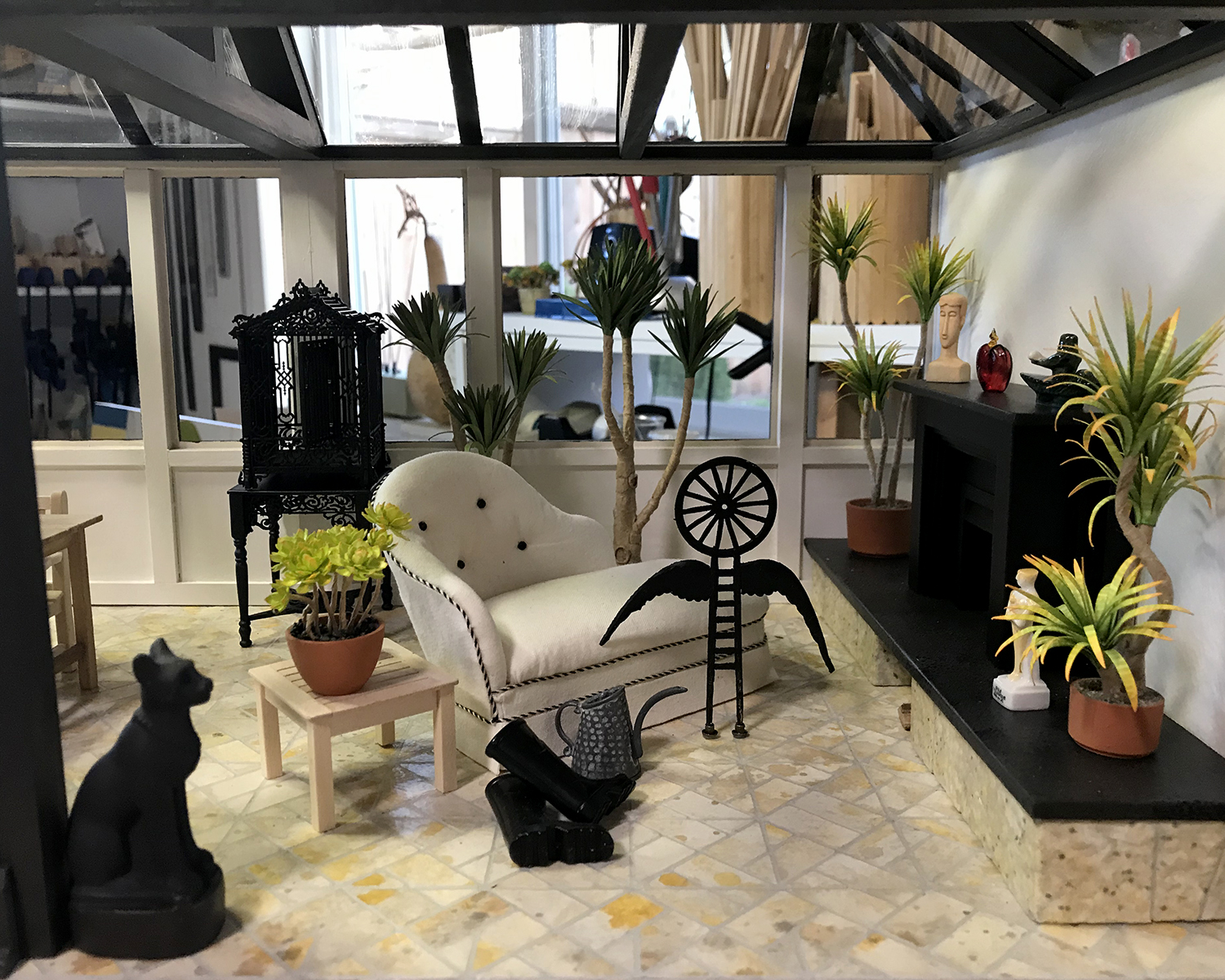
Wheelie at the fireplace end of the Conservatory

The fireplace and hearth underwent yet another color change. I wanted something more working/utilitarian looking, less living-roomy. Picture the chaise draped in reference books and aprons and a seaweed drying rack hanging from the rafters.

Sea House Conservatory leaded window design, 3 of 11

Turning my attention now back to the many windows, cutting the original kit grid mullions out of the frames with a Dremel. Tedious. Then sanding, painting, and fitting the cut leaded designs into the frames, front and back. Oh, and finishing (but not mitering) the outsides with 1/16-inch square trim. Ugh.

Pacifica sunset, between storm fronts, 15 February, 2019

We’ve been getting breaks between rain storms, glimpses of the sun, and some beauty clouds.

Ruby at 20 months, shopping in her sister’s vest for her mama’s birthday present

Spent a long weekend in Santa Cruz with my daughter and younger granddaughter Ruby, while her papa and older sister Maddie were in Lake Tahoe getting Xtremely snowed on. Ruby’s choice of outerwear was her sister’s vest. Ruby on the runway.

I like me. Print this out and hang on your refrigerator, lest you forget

Maddie, who turns six next month, is loving Kindergarten. Her mother shared some pages of the journals the children keep. The first remarkable is that upper and lowercase writing is still being taught — yay! So for Maddie, already proficient in capital letters, this manifesto represents challenge, learning, practice. And then the everything else: the sentiment, and the exuberantly joyful self-portrait. Perfect expression, I’d say.

Conservatory, Cycladic, Tomato, Cats, Rust

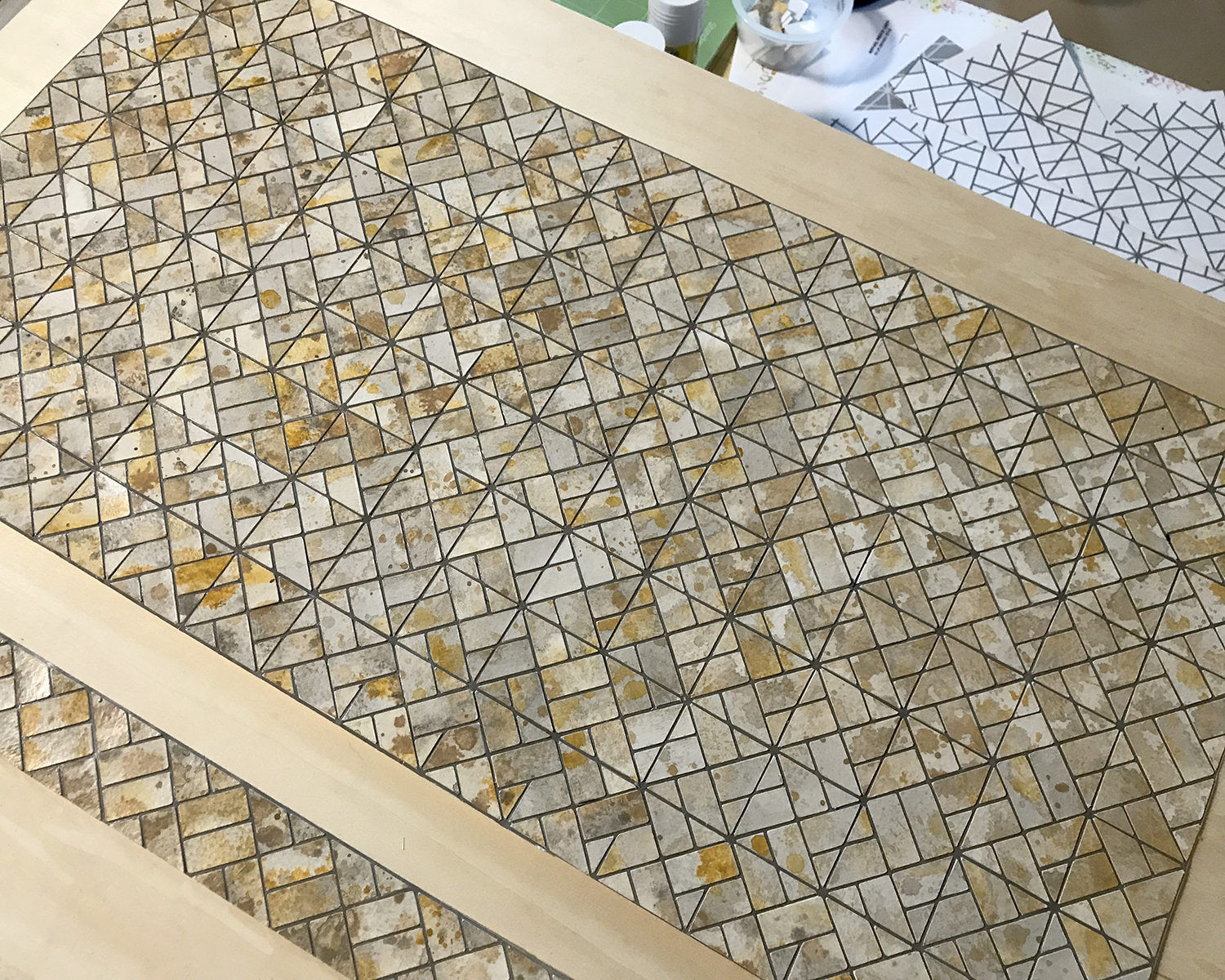
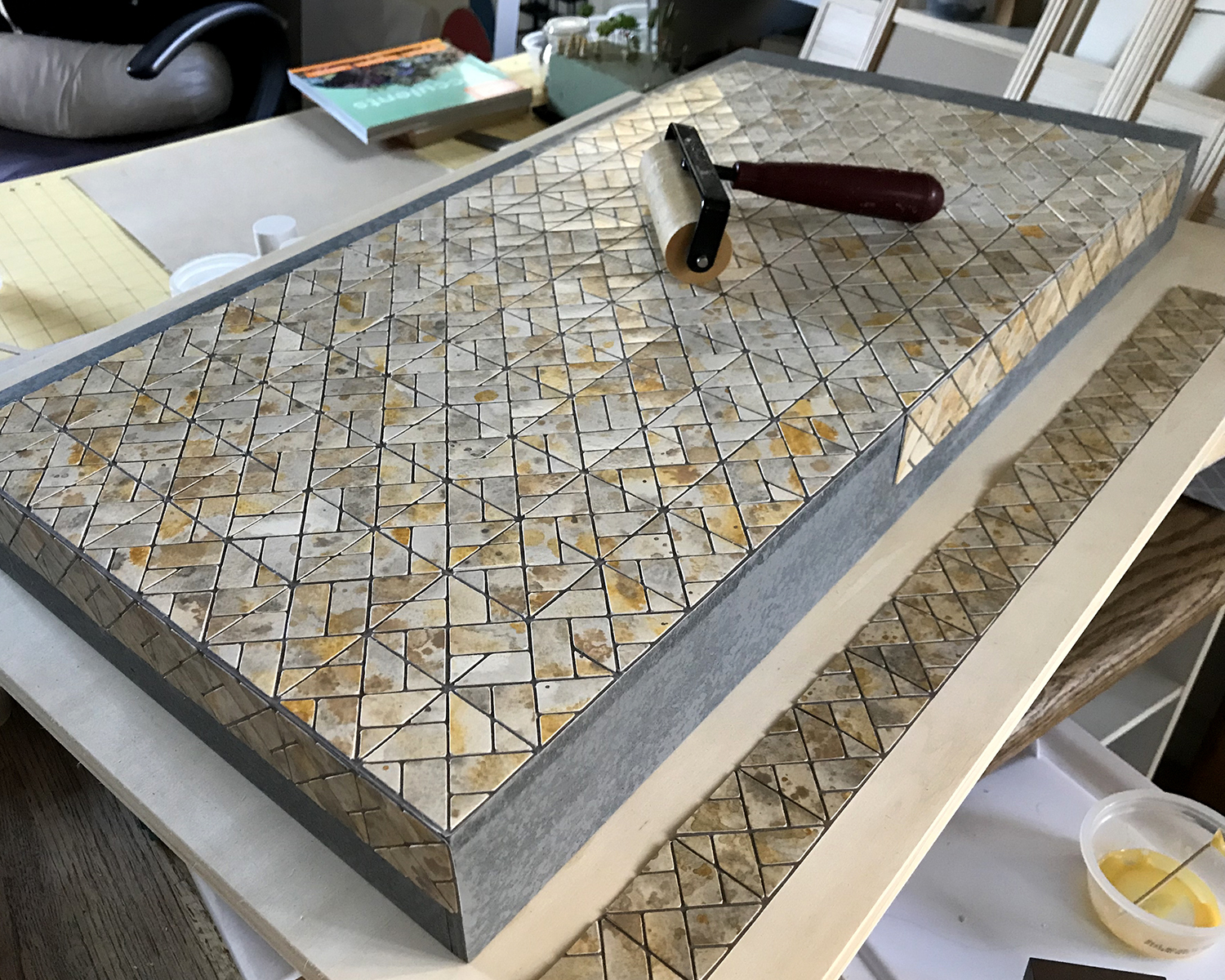
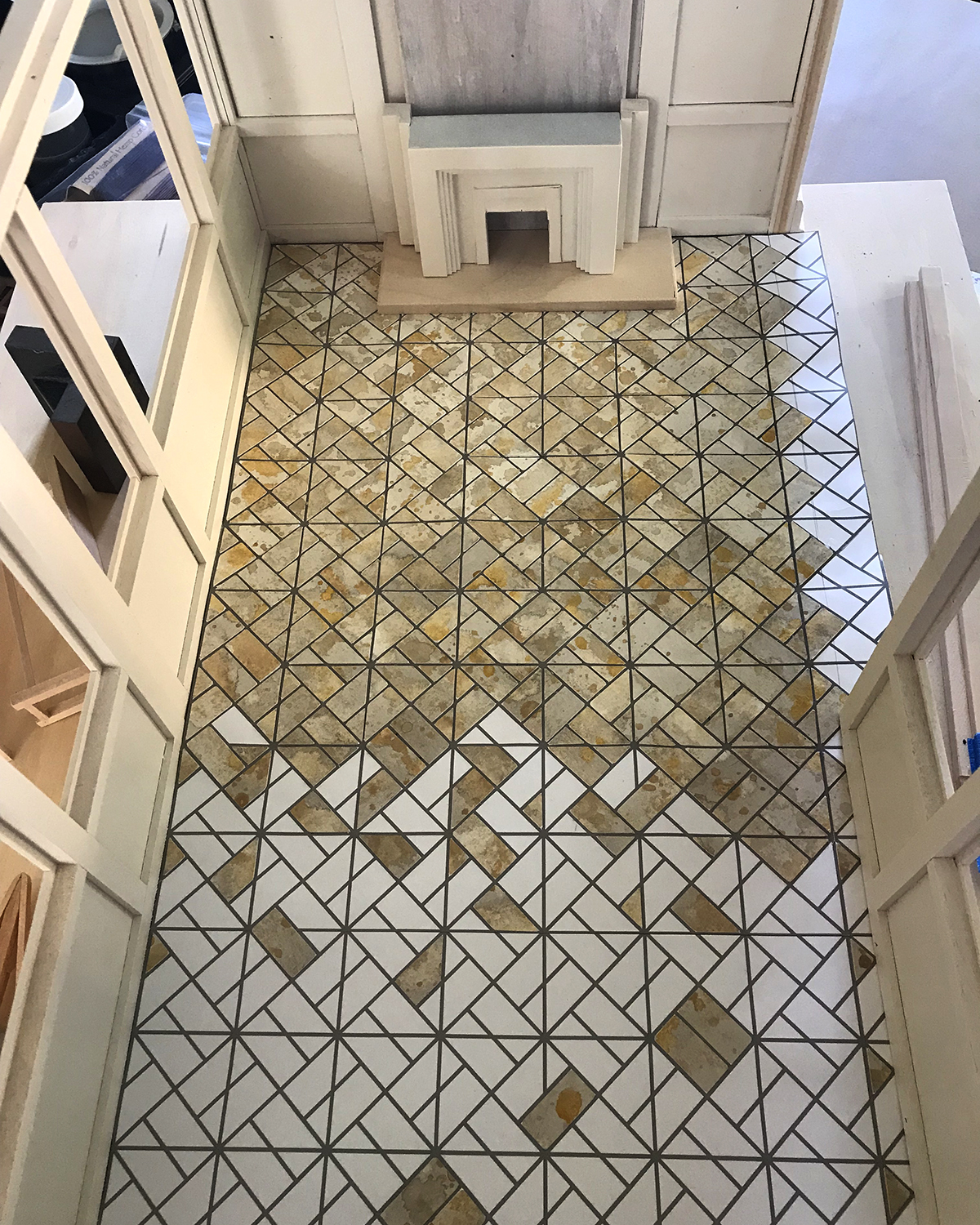
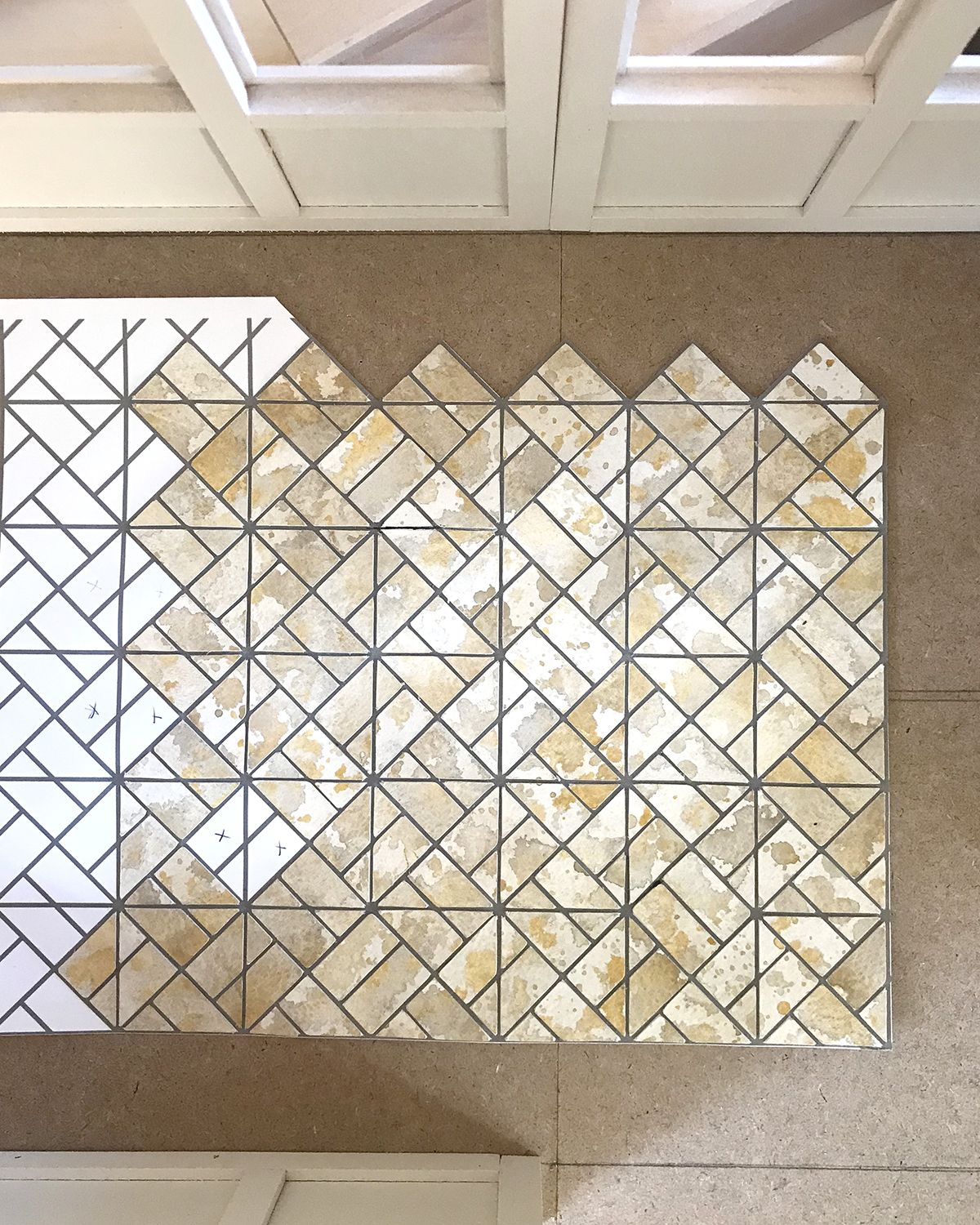
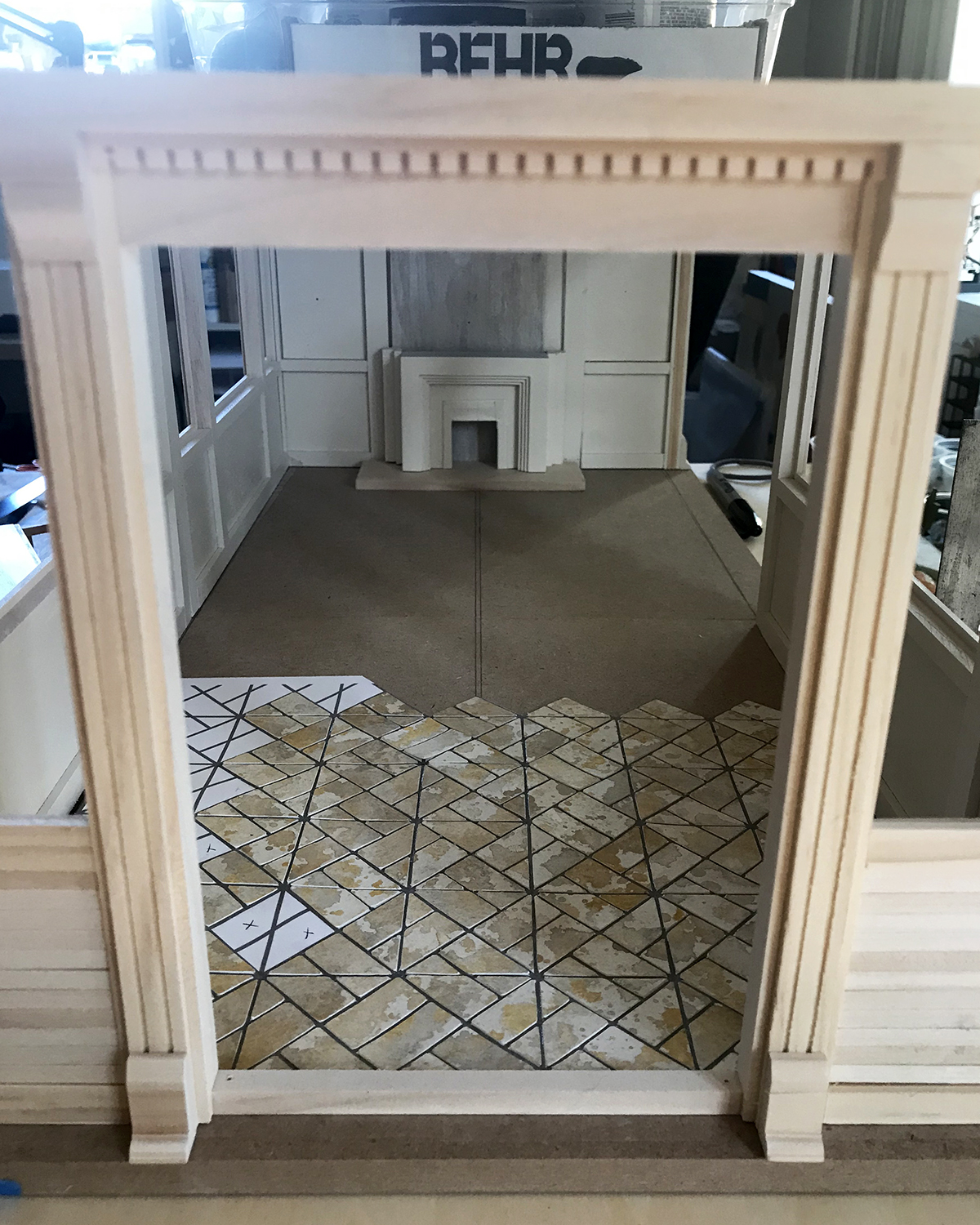
I finished gluing the painted paper tiles to the pattern for the Sea House Conservatory main floor.

Stoic Albie helped keep them flat, as Stoics do.

I then spent a lot of time considering how best to make the floor fit the base and carry over to outside the walls in a way that pleased me. 

If I was a cat, this is how I might look pondering the options. “Why yes, that might actually work …”

As part of the solution, from quarter-inch birch ply I built a two-inch riser for the base and painted it medium grout gray. And — not because I want to relive the 1980s and feature wall faux finishes — I sea-sponged on a lighter warm gray. Mostly because I didn’t want to stare at a flat gray box. (My building process involves a lot of staring.)

Eventually, the weather/temperature/humidity cooperated and I was able to spray two good coats of matte sealer on the floor tile assemblies, prior to their grouting.

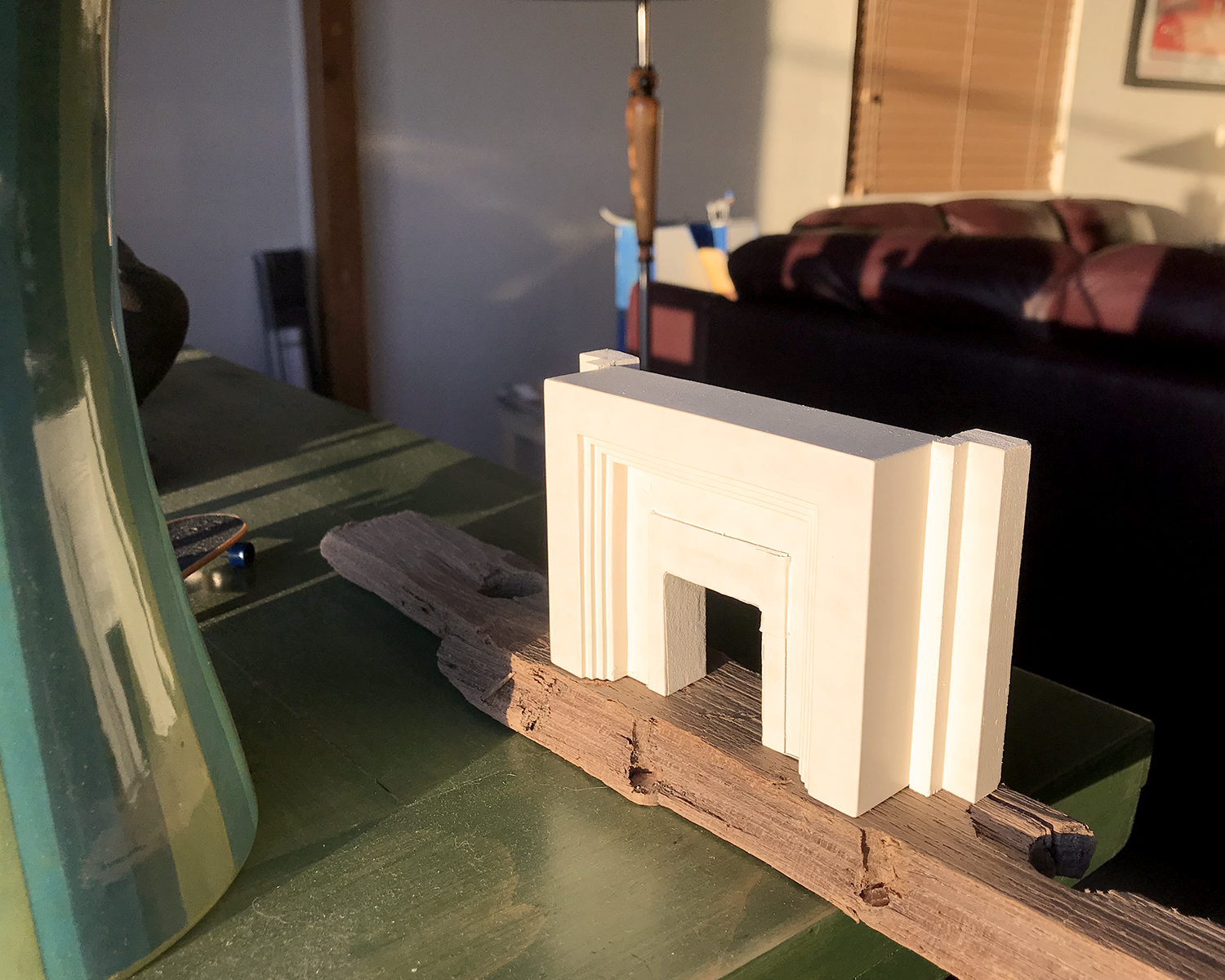
Also got a few more coats of satin antique white on the fireplace. (Built from this Houseworks Deco fireplace.) Here it is curing in the late afternoon sun, admiring its reflection in a glazed ceramic vase.

gluing_down

Gluing down the sealed tiles to the base. It will might make more sense in a few days when you see the whole idea. Are you really, really weary of seeing pictures of these tiles?

polkadot_towel

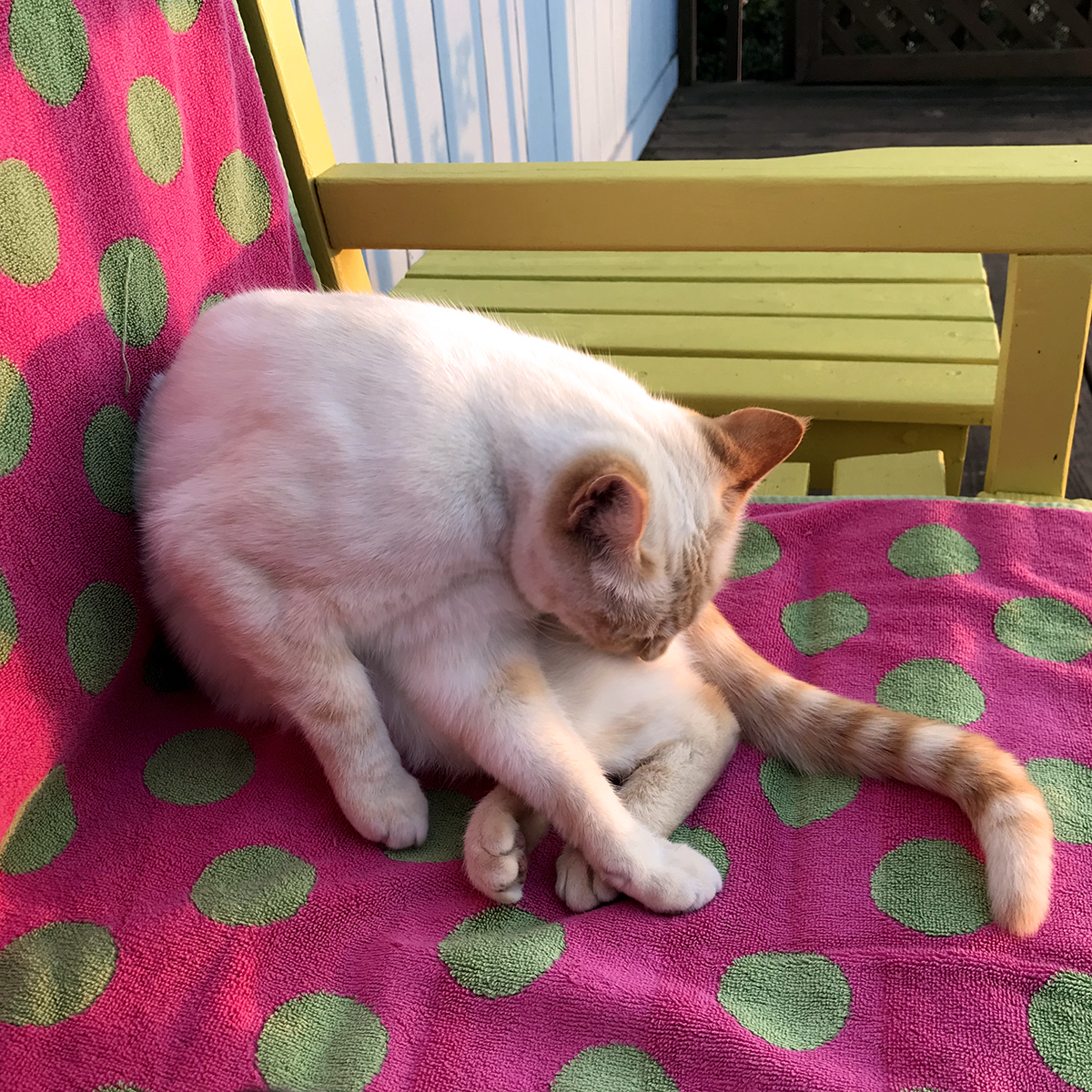
Then here’s a pic of Scarlett sitting next to me on the front deck yesterday, watching the sun go down (and grooming). (Her, not me. I was sipping a glass of delicious Double Brut IPA.)

cycladic_spirals

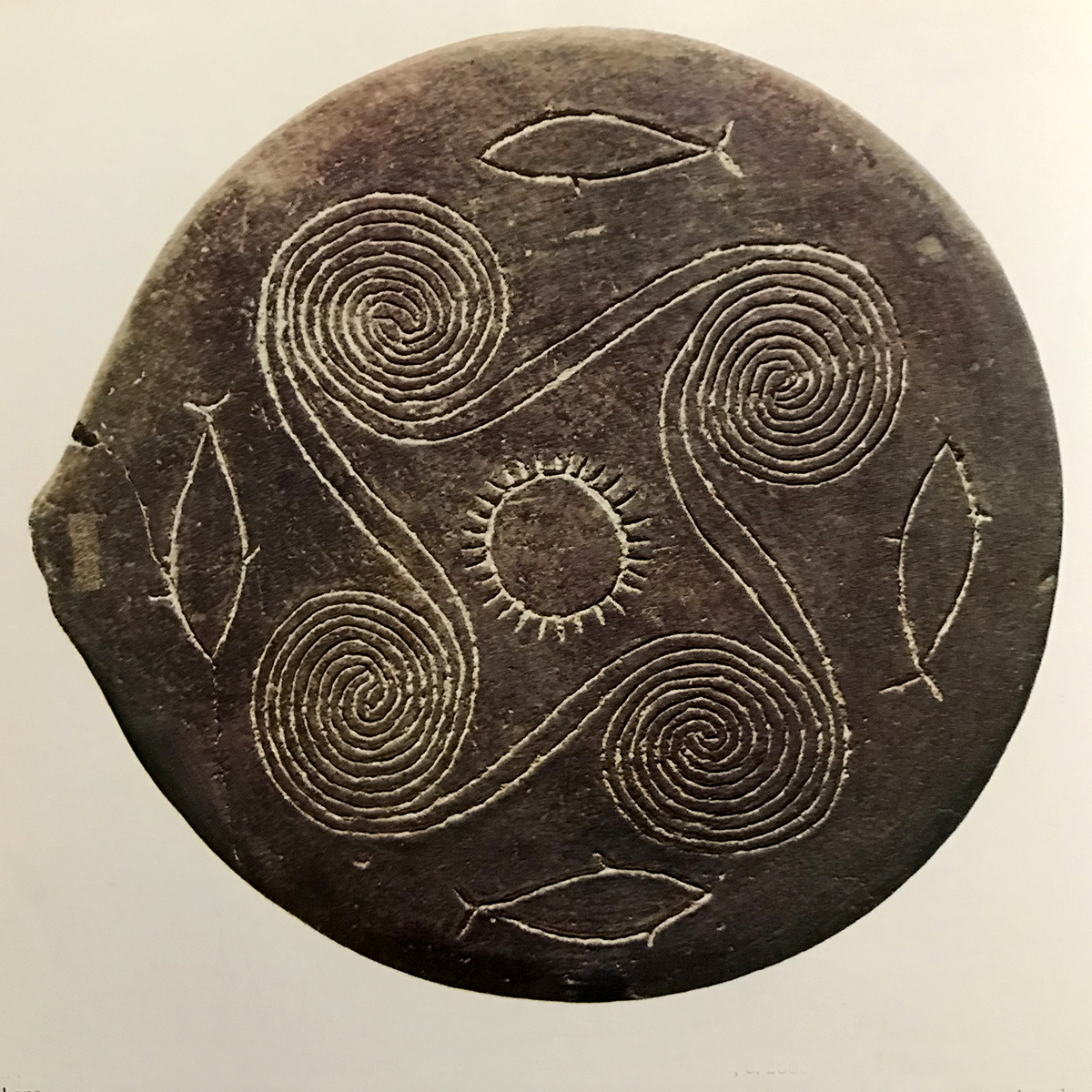
This is my current design inspiration for conservatory decor. It is a Cycladic terra cotta vessel from 2000 BC — ! — found on Naxos. I’m smitten with everything about it: the spiral waters, fish, the sun, or maybe a full moon? (From Art of Crete, Mycenae and Greece by German Hafner, 1968, public library.) 

floor_dryfit_00

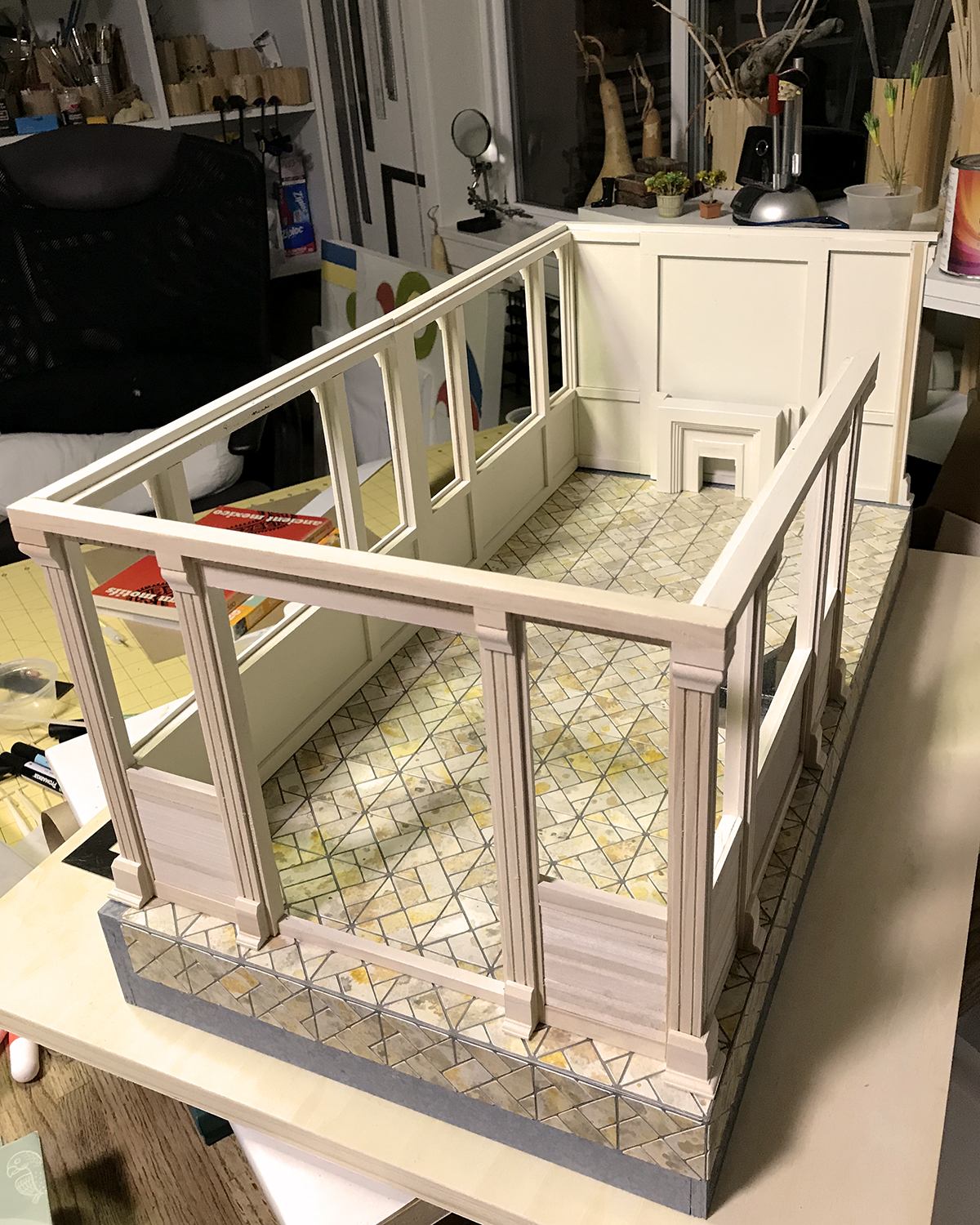
A last peek at the conservatory in the night studio, with the standing walls. For now.

tomato

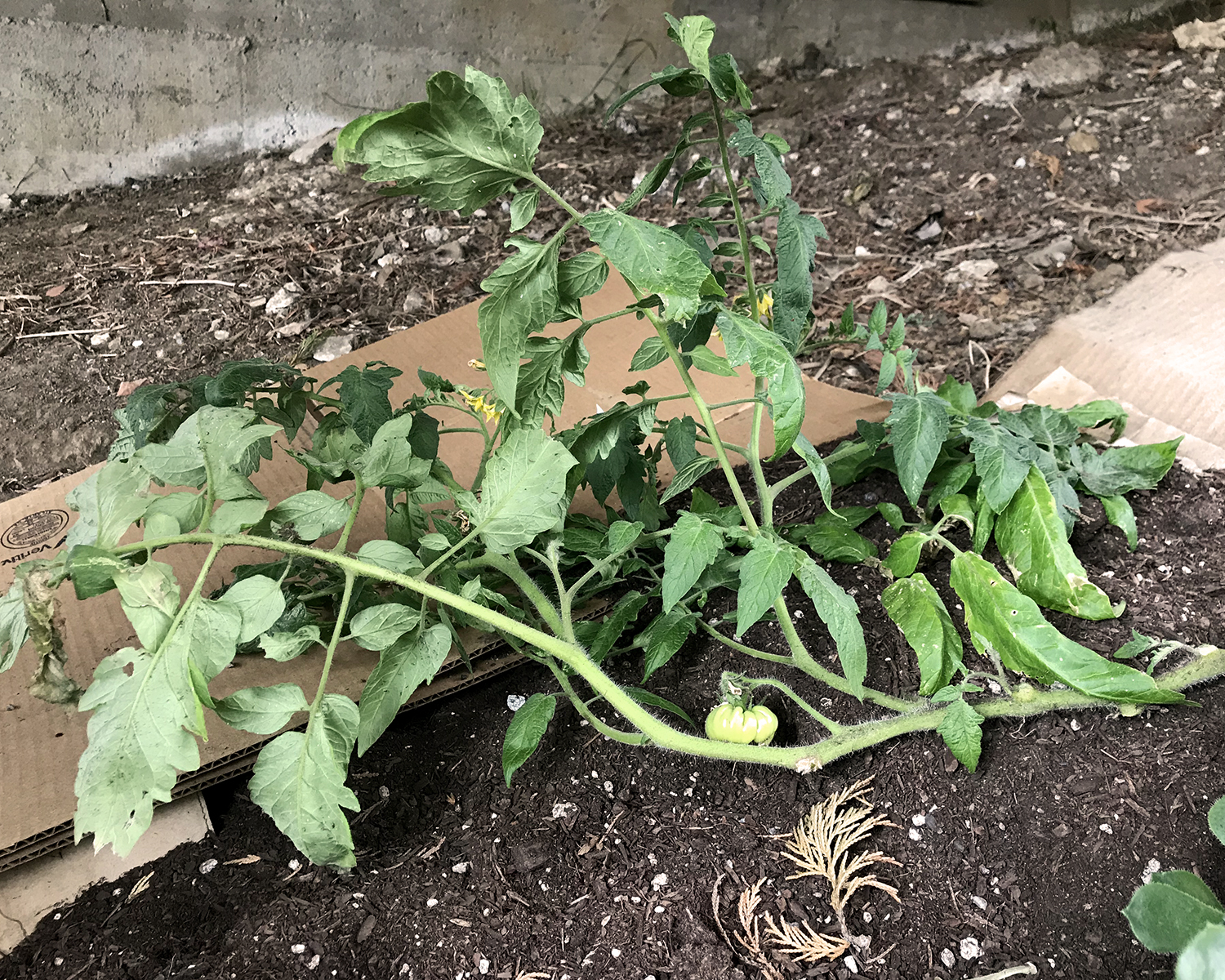
In real life, I’m working on a landscaping project on the side of our hillside house under the sunroom add-on. The soil is compacted and full of rubble, and I’m putting down flattened cardboard to suppress what weeds do grow, and adding top soil, compost and worm castings. There’s next to no direct sun, so I’m transplanting hardier succulent cuttings to see what will survive. They get a little leggy reaching for the light, but they’re doing all right. In September I noticed what looked like a young tomato plant growing at the back of the area, evidently self-started from the compost. When it put out flowers I was charmed; what hope and vigor this plant has! And then the other day I noticed it had made a tomato! A single, multi-lobed heirloom. In December! It’s like a miracle :)

rust_plancha

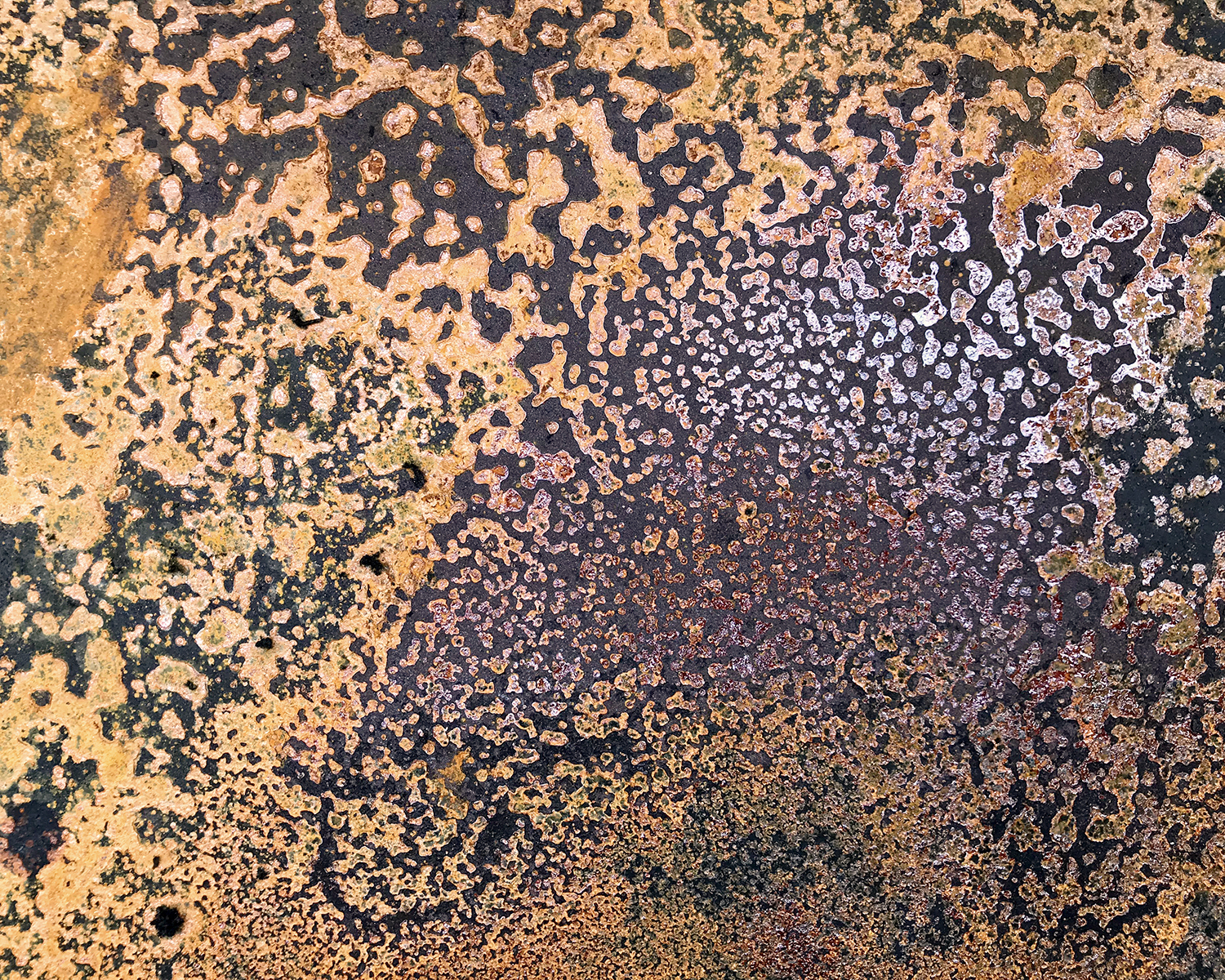
And finally, here’s one for your reference files. Look at the beautiful rust pattern and colors on this cast iron plancha, sadly left out in the rain next to the BBQ. (Left behind when our neighbors moved, it was already warped, but was still serviceable for outdoor cooking.) We’ll see if I can bear to scour it clean, or if it joins the Things That Are Rusting collection.

Doesn’t everyone have one of those?

Sea House Conservatory: More Floor Tiles

I added more pattern sections to the tile floor template.


To facilitate a smooth transition between tile colors, when I began to run low on the first set I glued them randomly further out on the template to integrate with the as-yet-to-be-painted new batch of tiles.

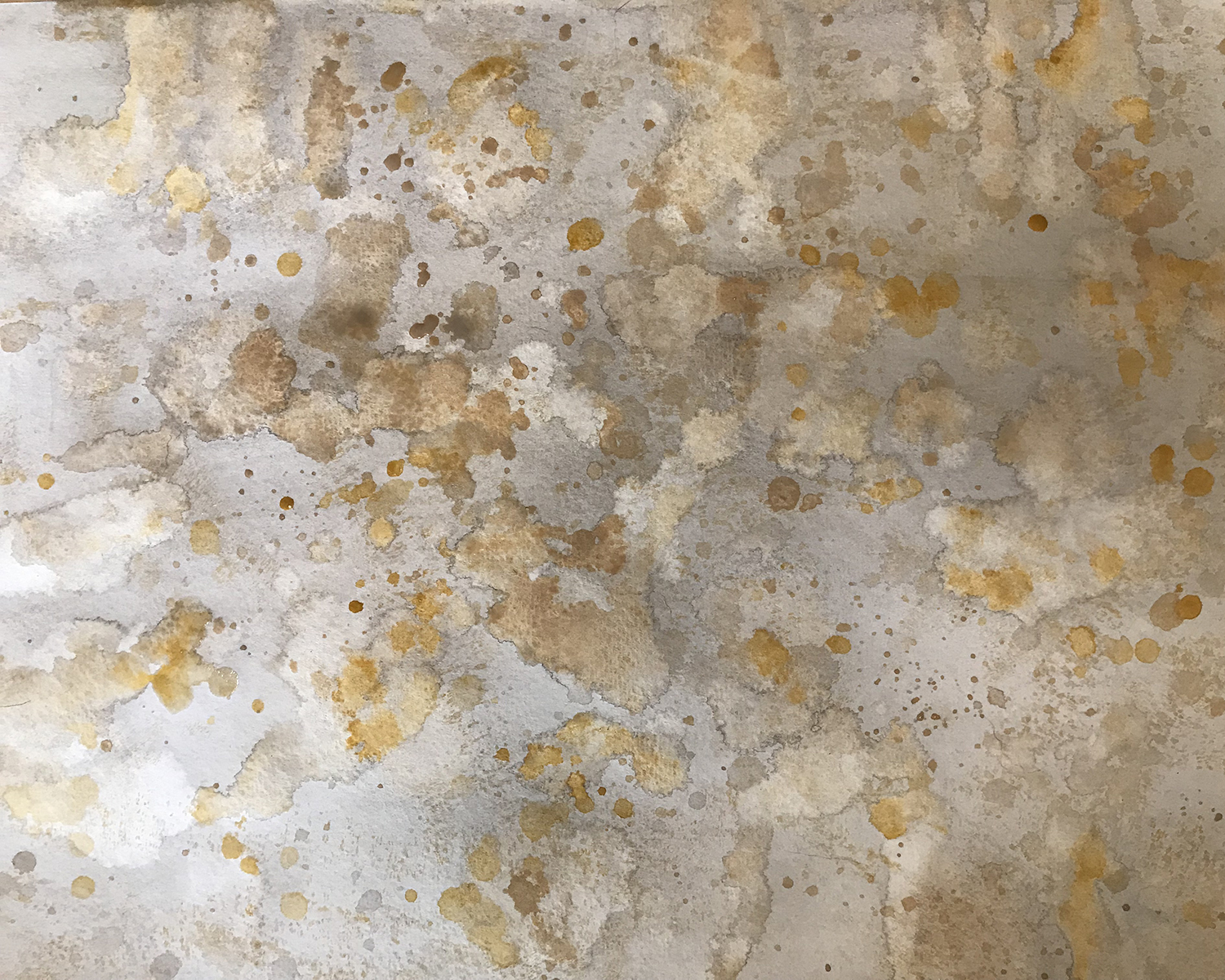
Using the same paints as before, I splattered up a new sheet to cut into tiles.

Meanwhile, I’ve got a working idea for the back fireplace wall, so I can alternate experimenting on that with setting floor tiles.

Sea House Conservatory: Tiled Floor

painted_paper

I painted a couple of sheets of 11 by 15-inch 140 lb. cold press watercolor paper with washes and splats of neutral gray, tan and yellow oxide acrylics, then pressed them flat between two drawing boards weighted with books.

pattern_test

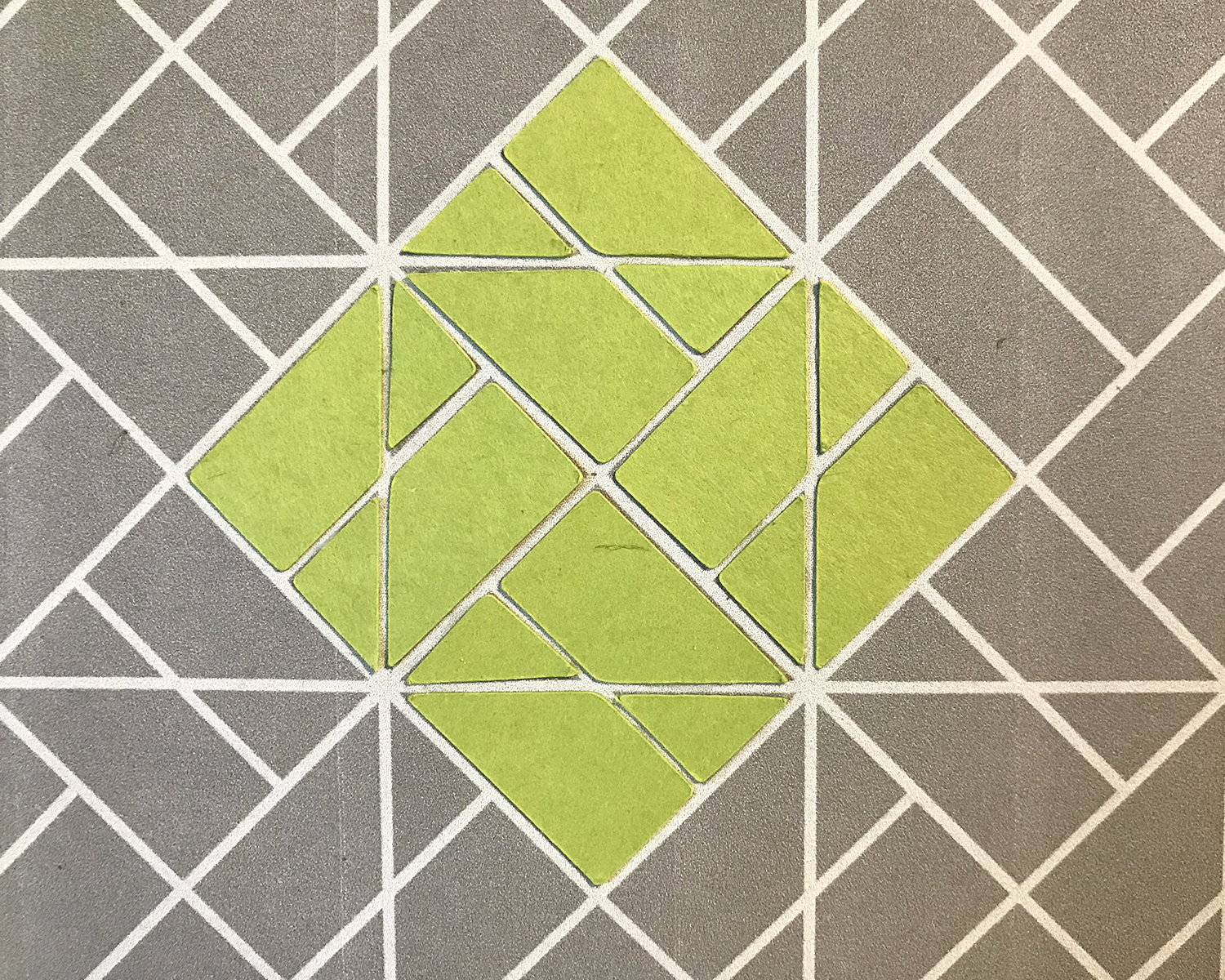
The tile pattern and grout lines were refined through several test cuts and pasteups. I added a 3-point corner radius to the tiles to suggest age and wear.

final_tile_cuts

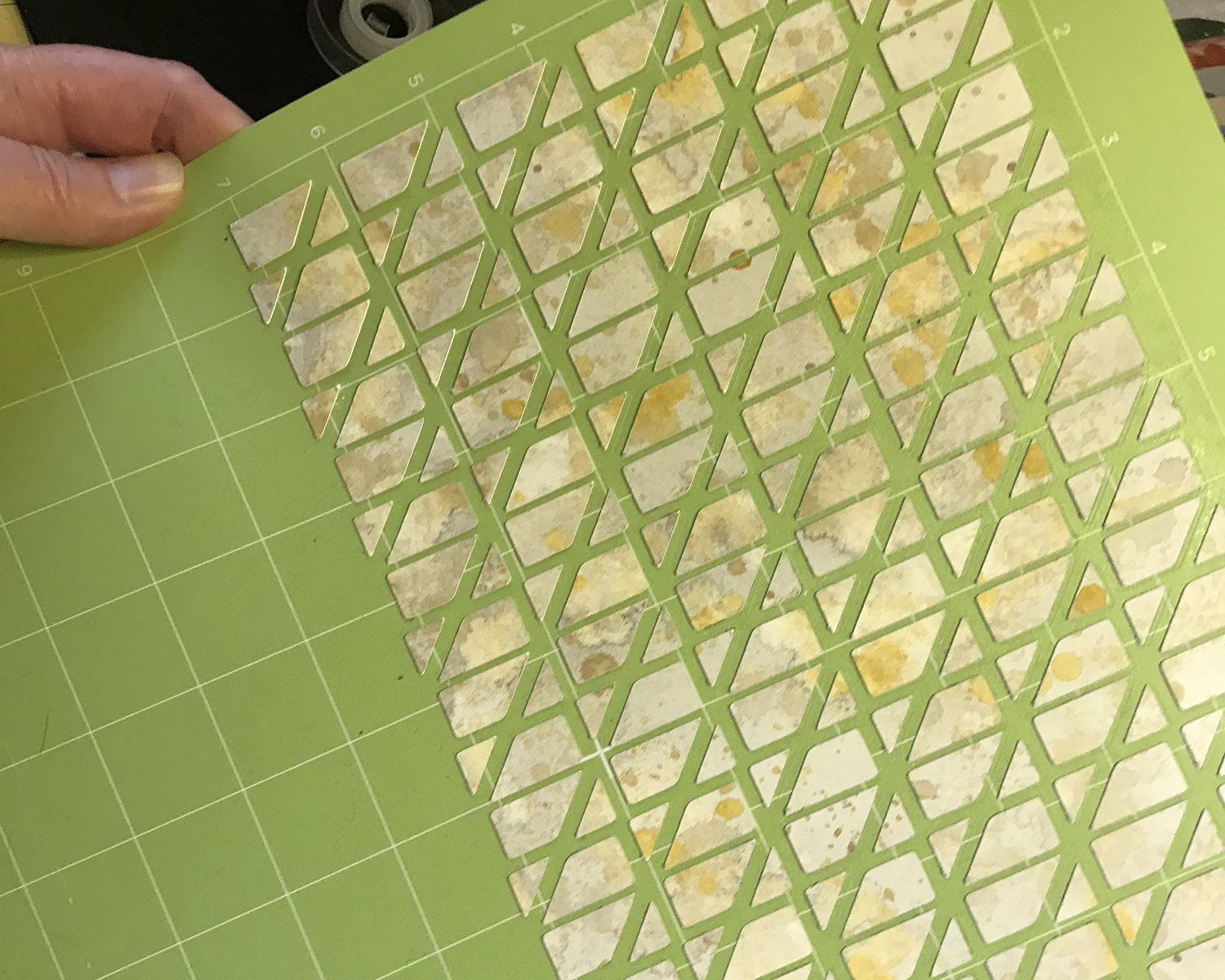
After a few more test cuts, I loaded the painted watercolor paper and began cutting tiles. Because this paper requires three passes of the deep cut blade for each tile, I used masking tape on the edges to hold the thick paper to the cut mat to ensure adhesion. (Lessons learned through bitter informative experience.)

pasteup_01

I’m gluing the individual tiles to prints of the pattern layout showing the grout lines. The process is far less tedious than I anticipated, a pleasant surprise. It *may be* that I won’t have to actually add grout after they’re all assembled and adhered to the subfloor. I plan to add one final light gray wash and some delicate speckling to the whole floor to unite the separate assemblies. And with pressing and a coat or two of matte varnish… we shall see.

in_place_01_

The final tile floor won’t be put in place for some time — so much painting to do! — and the ideas for its total design still floating need not be finalized at this point. Which is good, because I’m still kind of all over the place, design-influence-wise. Right now I’m trending from Art Deco back to Bauhaus, and how that might all fit in with the larger Sea House story, sea level rise, and a crow named Clary.

W: Weaving, Waxing, Waning

baskets _091518

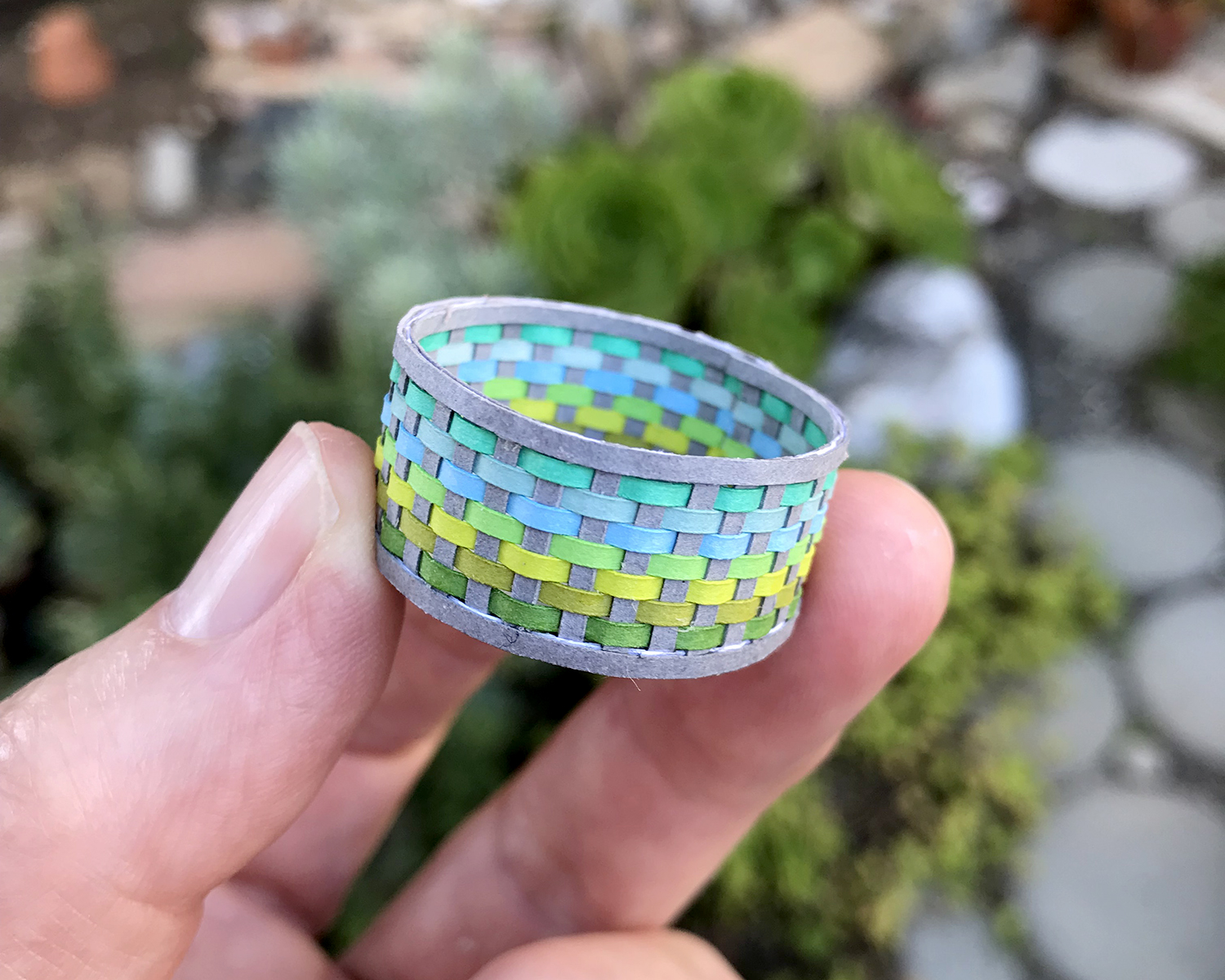
W is for weaving. I’ve been playing with hand-tinting the looms of the round basket kits in spectral and hombré shades. I started with black weavers and rims, then went to a medium warm gray. After a few baskets, I thought the offcuts would make good banners or samples of the colorways, and then the idea was born for the Basket Circus + Exposition.

BCE_sign_v1

Many thanks to Keli for participating in the totally legitimate focus group which determined this name.

black_weaver_warm

What a difference between black and gray for the contrast. I love them both.

gray_weaver_greens.jpg

gray_green_basket

sunset_091418

We’re getting to the glorious sunset colors time of year here in foggy-summer Pacifica. I remain in awe. Nature, you know she don’t mess around.

Albie_sunset_091418

Albie joined me a short time later on the front deck. This picture is significant because it answers the question, “What phase is the moon in?” Each September, my husband and I celebrate the anniversary of our marriage on the full moon. This year, it seems we have 10 or so days to go. (Hope we remember.)

gravity

And finally — as if you’ve ever doubted — here is proof that cats can defy gravity. Even when they’re sleeping.