new build: the great green room

Goodnight Moon great green room

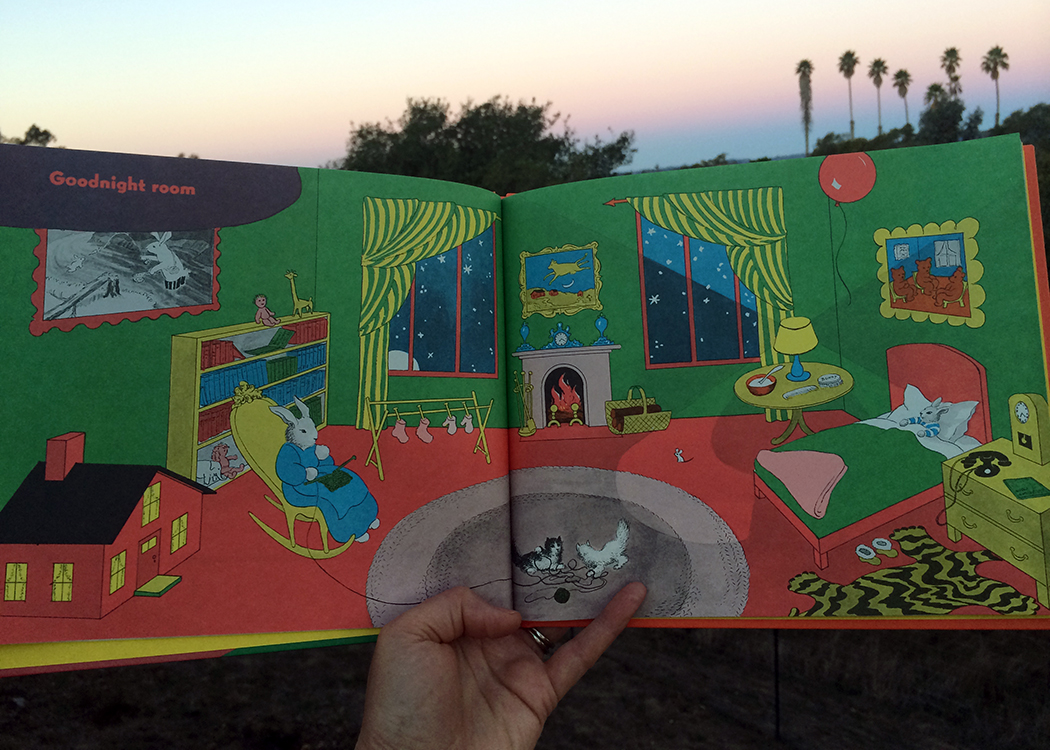
The great green room in “Goodnight Moon” by Margaret Wise Brown, with pictures by Clement Hurd

Goodnight Moon captivates baby Madeline as much as it did her mother, so for Maddie’s first birthday I’m building a roombox of the great green room. Here’s a picture (taken at dawn, actually) to mark when the idea came to me — and to show those of you unfamiliar with great modern literature and art — what the great green room looks like.

One of the notable features of Clement Hurd’s pictures is his use of flat, vibrant color. After several color studies, turns out it’s pretty much kelly green, vermillion and bright yellow. The how of the colors — whether to use paint or paper or polymer clay — is a figure-out-as-I-go-along. Similarly, what will be crafted from cardstock, built of wood and painted or modeled in clay. I am printing custom fabric for the curtains at Spoonflower. I briefly considered trying to 3D print some of the objéts, but there’s not enough time for me to learn the technology before her March birthday. (It has prompted me to enroll in a 3D class at Skillshare, though :)

For the walls, built of foamcore for lightness, I chose cardstock to cover, but I painted the floor.
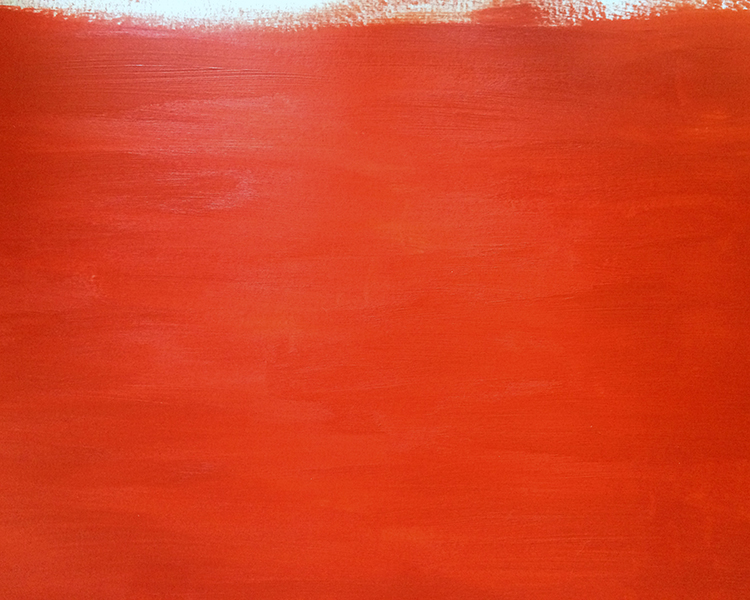
great green room floor

Vermillion

great green room building

Many color and materials decisions were made.

Windows are trimmed in painted 3/16 x 1/8-inch basswood. I edited the views of starry night sky in Photoshop and taped them behind the plexiglass, temporarily for now.

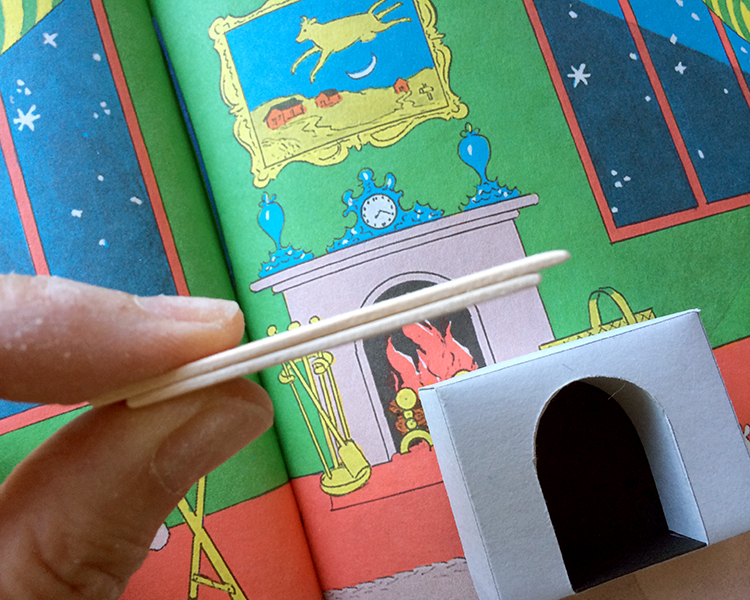
The fireplace is built from cardstock, with a wood mantle. The fire will be illuminated.

ggr_fireplace_02

ggr_fireplace_mantle

Here you can see my sawdusty fingers holding the mantle cut from 1/16 x 1/2-inch basswood. I matched the pinky-gray color and painted the assembly with acrylic paint.

Goodnight moon roombox build

The great green room before the Bunny family moved in

You can see in the window trim gaps how not-90° I cut the foamcore, *cringe* but the curtains will (mostly) hide that imperfection.

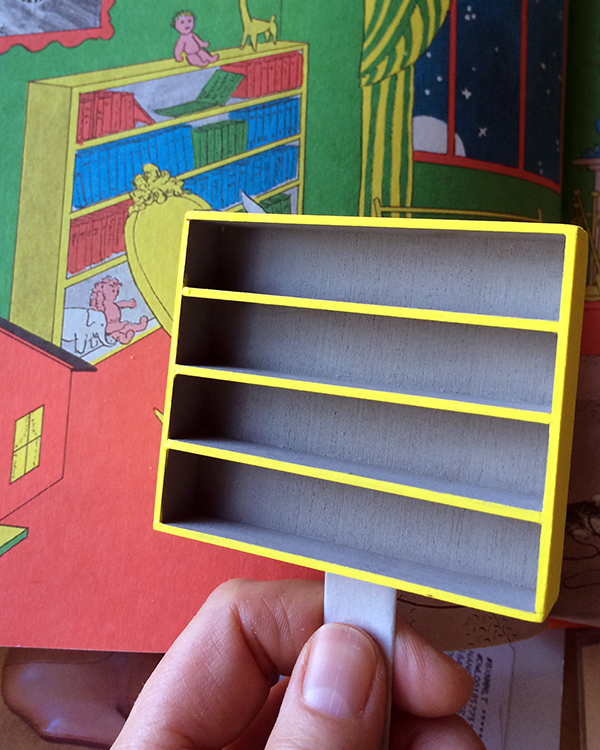
Next is the bookcase, built of 1/16 x 1/2-inch basswood. When I was matching the yellow to paint, I noticed that the inside of the case is gray. What a curious detail. But hey, true to the great green room as painted by Mr. Hurd am I.
First coat of paint(s)
First coat of paint(s)

tiny baluchi prayer rug

miniature baluchi prayer rug

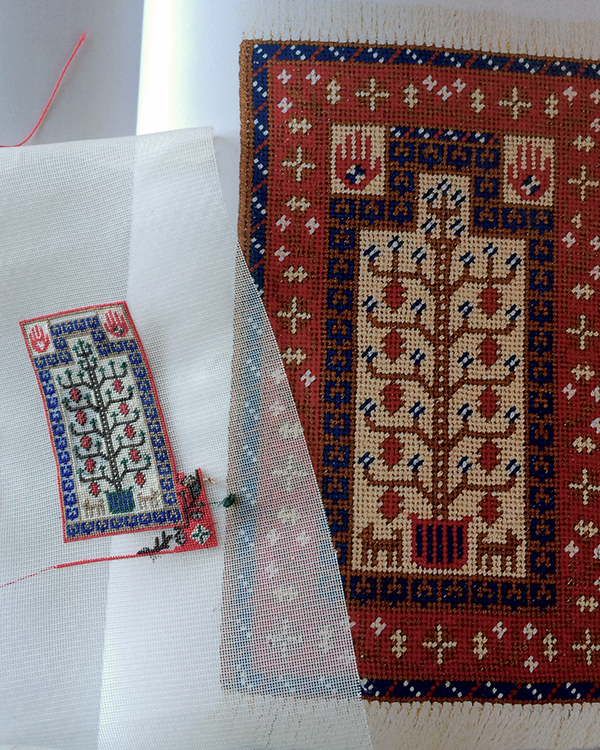
My little guy next to a photo of the original rug pattern (5.25 x 3.5 in, 137 x 88 mm)

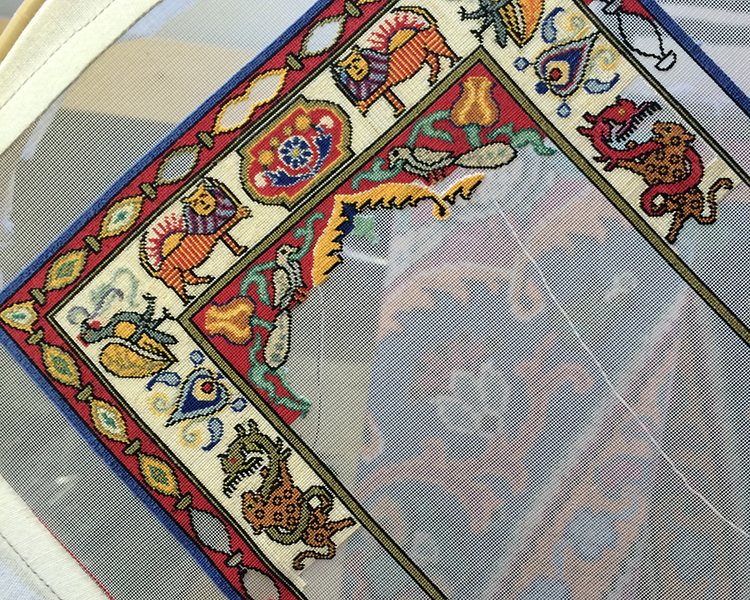
I wanted to do a “quick” small rug and started this 20th century Anatolian prayer rug design from Meik and Ian McNaughton’s Making Miniature Oriental Rugs & Carpets. Their patterns are charted for 24-count canvas and crewel wool or cotton floss, so mine, stitched on 49-count silk gauze with Gütermann silk, will be about half their projected size of 5.25 x 3.5 in, 137 x 88 mm. But no fringe. I hate fringe.

Of course I had to change up some of the colors. Wanting to emphasize the vitality of the tree of life motif, I added a deep green for the five-stitch leaves, and to carry the “live” through to the red border. My version kind of has a Scandinavian pinecones and twigs-with-leaves thing mixed in with the pomegranates on the tree, but in my worldview, these go together.

miniature baluchi prayer rug

The compromised area is just to the right of the lower right creature, past the Greek-looking motif in the red border :(

Started the first of the year, I got sick soon after, and managed to snip a bit of the silk gauze trimming a waste knot :( (I blame the psychotics sold as OTC cold meds.) I carefully stitched the threads in where the tiny cut is, and hope the fusible backing I’ll use to finish it will stabilize it sufficiently. If not, I might need to add a dot of fabric glue or something. It’s not horribly visible, and I’ll just remind the tiny people to take off their shoes and not scuff their feet. Or position an ottoman over the spot. (Haha, see what I almost did there? Ottoman over an Anatolian? Get it? Sorry.) Or maybe just let the hole be, and age the whole rug to historic vintage.

sea house pavilion: fire place moss trough

hmmm… the moss seems to have grown unruly since I first transplanted it

hmmm… the moss seems to have grown unruly since I first transplanted it

One of the things I like about outdoor rooms is how luxurious commonplace interior items, like a fireplace, look and feel. The granite blocks are cut from textured cover stock, glazed with matte acrylic washes of warm grays and taupe, and very lightly spattered while still wet with Payne’s gray on a fine brush. They are glued onto a foamcore structure (which also conceals batteries) that extends up into the rafters. I painted the firebox black and drybrushed on some char and ash. Brian split all the logs and made the grate by soldering bits of metal fencing together :) There is a shelf/bench of salvaged planking from the Sea House Pleasure Pier on one side and part of the front, made from basswood stained with Classic Gray Minwax, weathered with a fine-toothed razor saw blade and mechanical pencil, then sanded smooth.

The final addition was a low trough of the same wood planted with moss, which thrives in the cool marine climate. I like how it adds softness to the linear structure, and a bit of life and color. It also conceals a devilish leveling problem with the old wood decking and the quarried granite.

sea house pavilion: tiny charming cottage

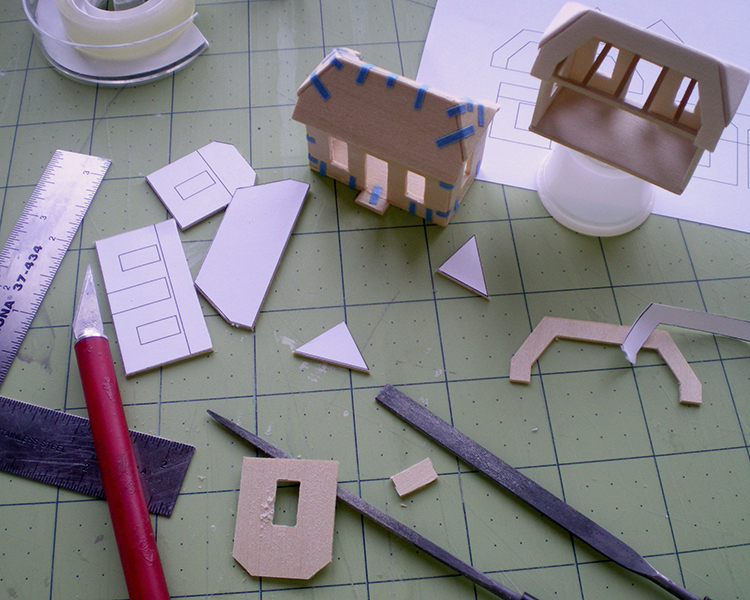
tiny charming cottage dry fit

tiny charming cottage dry fit

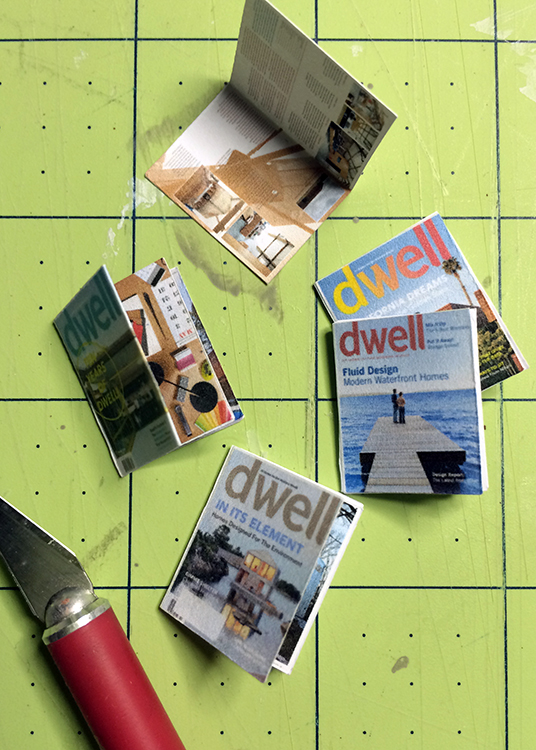
To illustrate how the pavilion adds outdoor living space, I made a 1:144 scale model of the Charming Cottage in an early dry fit, with a tiny roll of masking tape, the instruction sheet, and my notebook (with rounded corners :) open to some of my initial sketches. And plenty of back issues of dwell, for inspiration and research.

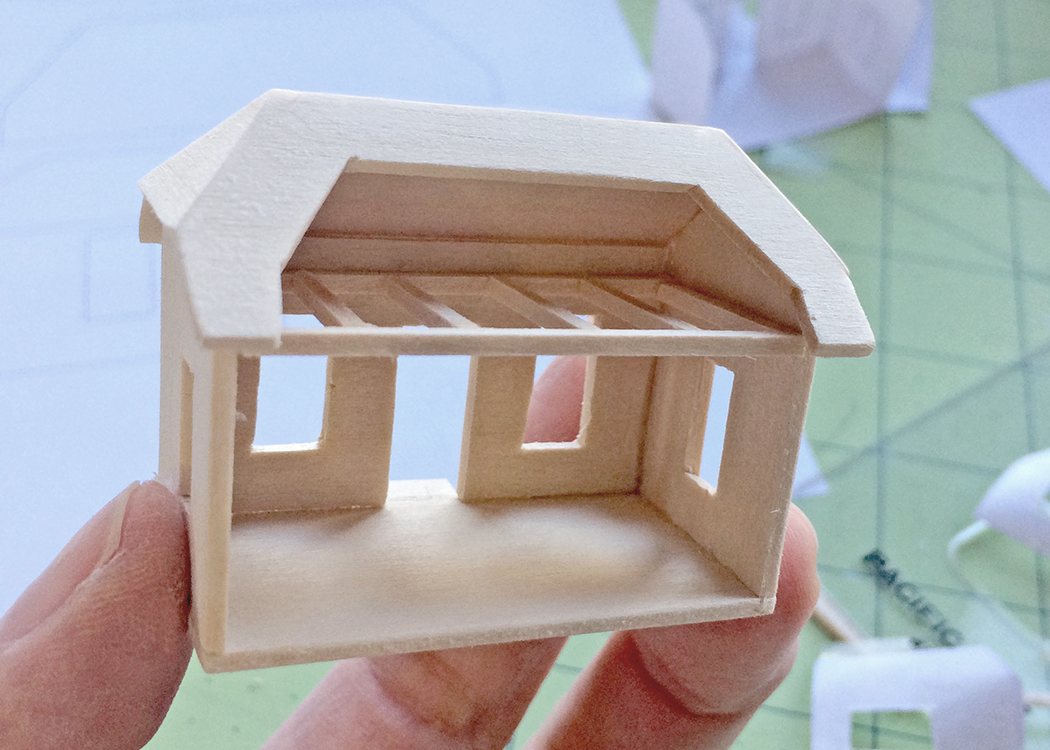
tiny tiny Charming Cottages

tiny tiny Charming Cottages

Since then, I’ve built a few more to refine the pattern and improve my skill. The first were cut from 1/16-inch basswood; this one is from 1/32-inch. I doubt I have the patience to paint or to make 1:144 furniture, but I guess I should make a model of the pavilion itself, just for that recursive view thing.

If you’d like to make one, let me know and I’ll send you my pattern.

new build: old brick walls and rock painting

brickwall_111813

tiny old brick wall building

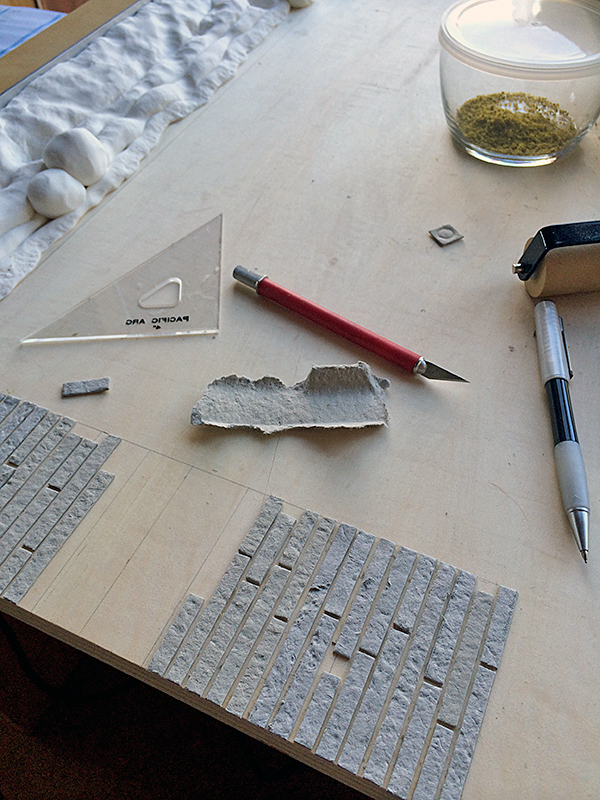
My original concept has been steadily downsized as I build. Seems like it could easily fill four of my self-imposed-sized bases to maintain the scale, so there’s been quite a bit of re-thinking and simplifying.

rock_painting_01

tiny painted boulders

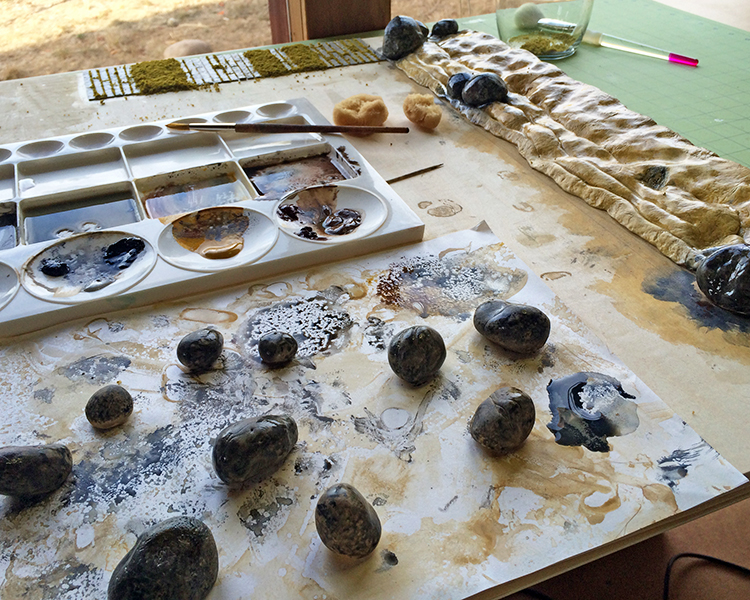
Air dry clay takes days to dry, but I started painting the boulders on day 2 with thin acrylic washes. So much fun! I think I’ll add one or two more stipplings once they’re in place in the landscape, and I see how much more they change with drying.

new build: base sculpting and paving

new paving design

new paving design

Had to scrap my first paving design as the new build reveals itself. These are quarter-inch (0.635 cm) modern egg carton pavers, and will have some sort of greenery growing between them.

Some of us conceive an idea, make extensive plans and work out a lot of details before beginning to build, and some of us mostly make it up as we go along. This is my fourth structure, and I’ve learned a thing or two, starting with base size and weight, especially after crating and moving the other three across the country, and to a much smaller house and studio. I now limit the base to a 20 x 26-inch (51 x 66 cm) birch drawing board. They’re lightweight, stable and have nicely finished edges — a good place to start.

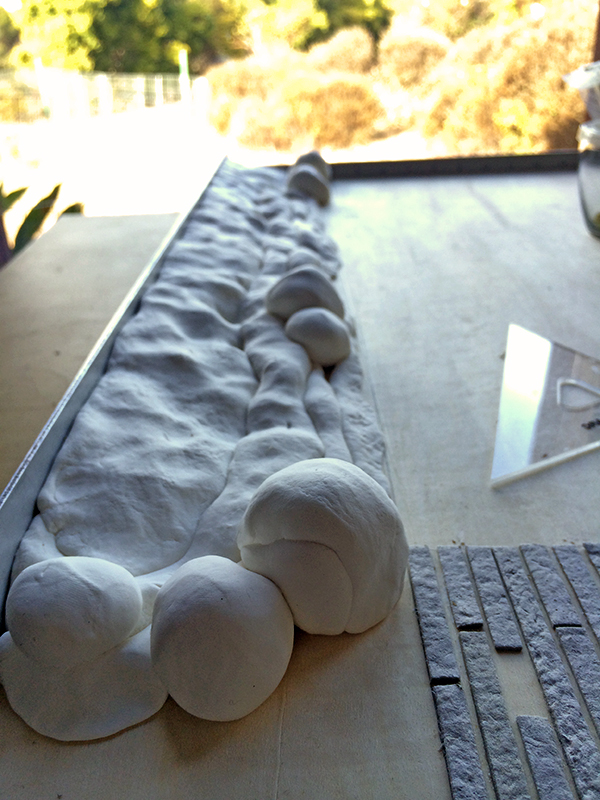
My Quest for True Scale Fidelity is now tempered with weight considerations as well. I used real stones and rocks landscaping my first two builds, and they are beautiful but heavy. This time, I’m using air-dry clay to sculpt both the gentle grade and boulders. I’ve never used it before — it’s kind of like a cross between marshmallow and Silly Putty. (Brian says it shrinks like crazy, so we shall see how it turns out). And how mad are my painting skillz.

using air-dry modeling compound as a landscaping base

using air-dry modeling compound as a landscaping base

I’m also terrible at waiting for glue to dry.

the animals rug lives

two doves and a second leopard snakey-beast

center panel progress and a second leopard + snakey-beast

In progress. Underway, going on, ongoing, happening, occurring, taking place, proceeding, continuing; unfinished, in the works.

Aide-mémoire: 2,400 tiny diagonal stitches per square inch of material.