new build: base sculpting and paving

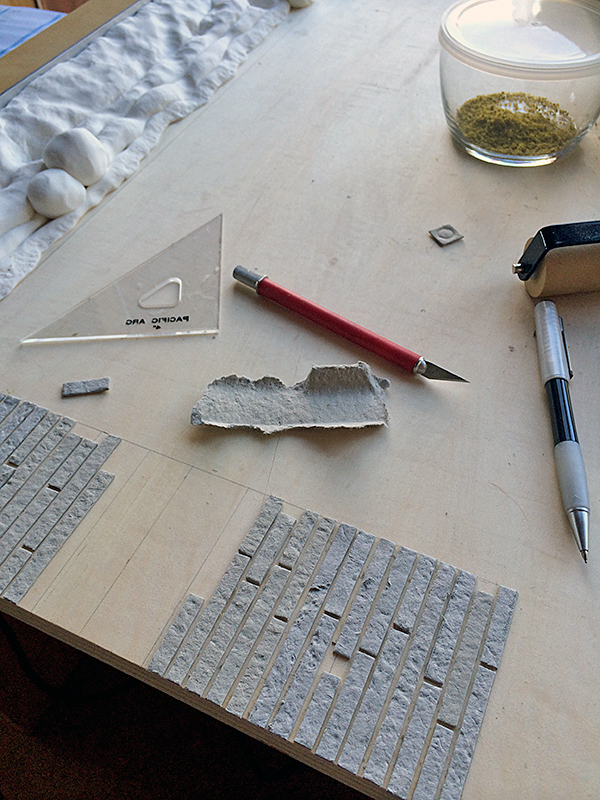
new paving design

new paving design

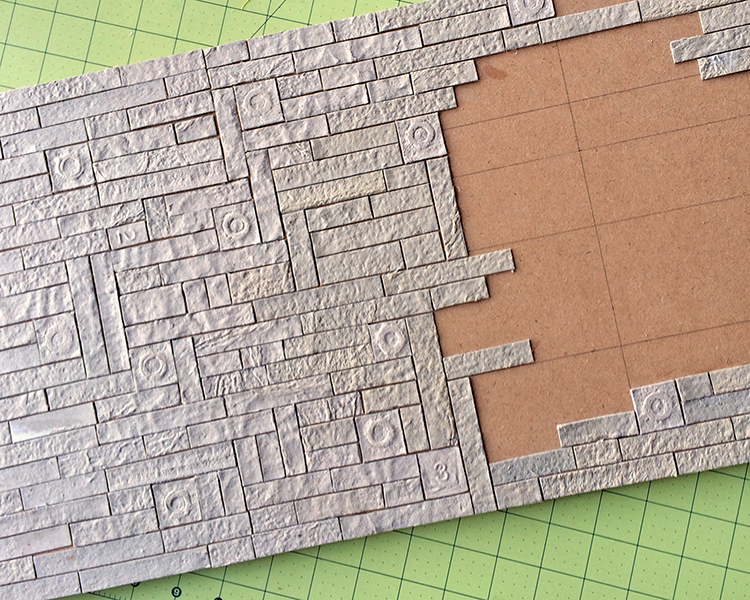
Had to scrap my first paving design as the new build reveals itself. These are quarter-inch (0.635 cm) modern egg carton pavers, and will have some sort of greenery growing between them.

Some of us conceive an idea, make extensive plans and work out a lot of details before beginning to build, and some of us mostly make it up as we go along. This is my fourth structure, and I’ve learned a thing or two, starting with base size and weight, especially after crating and moving the other three across the country, and to a much smaller house and studio. I now limit the base to a 20 x 26-inch (51 x 66 cm) birch drawing board. They’re lightweight, stable and have nicely finished edges — a good place to start.

My Quest for True Scale Fidelity is now tempered with weight considerations as well. I used real stones and rocks landscaping my first two builds, and they are beautiful but heavy. This time, I’m using air-dry clay to sculpt both the gentle grade and boulders. I’ve never used it before — it’s kind of like a cross between marshmallow and Silly Putty. (Brian says it shrinks like crazy, so we shall see how it turns out). And how mad are my painting skillz.
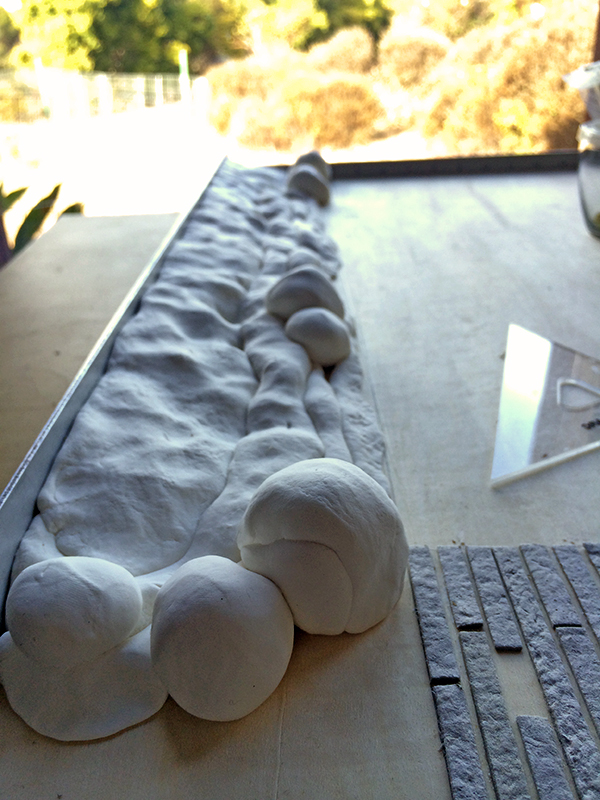
using air-dry modeling compound as a landscaping base

using air-dry modeling compound as a landscaping base

I’m also terrible at waiting for glue to dry.
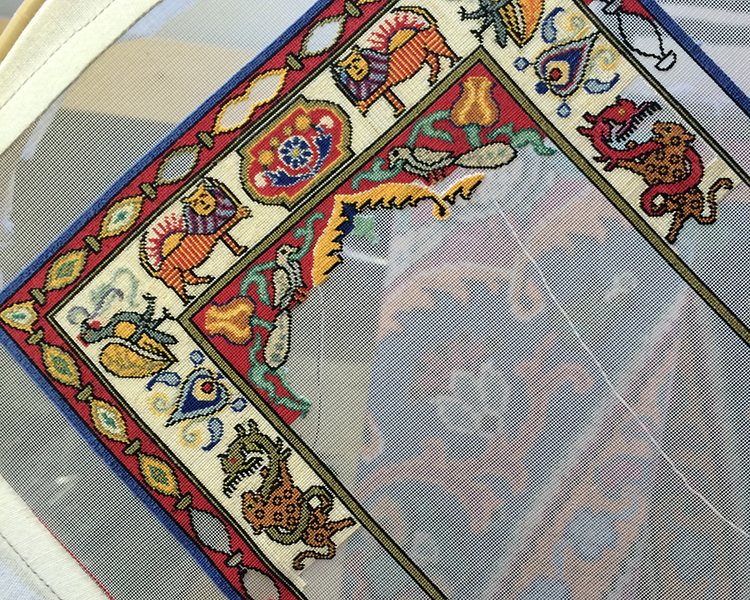
the animals rug lives

two doves and a second leopard snakey-beast

center panel progress and a second leopard + snakey-beast

In progress. Underway, going on, ongoing, happening, occurring, taking place, proceeding, continuing; unfinished, in the works.

Aide-mémoire: 2,400 tiny diagonal stitches per square inch of material.

new build: main structure

main deck nearing completion

main deck nearing first round of completion

The timbers and planks for the outdoor room are salvage from the Sea House Pleasure Pier when it closed in the early ‘60s, when that kind of pleasure was no longer popular nor profitable. They had been stored in a warehouse with other artifacts, apparently forgotten until they were rediscovered by two of the Sea House heirs and put up for auction in July, 2007.

the builder considers the view from the newly completed main deck

the builder considers the view from the newly completed main deck, and contemplates landscaping, cheese, if time is more like a wave or a spiral, and the stories old wood can tell

The builder swears the wood smells like sea air and pink popcorn, and when cut, you can sometimes hear the sound of waves from under the pier.

new build: first looks

Pretty sure Buckminster Fuller used egg cartons in the Usonian House

Pretty sure Frank Lloyd Wright used egg cartons in Usonian Houses

Also it kind of looks like the Death Star, but of course it’s really just a floor, and will mostly be covered up. I love egg cartons. They are one of the most versatile, suggestive and satisfying materials I’ve worked with. Although they dull X-Acto blades surprisingly fast, still totally worth the effort of begging cartons.

experimenting with palm leaf shapes cut from fabric flower foliage

experimenting with palm leaf shapes cut from fabric flower foliage

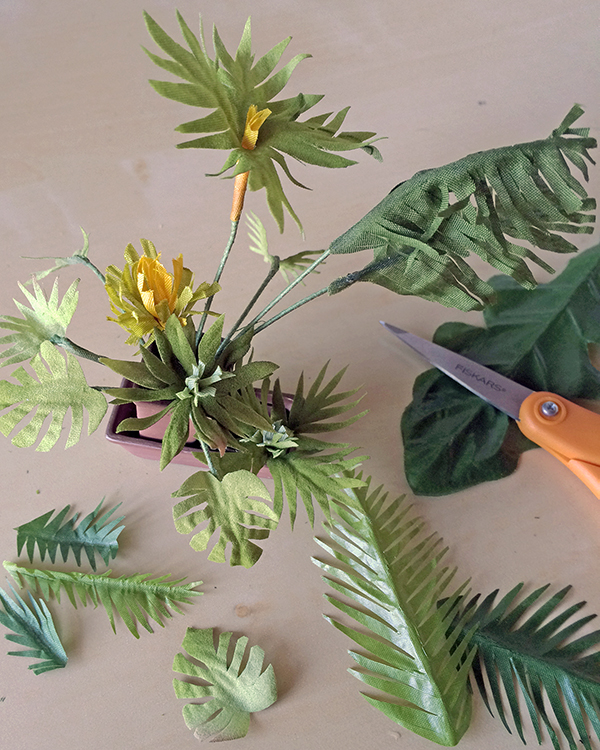
Exploratory phase, hand cut, with an eye toward being able to make lots of plausible landscaping without letting the plants tyrannize and crush me. Next photo I’ll leave the hundreds millions of tiny snippets cut from the shapes. Possibly the worst part is having to go into the kind of stores that sell fabric flowers.

the roof interior and color scheme inspiration

the roof interior and color scheme and location inspiration

The roof, which is pretty much the only — and the most distinctive — part of the kit I’m using (other than the floor and rafters), will be clad in corrugated steel. Actually it’s plastic but it will be painted to look like metal and suitably aged and weathered. You will want to believe it’s perfect tiny corrugated steel, and the obvious choice for an outdoor room in a North Coast city lot.

how the leopard got its spots

the leopard and the snakey beast

the leopard and the snakey-beast

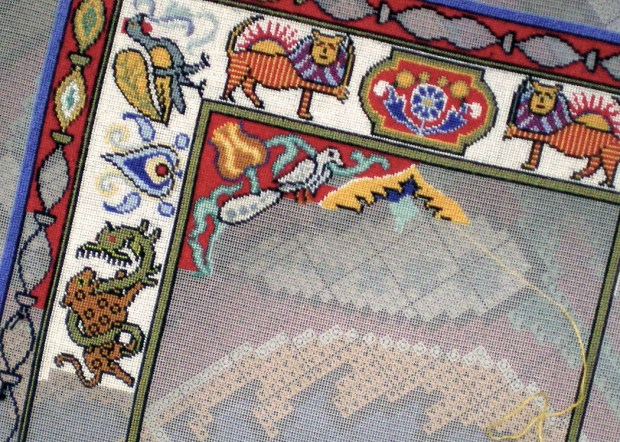
This motif was one of the most agreeable to stitch, and watching it emerge was very satisfying. I changed the snakey-beast’s colorway with two shades of olive green and gave it a red eye. The leopard’s eye is the same bright olive because the two are regarding one another, entwined, and I kept thinking about Paul Schrader’s 1980s film Cat People, and hearing Giorgio Moroder’s soundtrack and David Bowie’s voice singing “…I’ve been putting out the fire, with gasoline…” So now you have an eensy insight into why this is my favorite motif thus far.

The leopard’s spots were worked by my third-grade self, when “How the Leopard Got His Spots” from Rudyard Kiplings’s Just So Stories was one of my best beloved books.

Before this, I thought the striped lion was my favorite animal, with its Nepalese flag-reminiscent rising sun and its music Yeah Yeah Yeah’s Gold Lion. Curiously, I learned that until 1962, both emblems of that flag had faces; they were removed for “modernization”. Natalia’s chart has faces on its suns which I chose to omit. Me and Nepal, thinking modern. And the Gold Lion lyric, “Gold lion’s gonna tell me where the light is / Take our hands out of control” is an interesting concept to consider when making tiny stitches.

infinite ways to make mistakes

as if I needed more opportunity

as if I needed more opportunity

Tiny rug progress! I am still *loving* stitching this. It’s really cost-effective therapy: I have to concentrate so intently, few other thoughts slip in like, Really? We’re driving across North America with three cats and a giant dog in a 31-foot long so-called recreational vehicle? By choice?

I’d like to able to say my purity of focus prevents mis-stitchery mistakes, but that is profoundly not so. I’m rather amazed at all the many ways I make them. And although I’m learning as I proceed, inventing tricksy cross checks and multi-stranding, new mistakes creep in despite my diligence. Some are caught soon enough, and I can de-stitch the messups, but some are insidious and aren’t detected until far, far too late.

When that happens, I usually just go to bed.

And thus a whole realm of stitchery and pattern adjustments opens up, and I ponder and puzzle the most graceful way to move forward. With 2,401 tiny stitches per square inch of basis, one might think I have lot of options. But pattern and symmetry are both demanding taskmasters, and the challenge becomes how to fail slightly less obviously, and to not let the tiny errors compound.

I totally fail especially at symmetry; my brain fingers invent ways to diverge on not one but both sides of the pattern. And where motifs repeat, I must decide whether to intentionally try and recreate my, um, adjustments or go for the original pattern again. Thereby introducing further potential mistakes variations.

It’s humbling.

So this is about four of the 20 chart pages completed. Mostly. Impressive, ne?

summer coping with liger

pheasant chicken ? and rising sun lion tiger with sword?

pheasant chicken ? and rising sun lion tiger with sword?

The liger motif is what drew me most to the “Animals” rug pattern. I chose not to include the silly face on the sun, but everything else about the creature I love: the vaguely Egyptian mane, the jaunty red and yellow stripes, and the sword ? or staff ? held upright in its paw. I think of it as the cheerful beast who cuts through illusions, allows us to perceive reality, and makes our house sell for full asking price tomorrow. Actual width of the two-motif stitched area is 2.5 inches (6 cm) and represents about 1.5 chart pages of 20. Twenty. I’ve plenty of time and opportunity to perceive reality. Yay!

3 > 2

3 strands Gütermann silk on 28 count canvas

3 strands Gütermann silk on 28 count canvas

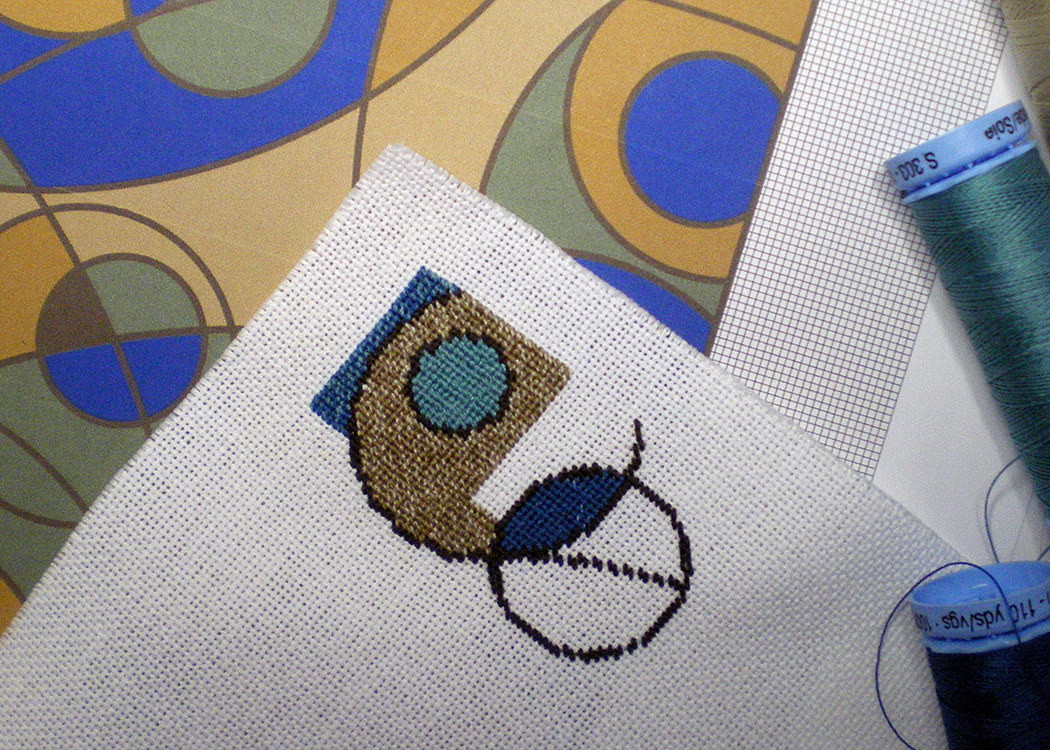
Two strands of Gütermann silk provided somewhat scanty coverage, and although three strands is a bit dense, I’m keen on the increased color options. And I like to imagine the satisfying, luxurious feel of walking with tiny bare feet on a thick silk rug.

I am sub-optimally charting the design in Illustrator as I stitch. Actually, I’m doing a fine, if tedious, job of charting, it’s just that Illustrator is not really optimized for this purpose. It was adequate for the Modern Cross Stitch Bodoni charts, but those were the letterforms only, with no backgrounds, on 14 count canvas.

This has led me to explore actual charting software. I’m messing around with a demo copy of Ursa’s MacStitch right now, and it seems pretty cool. There are tools to draw with, or you can import an image file and it will translate and map it into a chart of your specifications. I’ve yet to determine if the time investment in learning a new program vs. working with one I know so well will balance the number of designs I’m likely to actually produce. Given my… serial enthusiasms history.

so of course

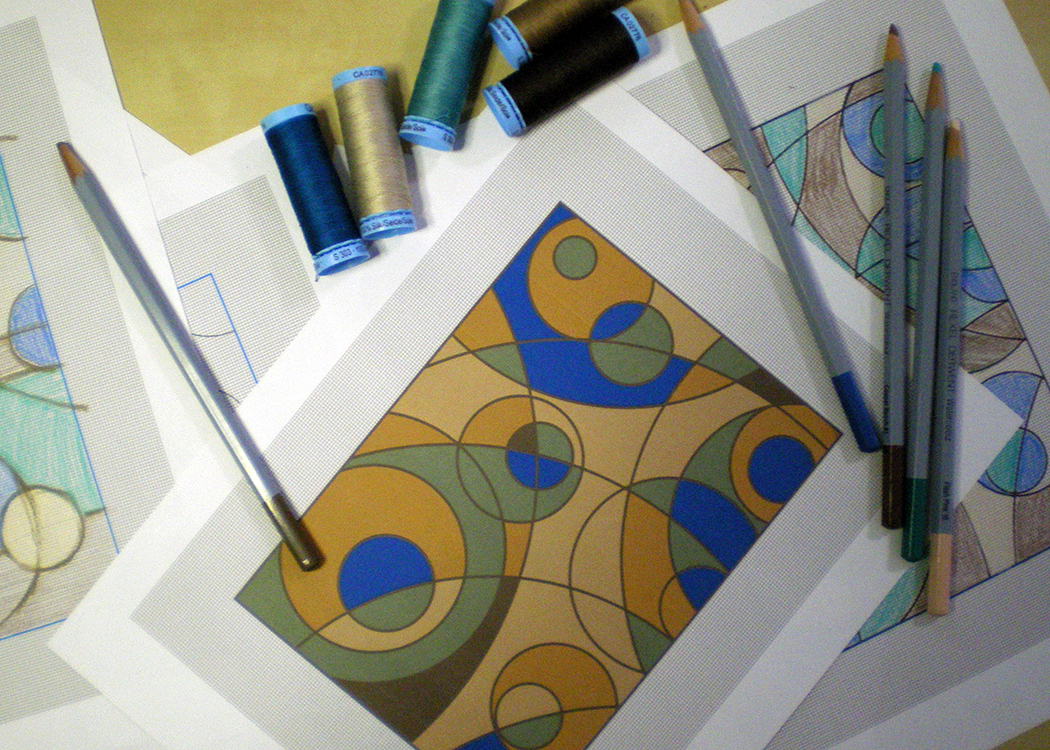
messing around with modern rug design

messing around with modern rug design

So now that I’m all obsessed with miniature needlework, I’ve been searching for some modern design charts. I haven’t found any yet, so I started sketching up one of my own. I also want an easier project to work on, so I got some 28-count evenweave canvas and picked out some silk thread from the minimal selection of colors available at the local fabric store. This will be a 5 x 7 inch (12.7 x 17.78 cm) rug, so on 28-count that will be… 140 x 196 stitches. Ha! Compared to the 49-count silk gauze, should be relatively fast and easy.