This is the piece I showed at the Art Guild Annual Members Exhibit. Glimmering Girl. Found metal objects, hand-stitched cotton thread, mono printed torn and cut paper collage, 8 x 10 inches
Here’s a closeup peek at the piece I’m working on now. The patinas and colors are so luscious. I’ve been collecting the found bits for years, and the process of messing around assembling them into beings is enjoyable. Something wants to emerge.
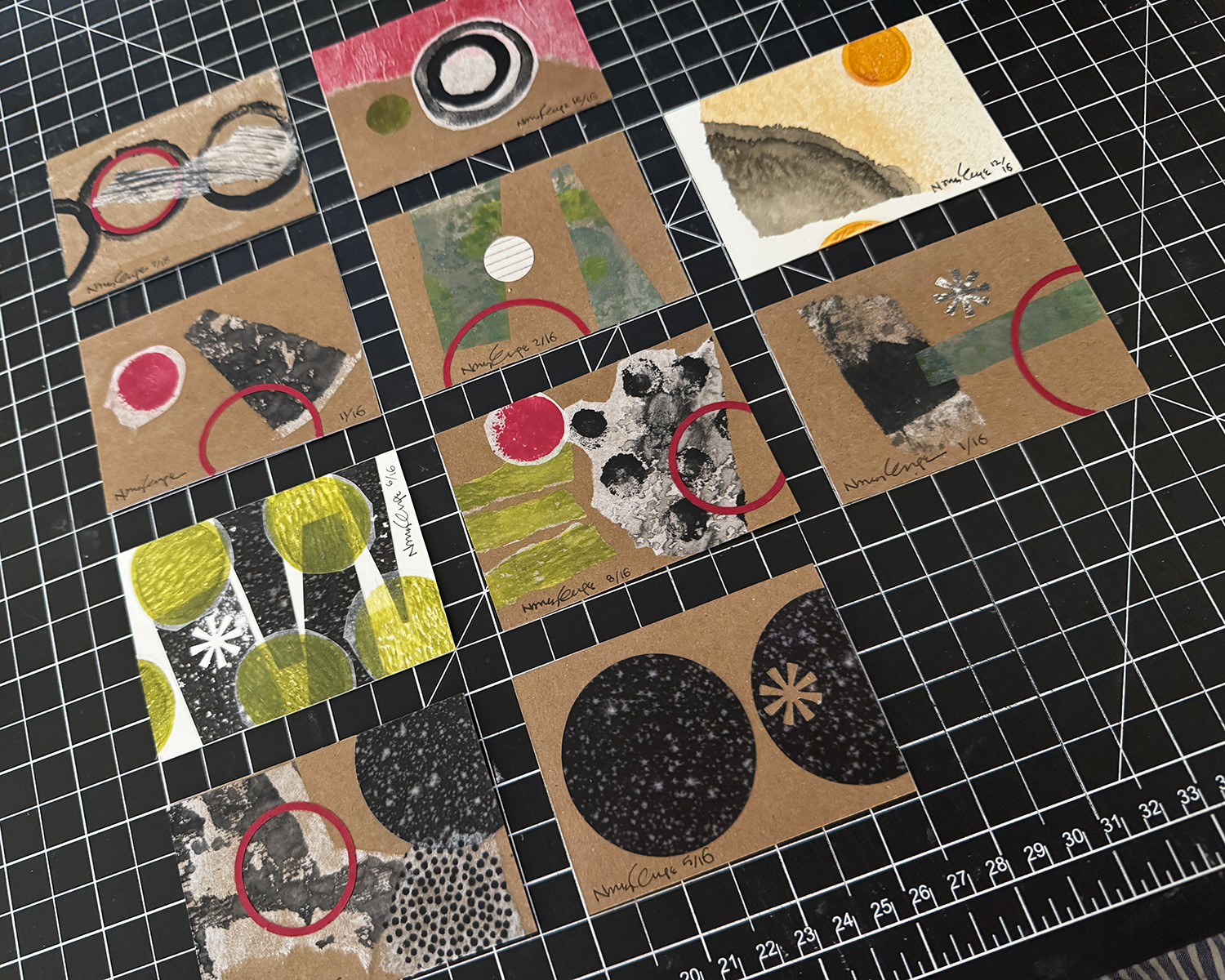
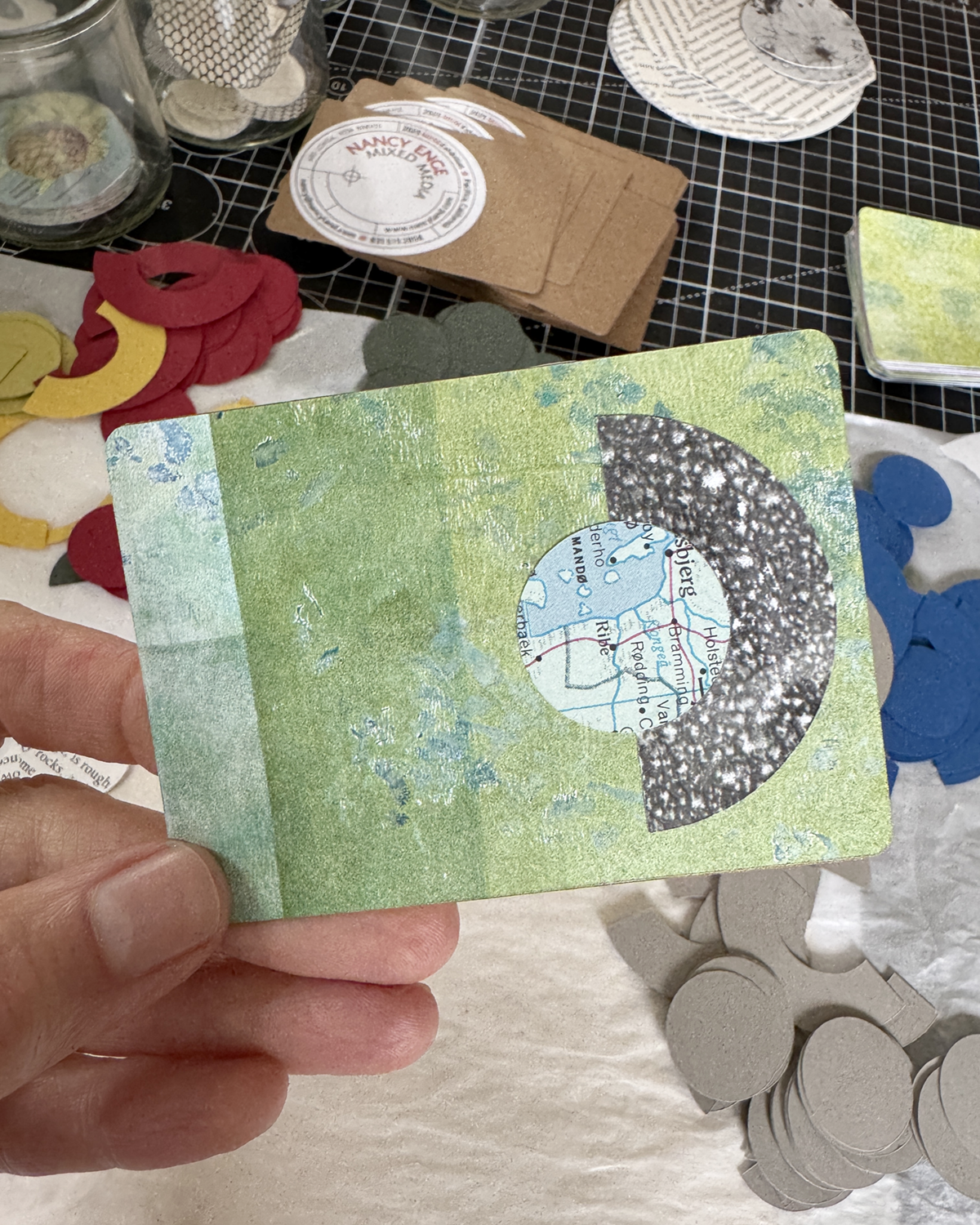
In the monthly discussion group I attend, we decided to exchange Artist Trading Cards. Fun to make, pulling out all the old scrap materials, and working small and fast.
So fun that I decided to do the backs as well. And afterwards, I was moved to tidy up and get rid of so many bits and pieces and better organize what remains.
Sharp Park winter sun beach walk, high tide, storm clouds gathering
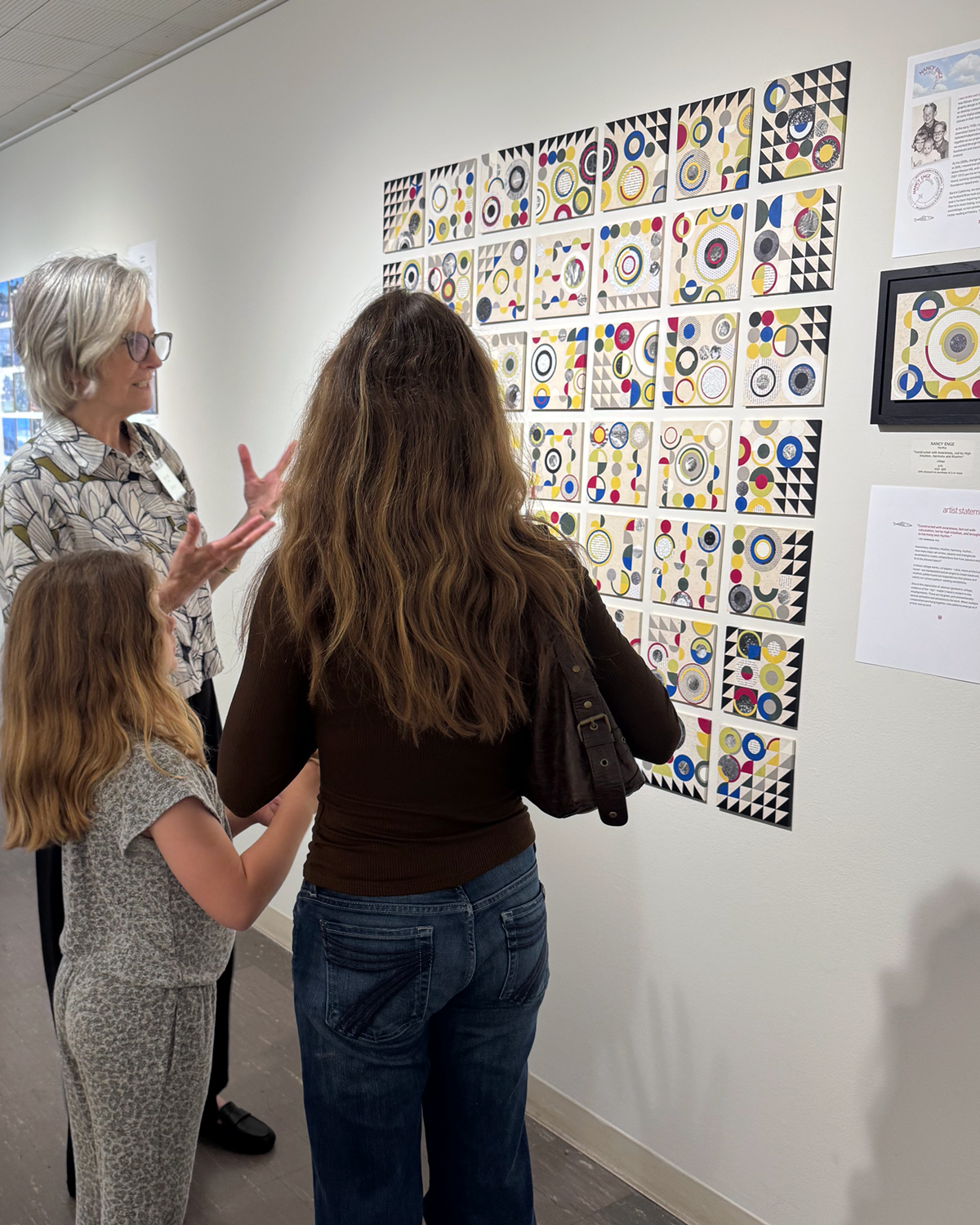
Discussing the work with my art-savvy granddaughters
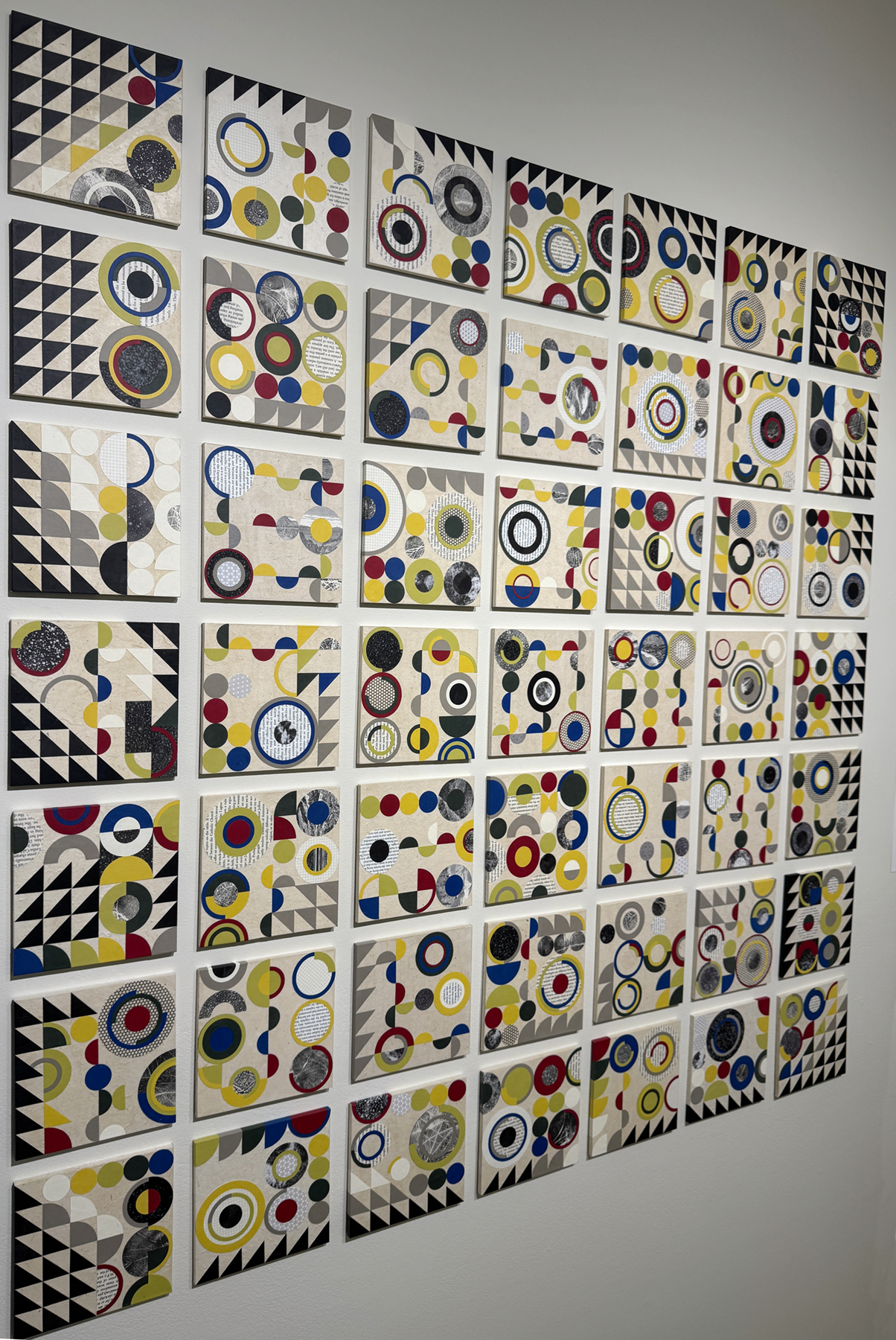
50+ artists, each producing 50 small works (6×6 inches) in 50 days
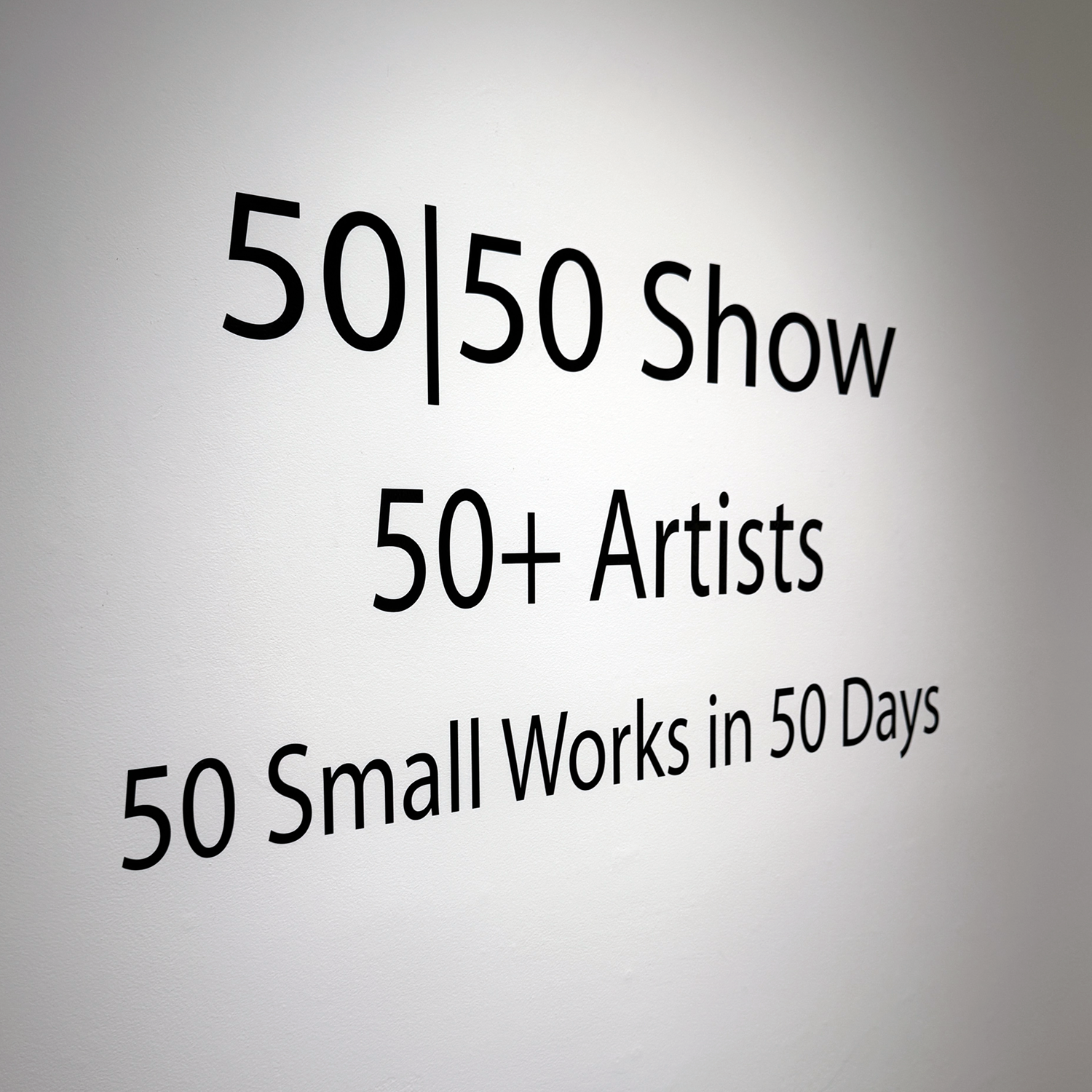
As the wall signage announcesDramatic angle of 49 of the 50
I’m still processing the experience, unfolding in successive waves. So much goodness and delight. The show runs for a month, and I’m signed up for weekly gallery sitting shifts, which means getting to study/enjoy all the works in depth, and meet and talk with artists and gallery goers (and assist them with their purchases). If you’re in the SF Bay Area, come by! (Sanchez Art Center welcomes visitors at no charge; galleries are open Friday, Saturday, and Sunday from 1–5 pm, through October 5. )
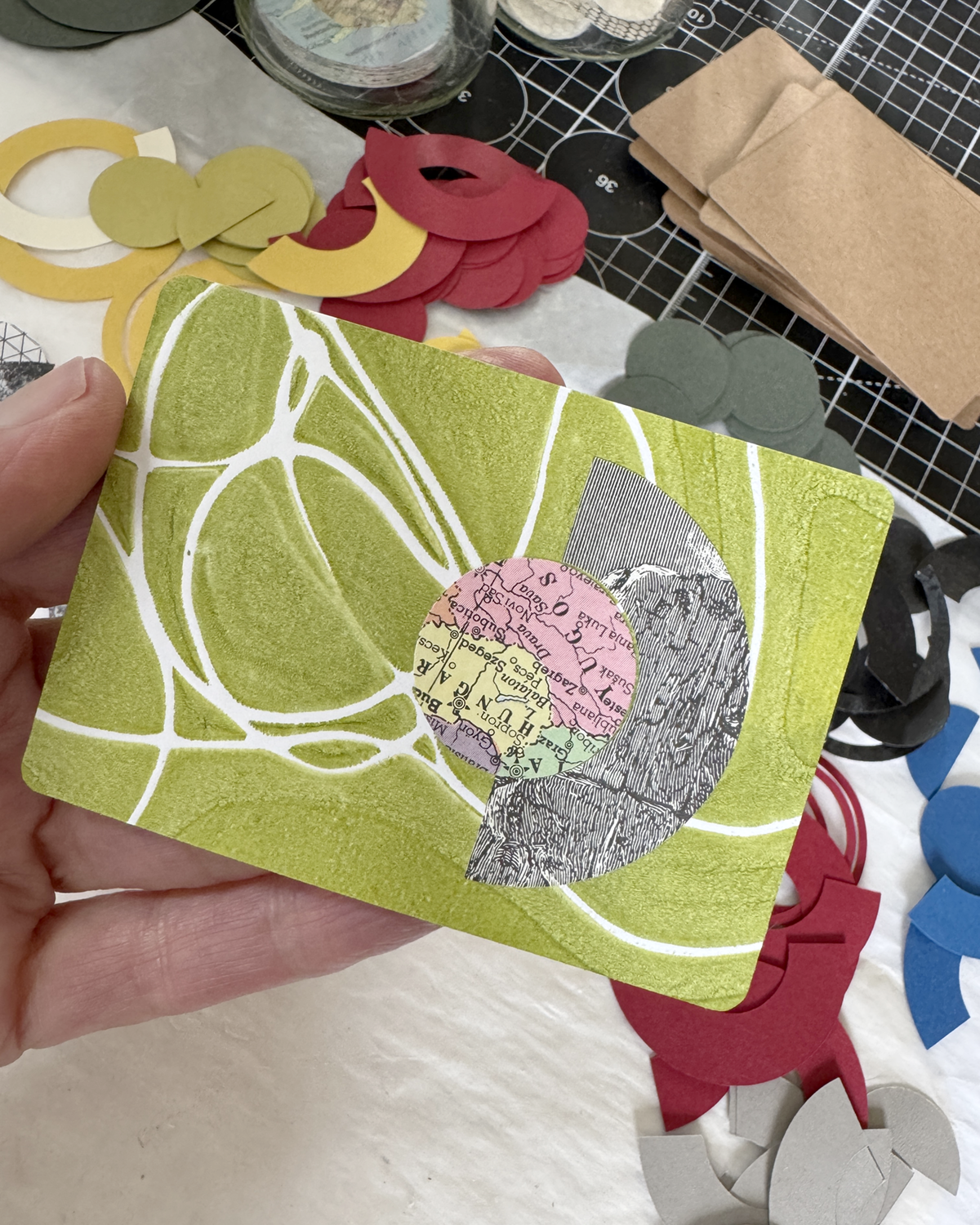
I decided to make an edition of 50 Artist Trading Cards with some of the leftover cut shapes and monoprinted papers for background. It’s a fast, fun and carefree process; no rulers, grids or light boxes involved.
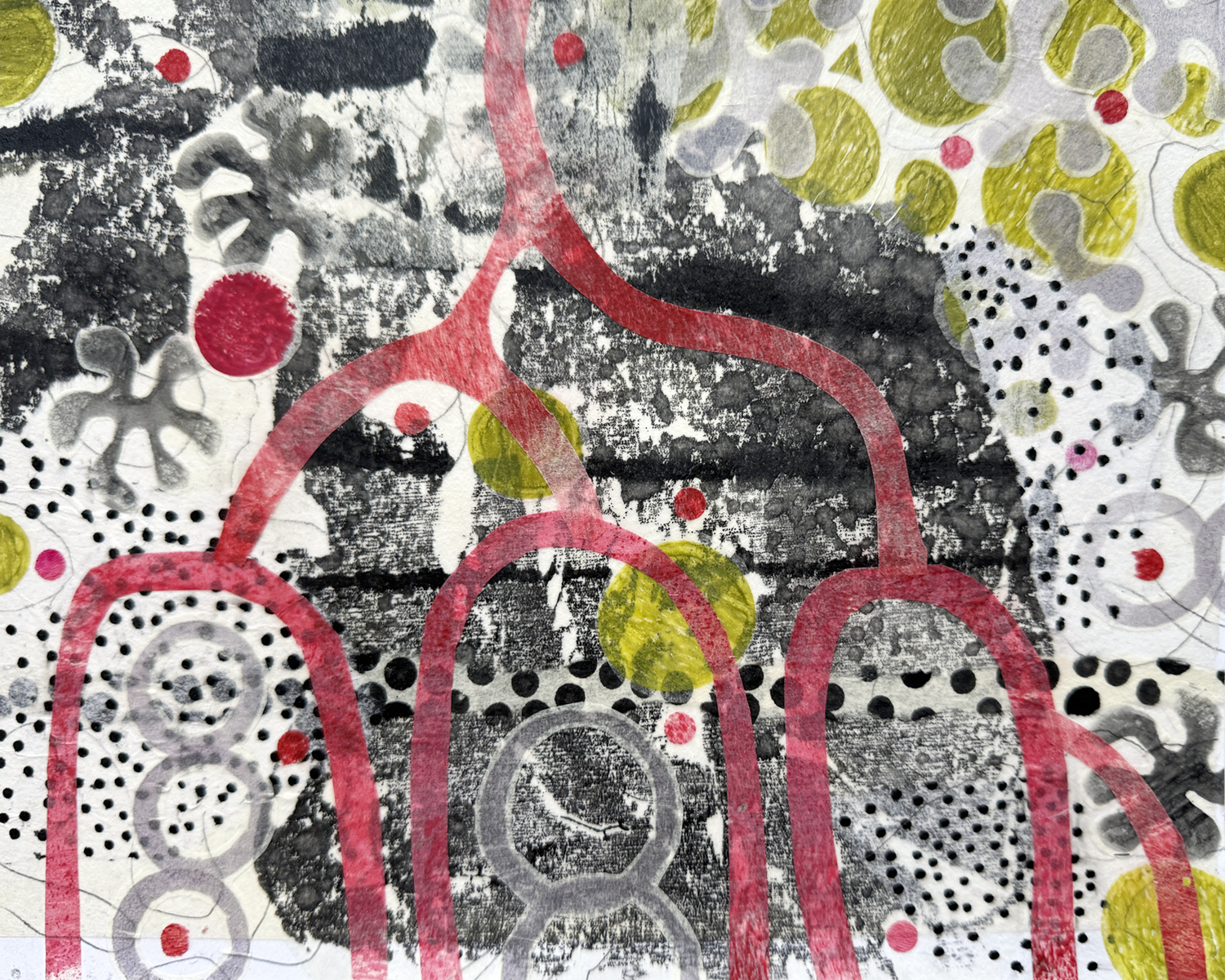
Choosing which mono prints — including brayer roll-offs, as seen above — is a pleasant task, like seeing old things with fresh eyes.
Some of the papers I cut for the 6×6 panels did not play so well with the color palette, and were rejected for use. However, they look swell on the various mono prints and the smaller ATC size! Yay old maps and line drawings!
Not gonna lie, fifty 6×6-inch panels is a lot of eventual individual artworks to make in as many days. Priming and sanding them all was a good way to ease into the enormity.
Border panel work-in-progress
I eventually got into a kind of rhythm of creation, with a set of steps and best practices. Iteration is a great way to really explore the geometric relationships with color and balance. (Amusing, too, as I rejected placements that looked like butts or boobs, although the occasional egg yolk or eyeball were okay.) Every single panel was a surprise, and interesting to see through to its completion. Somewhere after panel 25 or so, I gained trust in the process and my ability. Flow state increased in onset and duration.
Playing with arrangements, checking in with what works
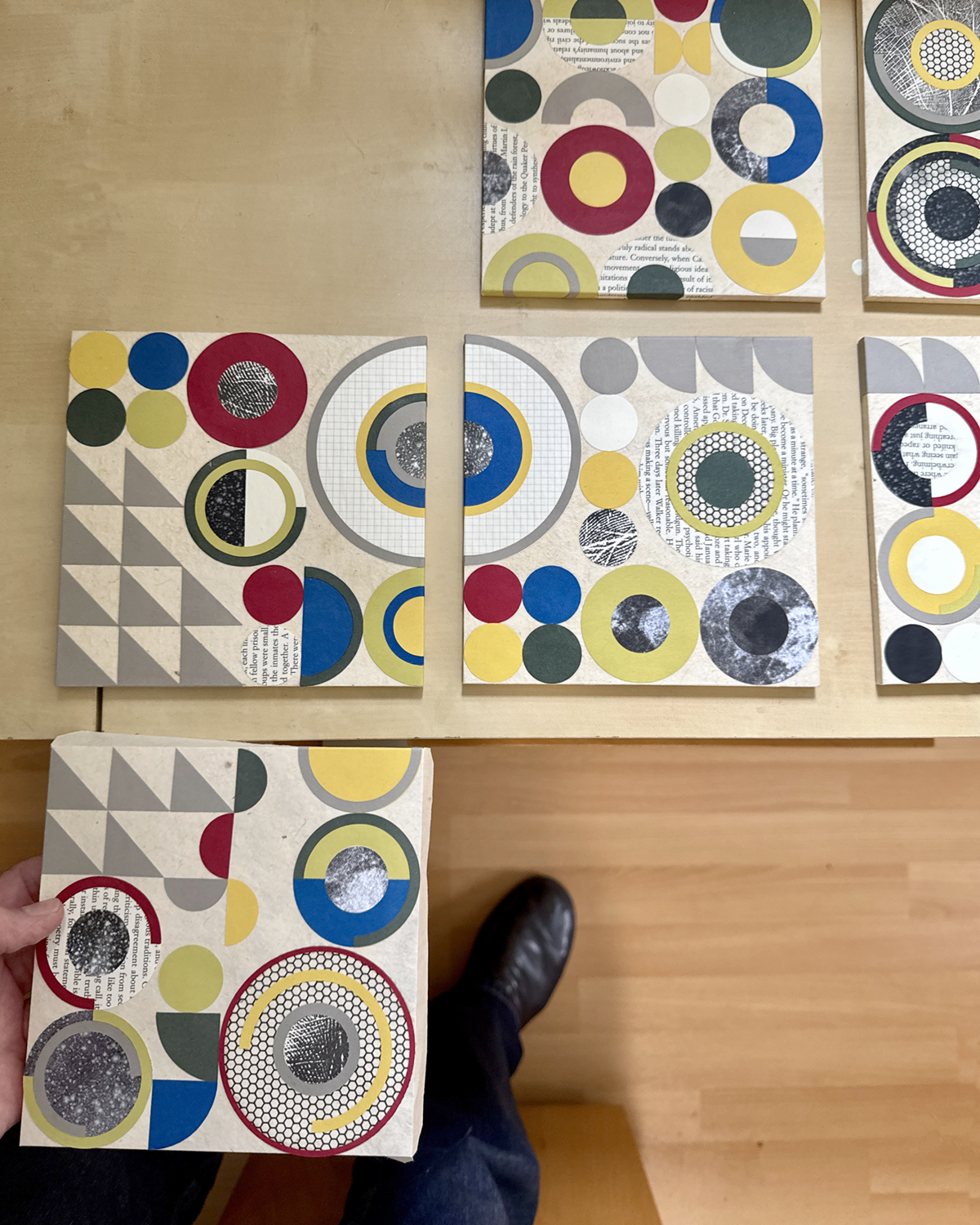
Periodically, I’d lay out the work to date on some inadequate surface and just look, to see what I could see, and use the insight or finding on the next piece.
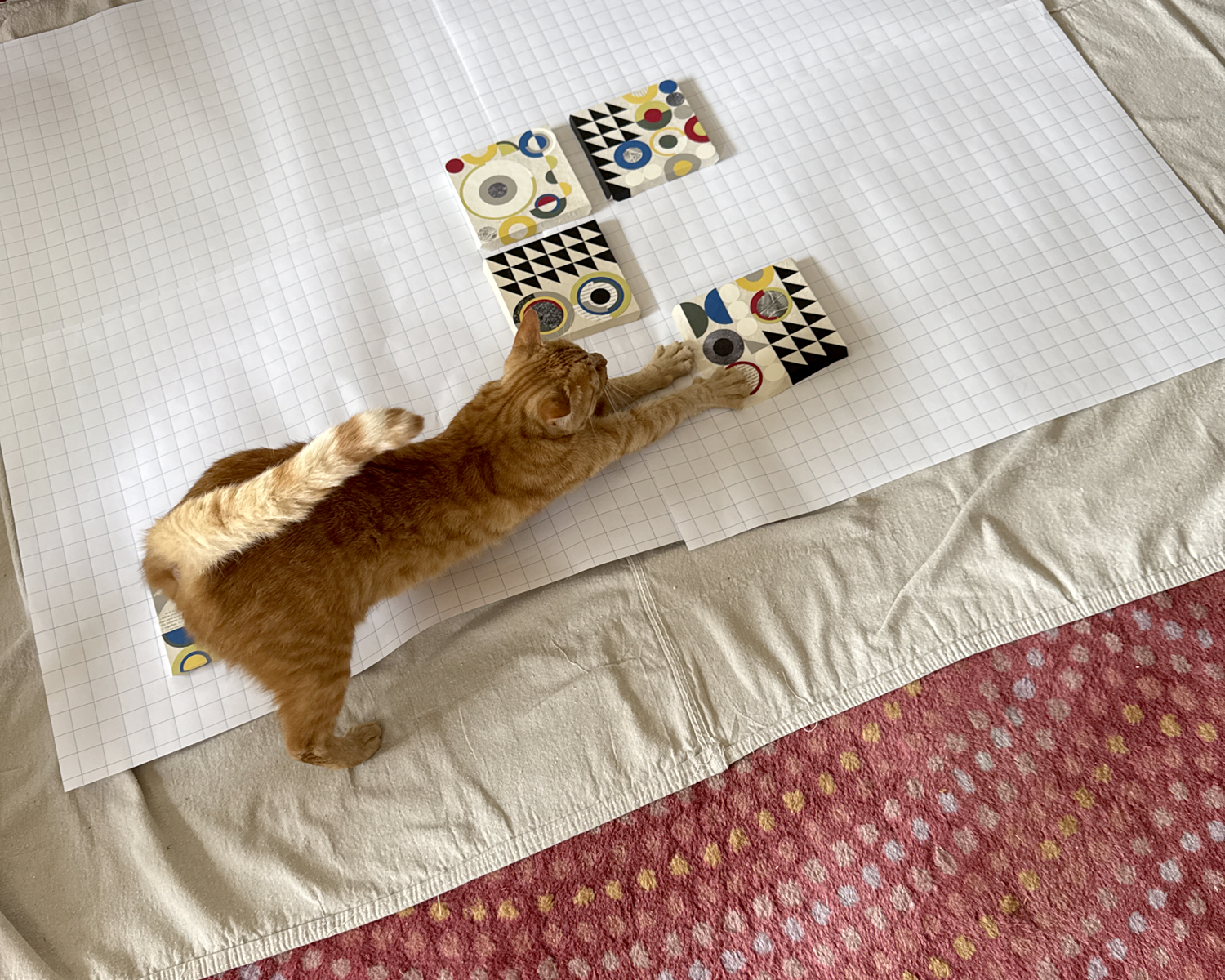
Of course I had help if I laid them out on the floor.Studio Assistant and First Buddy Mateo
Tater has a large flat box on the ell of my desk in which he lounges and naps, etc., while I work. In the process of sorting and packaging the finished panels for transport to the gallery, I took his large box and replaced it with a smaller one — just temporarily! — and he was not at all having it.
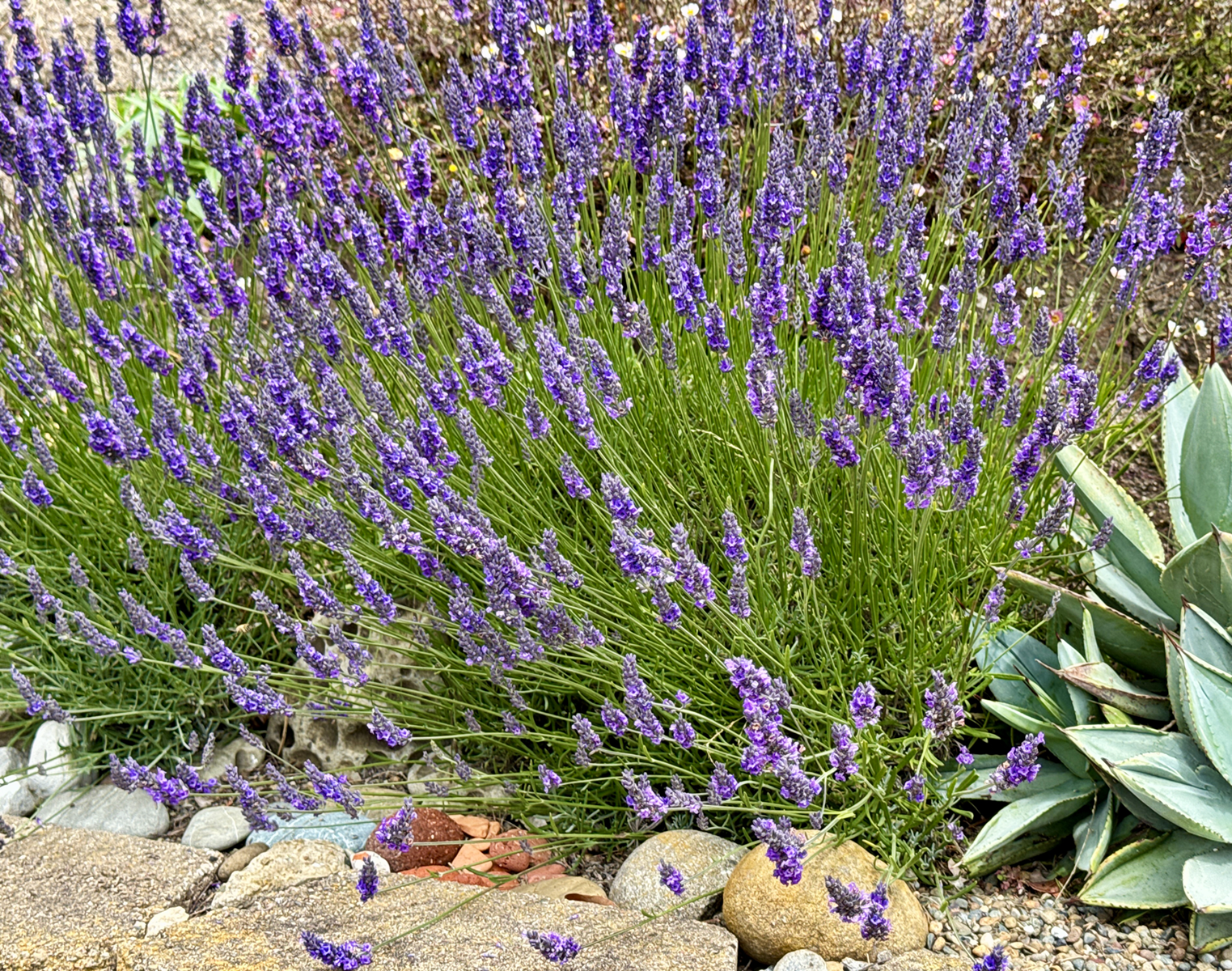
Lastly! The lavender is abloom here in foggy, mizzling Pacifica. There are about 20 bees of various species on the job, on this plant alone, and the scent is divine. I sit on the retaining wall and just breathe.
Earlier this month I was delighted/surprised to be accepted to the 17th Annual Sanchez Art Center 50|50 Show, in which 50 artists complete 50 small works in 50 days. (I’ll just let that sink in a bit. It’s both a lot and a little at the same time.)
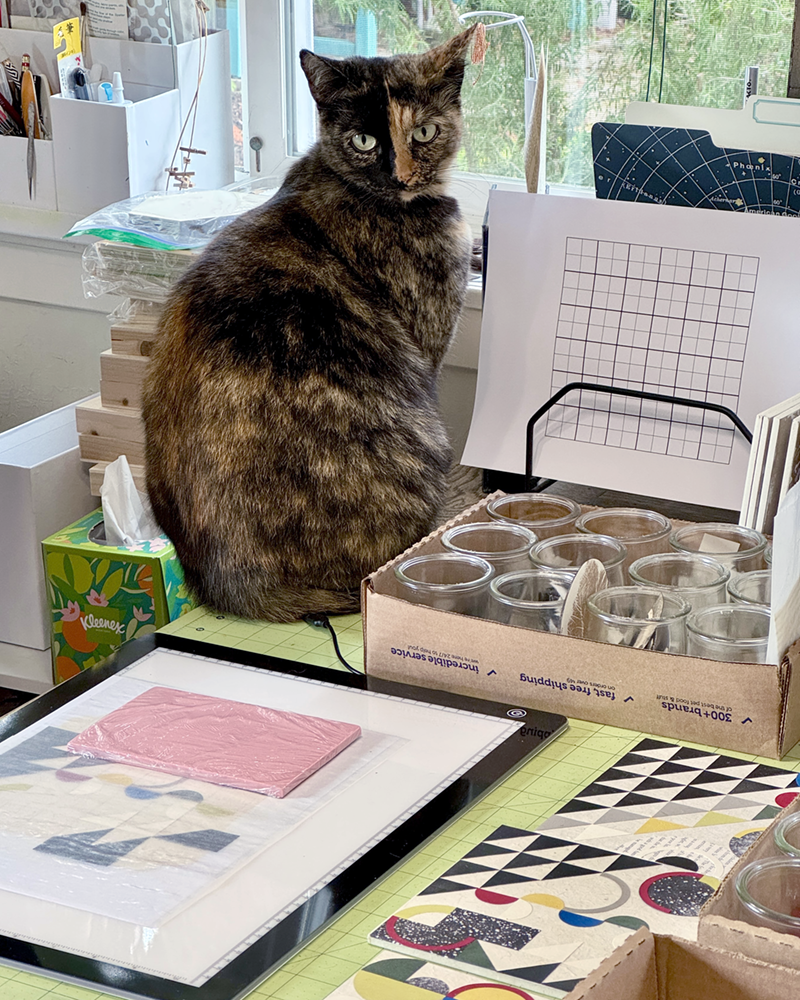
Maxine surveys the new mayhem on the studio table
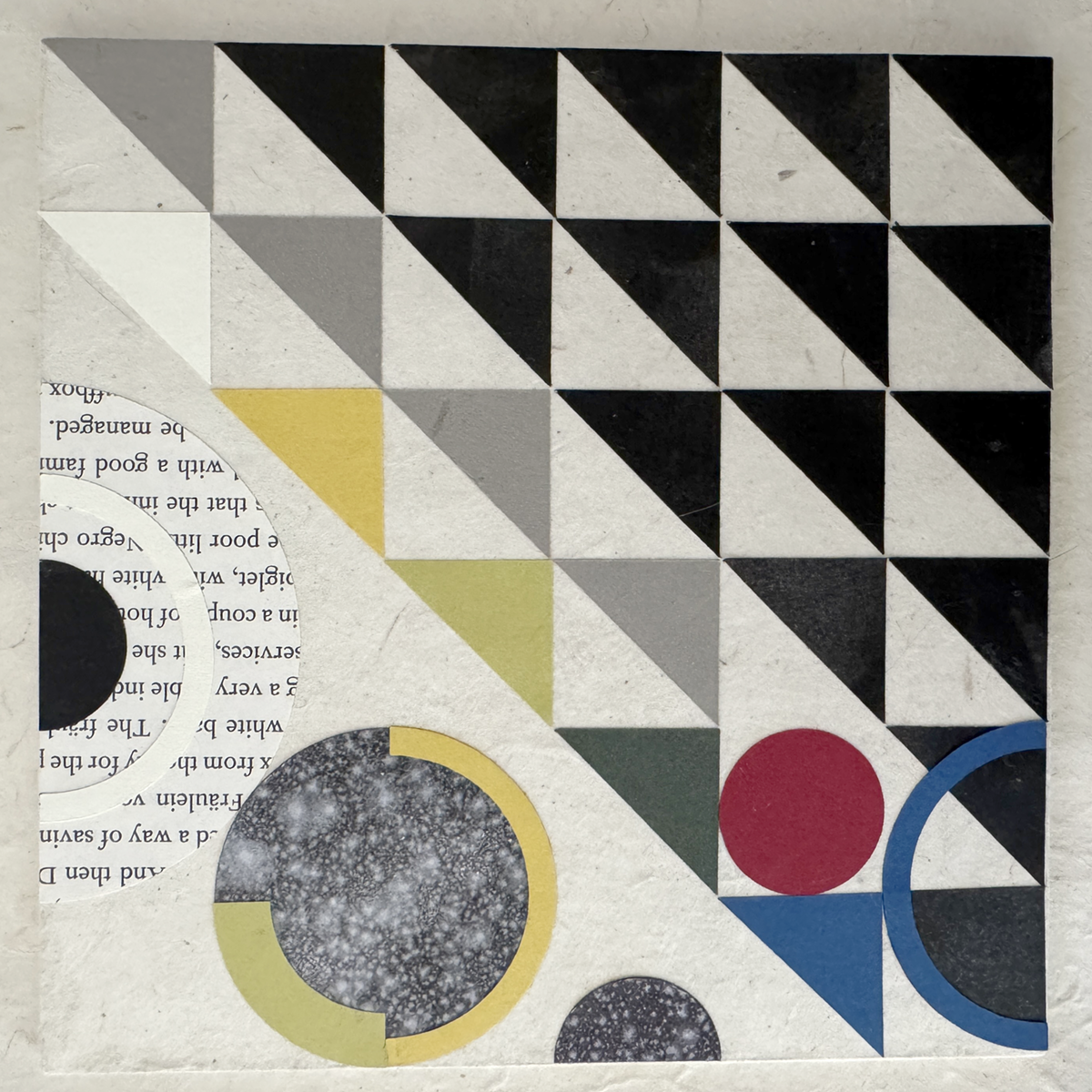
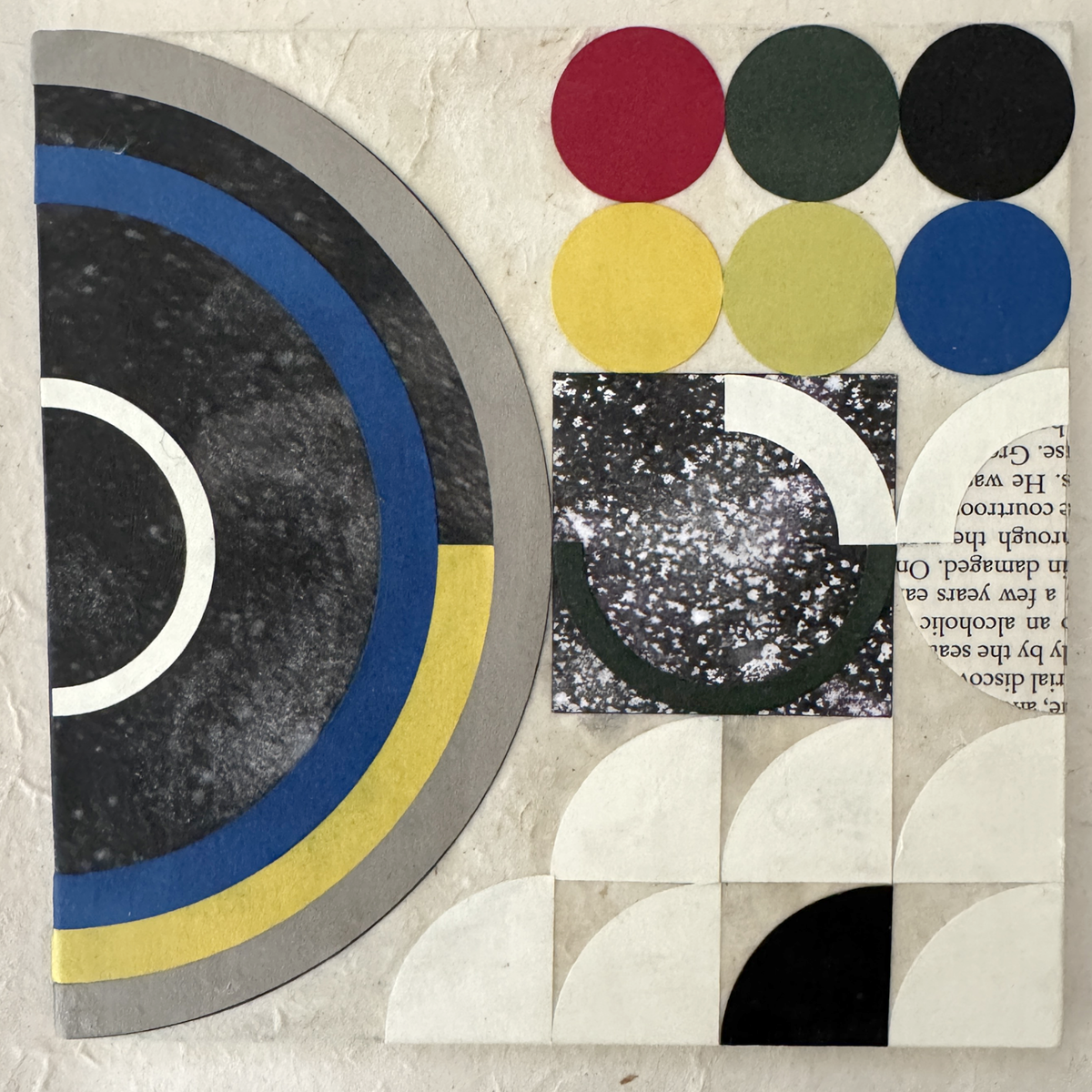
In the weeks leading up to the call for entries, I worked on ideas for proof of concept — Can I do fifty of this? Is it sufficiently interesting and compelling? Will I wish I was never born? I finally arrived at an exploration of abstract geometric collage — well suited to the size and scale of the project and of deep historical and personal significance. Working through a dozen or so test pieces, I refined my materials and techniques until I heard that still, small voice announcing, “Yes, this is good. You can do this.”
Prototypes in progress, solid, printed and found papers on handmade lokta
Then, I had to write the dread Artist’s Statement — a standard part of any entry process — and one of the most challenging things I’ve ever had to do. I made it excruciating, but! I persevered. Here’s what I arrived at (in fear and loathing) as the submission deadline was approaching:
“Constructed with awareness, but not with calculation, led by high intuition, and brought to harmony and rhythm.” — Piet Mondrian, 1916 Awareness, intuition, harmony, rhythm… How many ways can circles, squares and triangles be assembled to create compositions that flow, balance and fit in the space allowed? In these collage works, cut papers — color, mono printed and found — are manipulated and arranged to create balanced, rhythmic patterns and correspondences that please and satisfy our curious pattern-seeking sensibilities. In exploring abstract geometric collage, evidence of the — my! — maker’s hand is evident in tiny misalignments; they are forgiven and unintentionally lend an animation to the work. When multiple compositions are hung together, new patterns emerge. Possibilities remain endless.
Once I got over myself and that hurdle, I realized two things: first, artist statements are not carved in stone for all eternity and can and should be revised at will, at any time. Second, I’m pretty sure most people are not as mean, judgmental or paralyzing as my inner critic. And so, merrily, we rolled along.
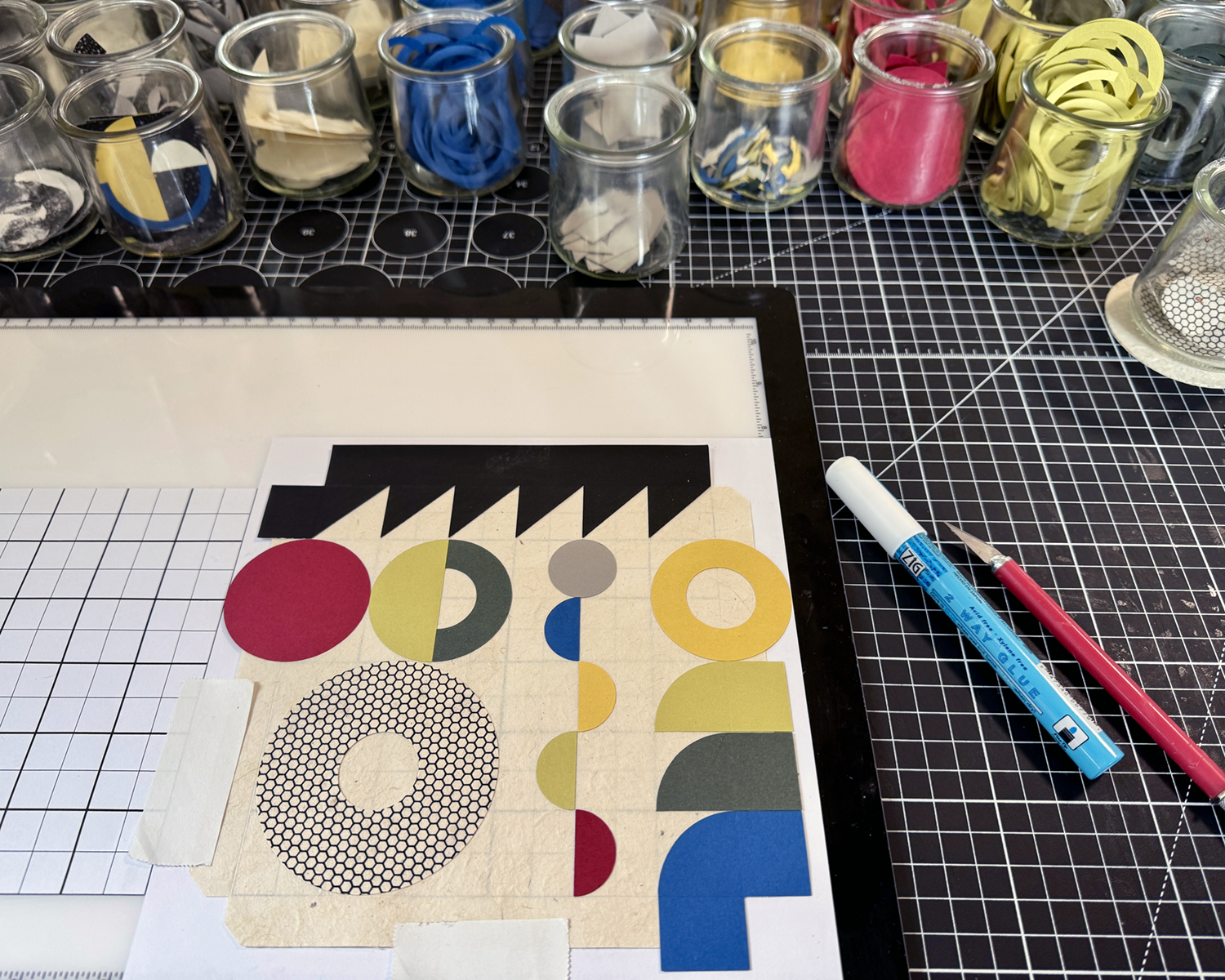
Front deck setup for panel priming, ten at a timeA new LED light pad makes accurate placement possible
Wish me luck, inspiration and endurance, friends! These panels are (thus far) fun and satisfying to build! They make your eyes dance (in a good way)! The show opens Friday, 05 September, and runs through Sunday, 05 October. If you’re in the SF Bay Area, do consider stopping by the Sanchez Art Center to enjoy this exhibition of 50 artists’ works!
Been a little sidewise lately, what with birthdays and some away time… but mostly with a new project involving compositions of geometric shapes, with limited color palettes and mono printed and solid papers.
Proto_000Proto_001Proto_002
These babes are like the third iteration (thus far) of materials, colors and component shapes. Sourcing non-bleeding papers of suitable quality, weight and hue was/is an ongoing process (looking at you, royal blue, and previously, lokta crimson). Still working out best practices for the hand assembly, adhesive finesse and crisp tidy edges.
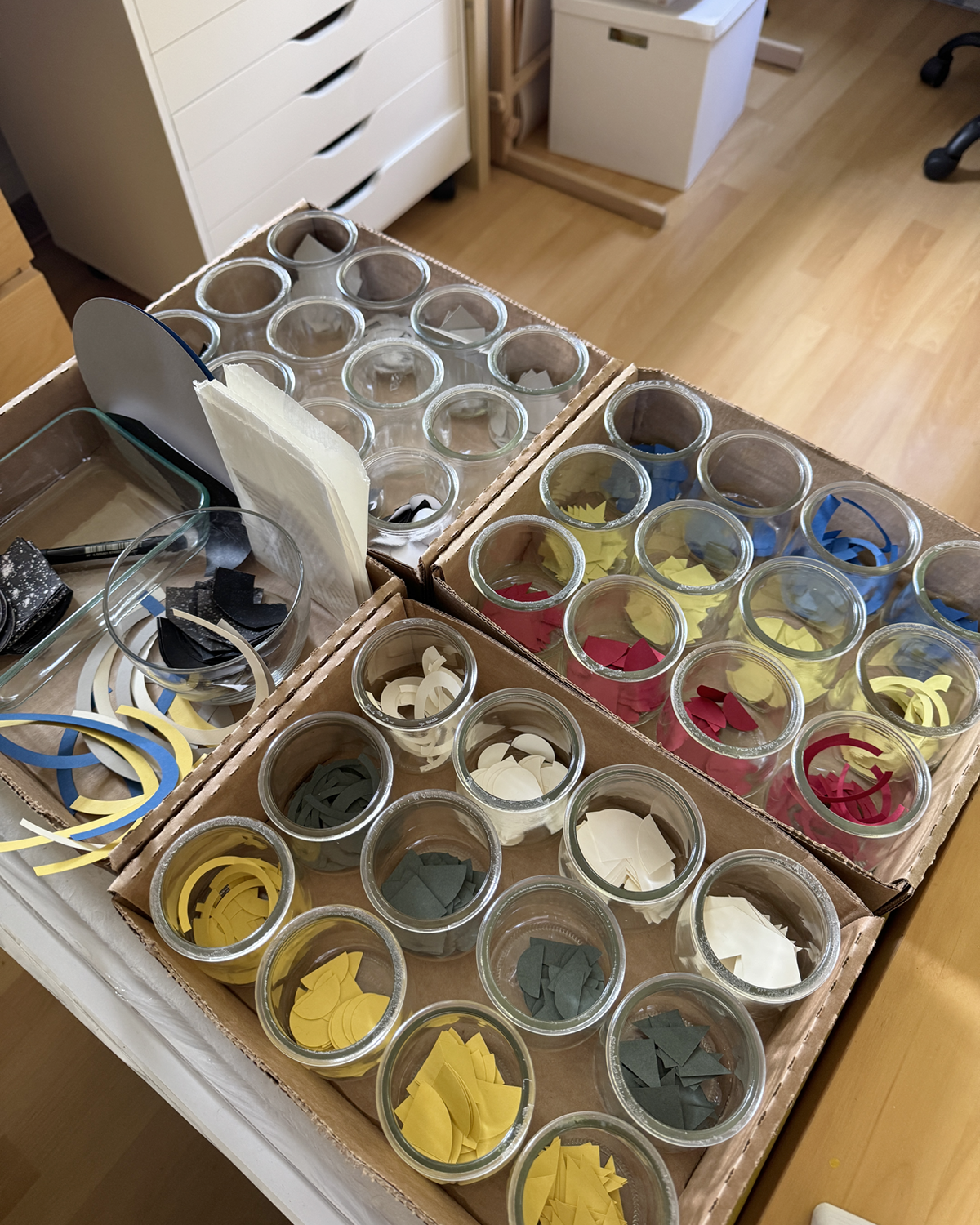
Sooooo many pieces
This is part of my color shapes system, with two other flats of the primary mono printed mixed blacks not shown. (And because I’m pulling prints on 28 lb. printer paper, I get to ink the white edges of each shape with a black PITT pen :)
I’m enjoying myself tremendously. All my graphic design training and experience gets to play, and I’m paying homage to some of my original influences: Bauhaus philosophies and practice, International Typographic Design (Cleanliness. Readability. Objectivity.) and, of course, beautiful, satisfying geometry.
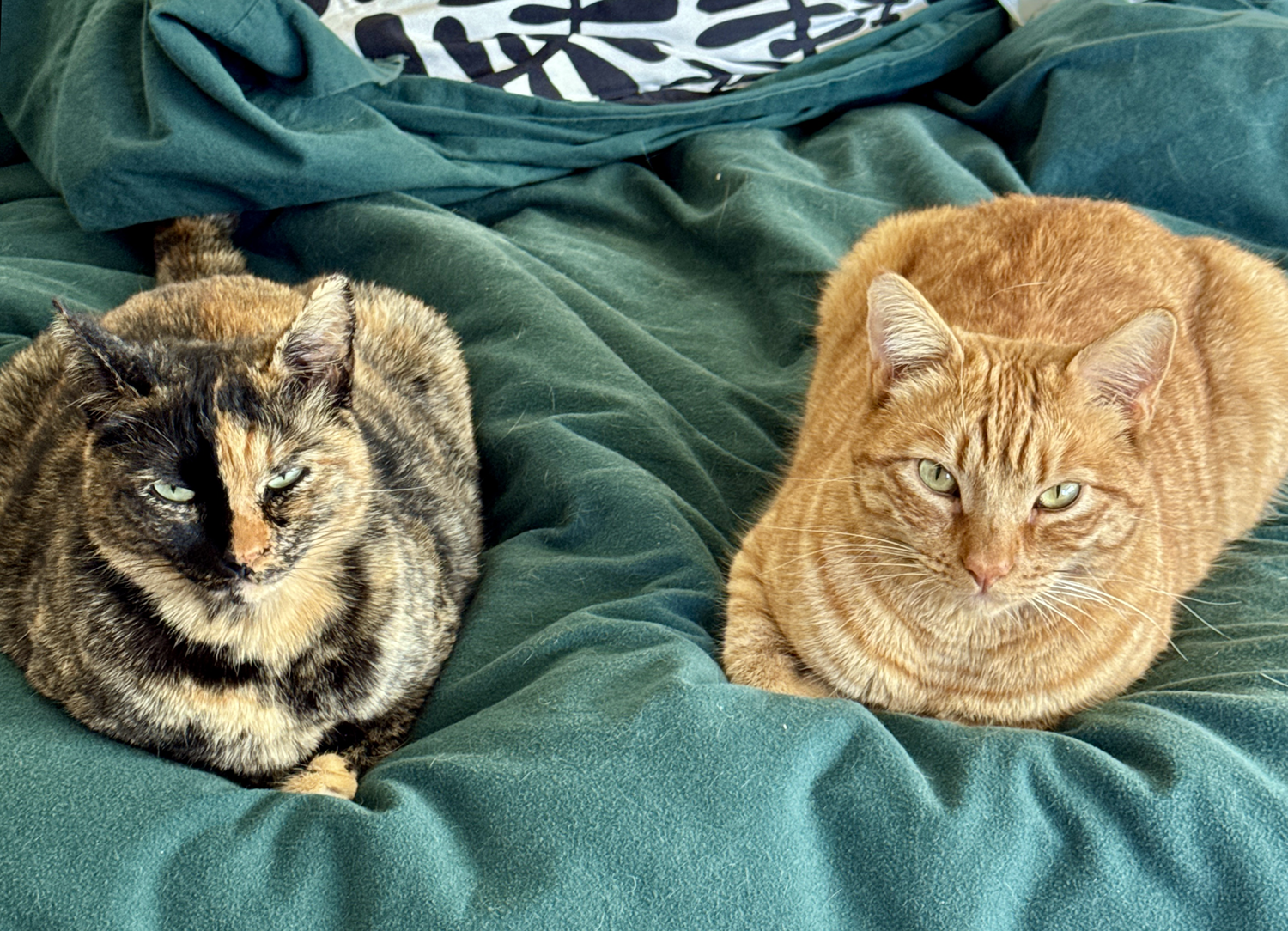
Maxine and Mateo also believe form follows function
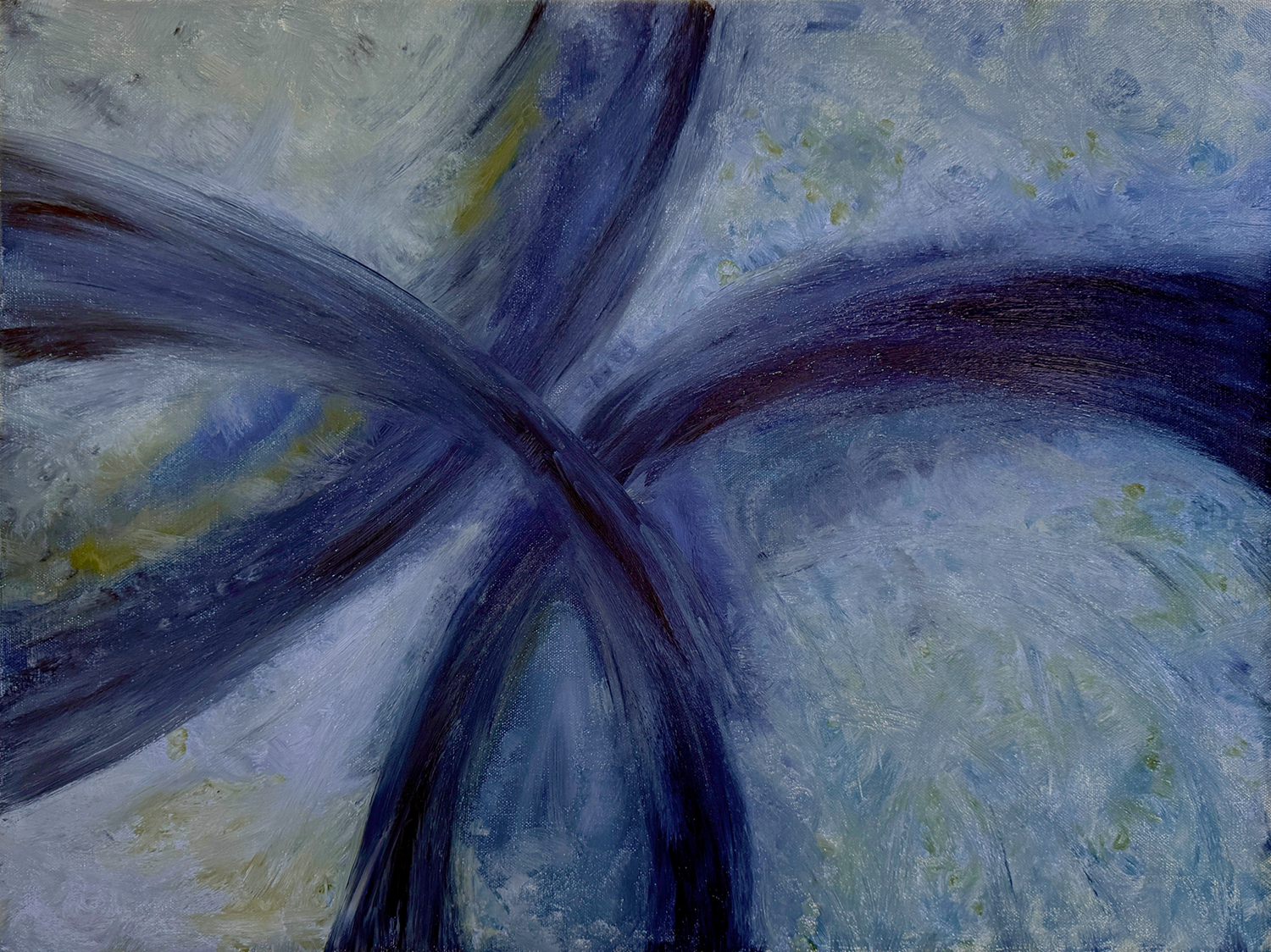
This piece started out last year as a foray into something else entirely, and sat in limbo a liminal state for months.
On the way, somewhere
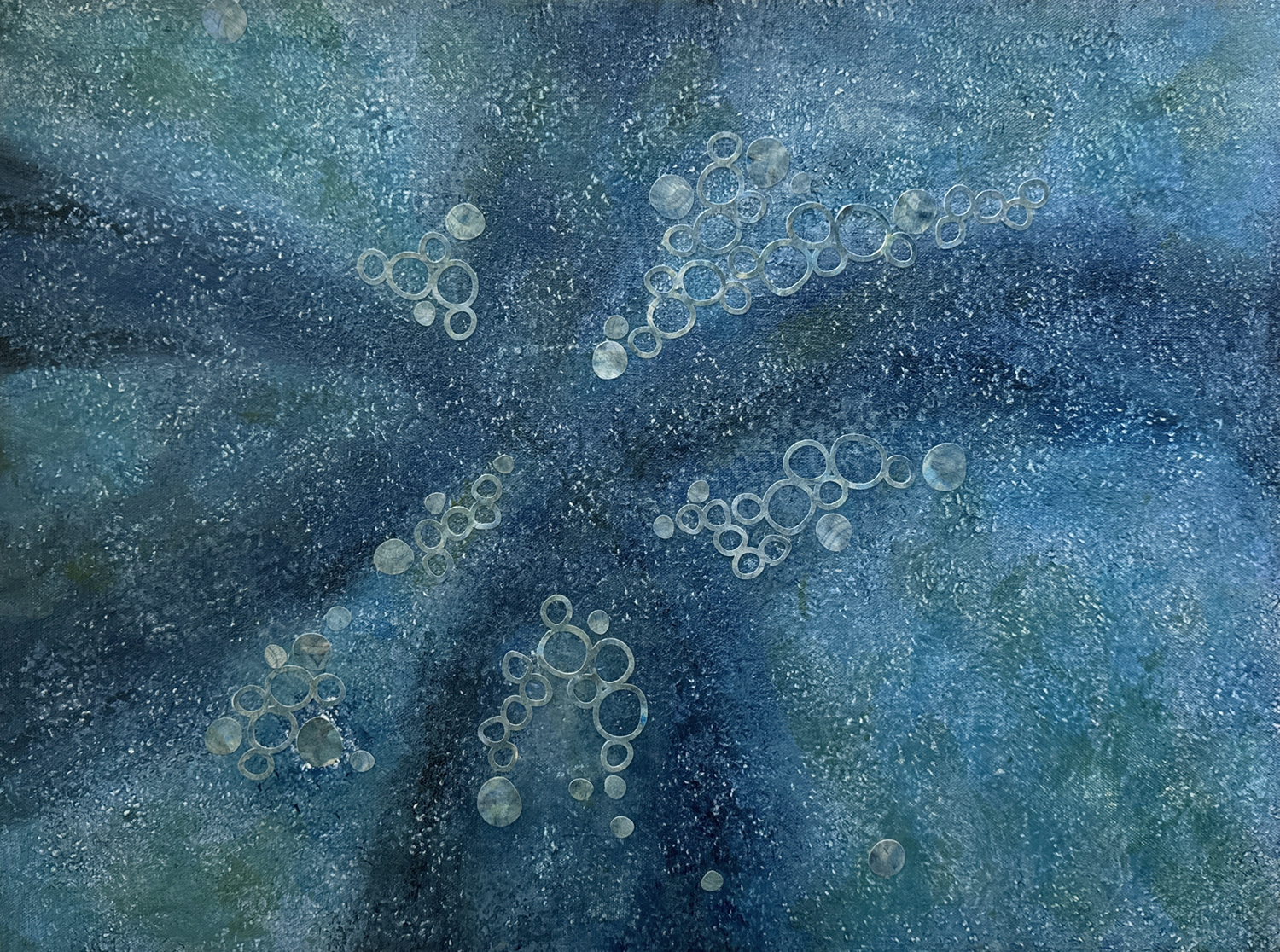
It became a deep blue-green painted background for an exploration of printed and cut papers in bubble patterns.
Going for a more backgroundy thing?
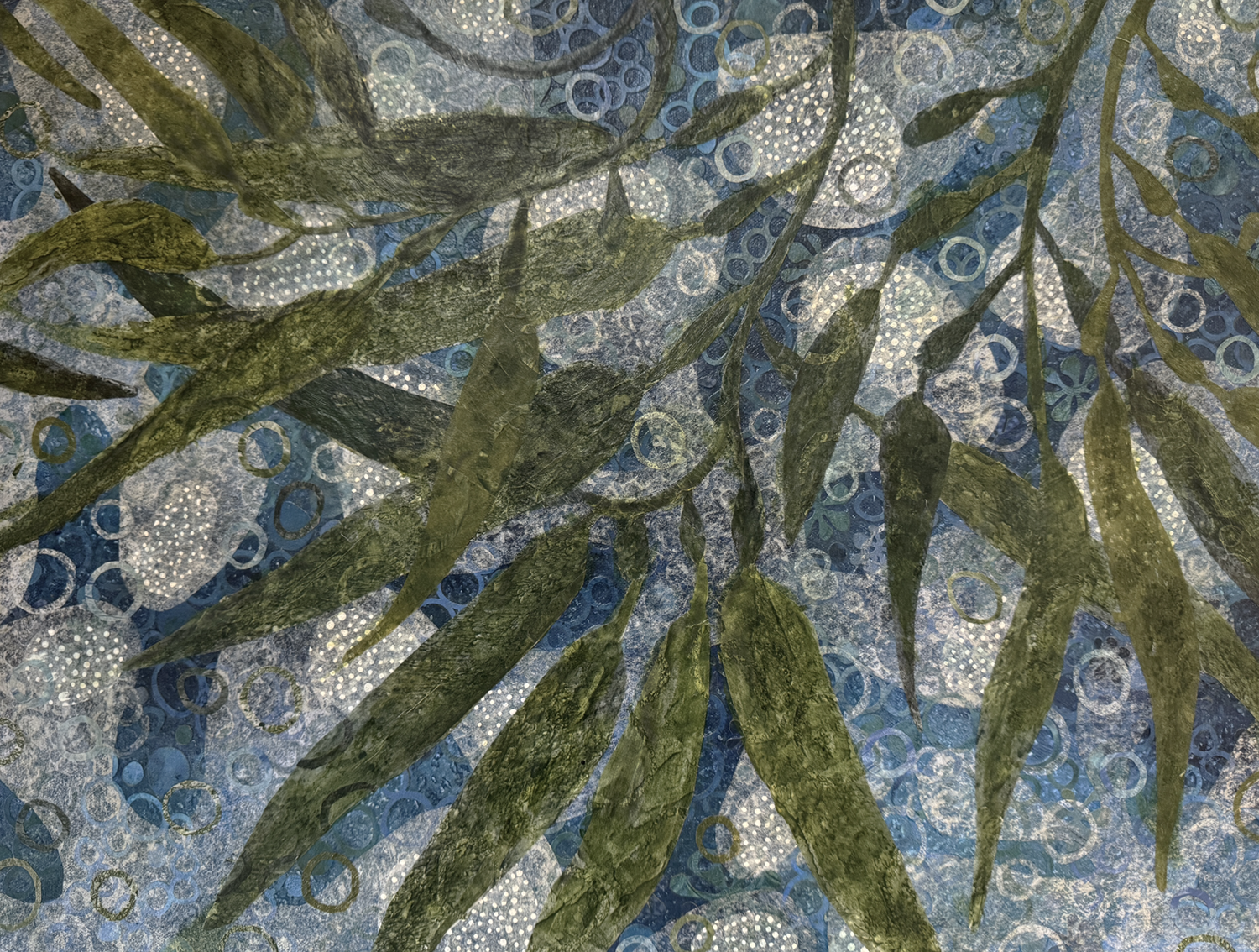
I worked mindfully, attentively, listening, conjuring beginner’s mind, getting discouraged. Small amoeba shapes — a recurring interest for me — were cut and added, to no avail. The piece and I were lost. It sat on the easel, sometimes covered by other projects, and became studio background. I studied, read a lot of art books, went to the Museum. And then, one day it occurred to me to add large lumpy amoeba shapes cut from thin tissue. I liked it! Then I saw they needed white dotted patches, and dot dot dot, a background was complete.
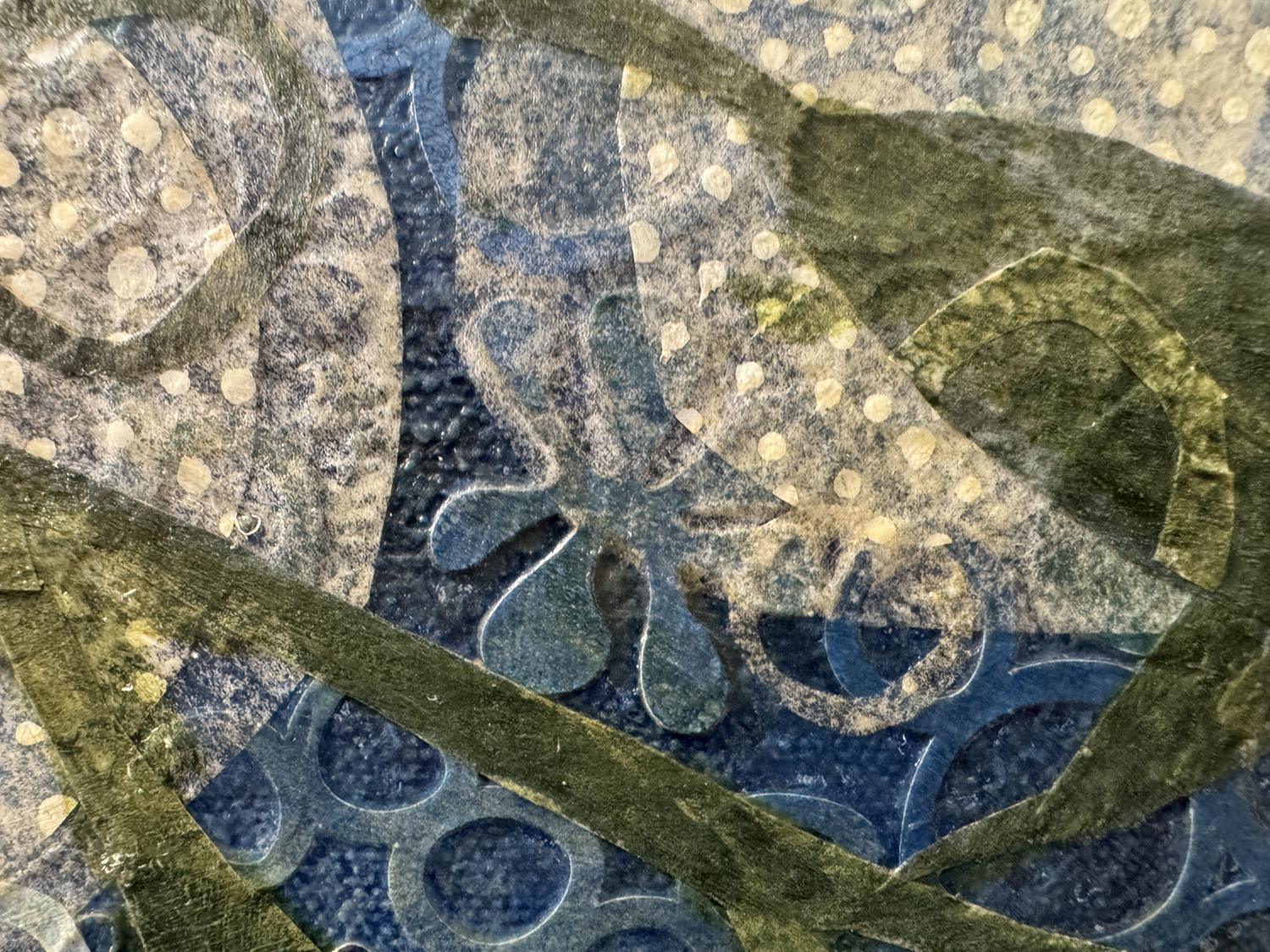
Closeup of one of the original background amoeba and bubble shapes, and subsequent layers
Ideas came regularly after that, and we were ON. The seaweed fronds and more bubbles! were cut from sheets of stamped, printed and painted tissue papers I keep readymade in stock. It was all cut, paste, consider, a bubble here, a bubble there, from there on.
I’ve learned so much from this piece — mostly what-not-to-do’s — and I’m satisfied to call it done. I can even look at it and smile, and feel like I’m another step along the way to competence. SO good.
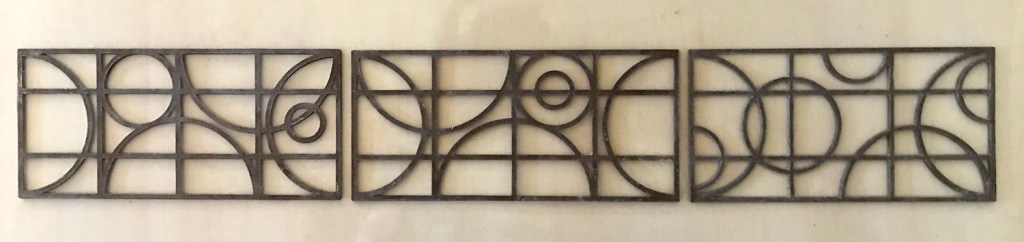
The Conservatory has a celestial motif in the leaded windows, which is carried through in the railing panel design.
I cut multiples of each panel from chipboard on the Cricut Maker. (Side note: I get the best results from editing the cutting presets, after a test cut on my chosen material.) I decided on a double, rather than triple layer, to lessen the alignment errors.
I used a lamination technique I learned from the talented Heather Tracy at Thicketworks. She uses thin cyanoacrylate on her intricate chipboard pattern pieces to seal, strengthen and stabilize the material. When dry they are easily sanded and very, very hard, and take acrylic paints beautifully.
Wheelbarrow pattern design by Heather Tracy of Thicketworks
To learn the nuances of the technique, I used one of Heather’s patterns she generously makes available free of charge. (She also has an Etsy shop, a YouTube channel of tutorials, and a maker club.) I made the blue wheelbarrow first, and then the red, slightly improving my results. It is a worthwhile technique, but messy. (Also, to me cyanoacrylate is one of those devil’s bargain products.) If you’re not familiar with Heather’s work, I encourage you to check it out!
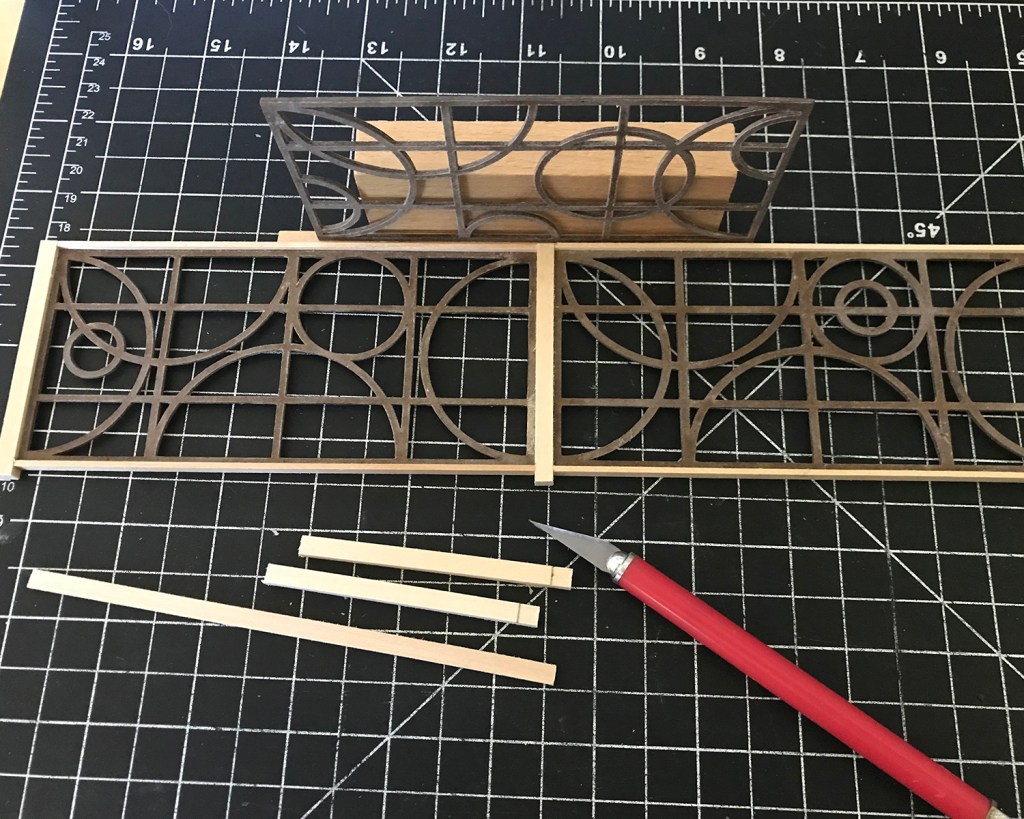
After sanding the panels smooth — paying particular attention to the outside edges — I glued (using wood glue) them into post and rail surrounds.
These were then joined into the L-shaped railing.
I sprayed the assembly with multiple light coats of matte black primer + paint, to seal and increase attachment bonds. After the glue and paint cures overnight, I’ll finish sand it and paint a final coat, then give it a matte seal.
I like a good wide top railing, for cats to lounge, elbows to lean, and drinks to be set upon, so I used 3/4- by 1/8-inch basswood. Thinking now of bracket designs to be cut from card stock to attach the railing securely to the deck, but that’s for tomorrow.
Having just finished watching the Amazon series Tales From The Loop, I’ll leave you with this image of Point Montara Light.
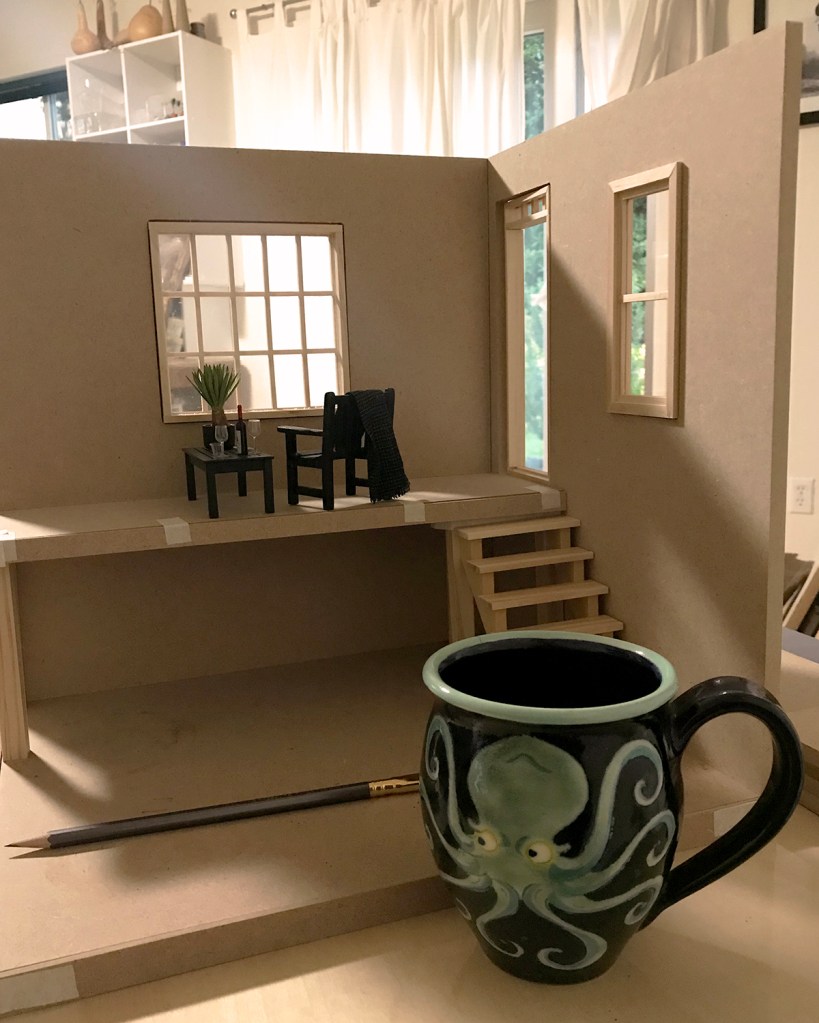
Late one night I decided to dry fit the HBS contest base because I needed to look at something new. I like the kit, but am undecided if I can responsibly build it. Ideas abound, and it’s currently on a turntable next to the studio thinking couch. It also makes a grand morning coffee cup platform.
UPDATE: Next morning. See?Sea House Conservatory under-pier detail
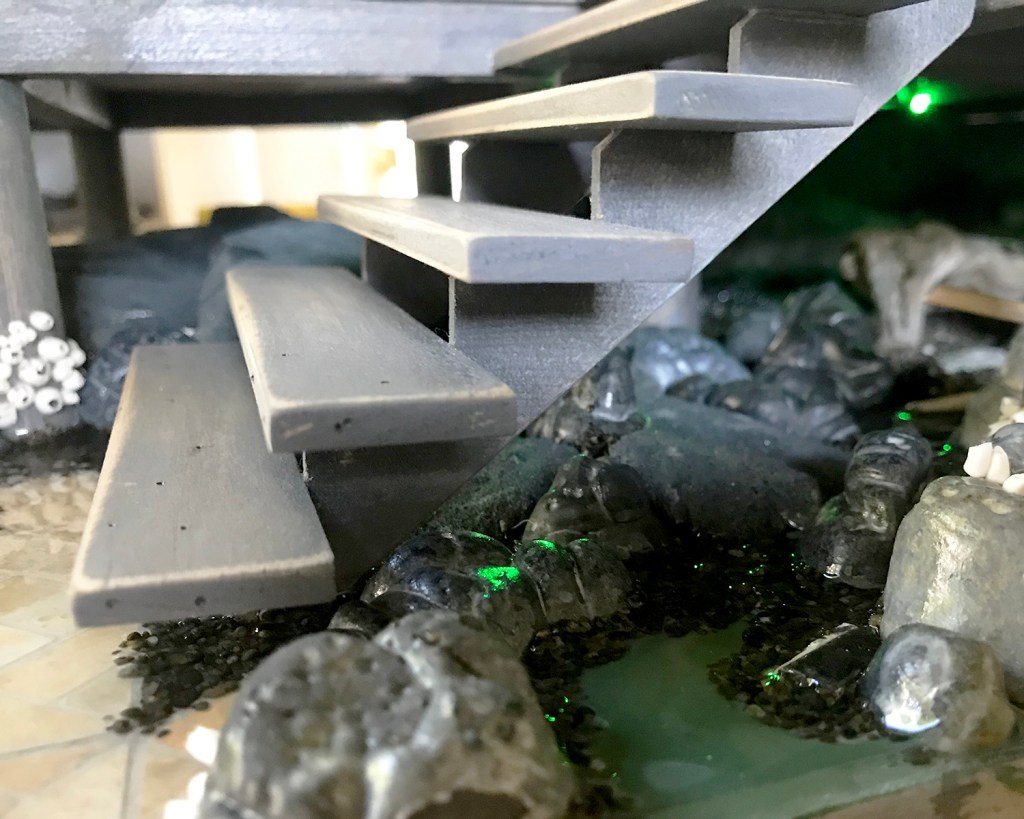
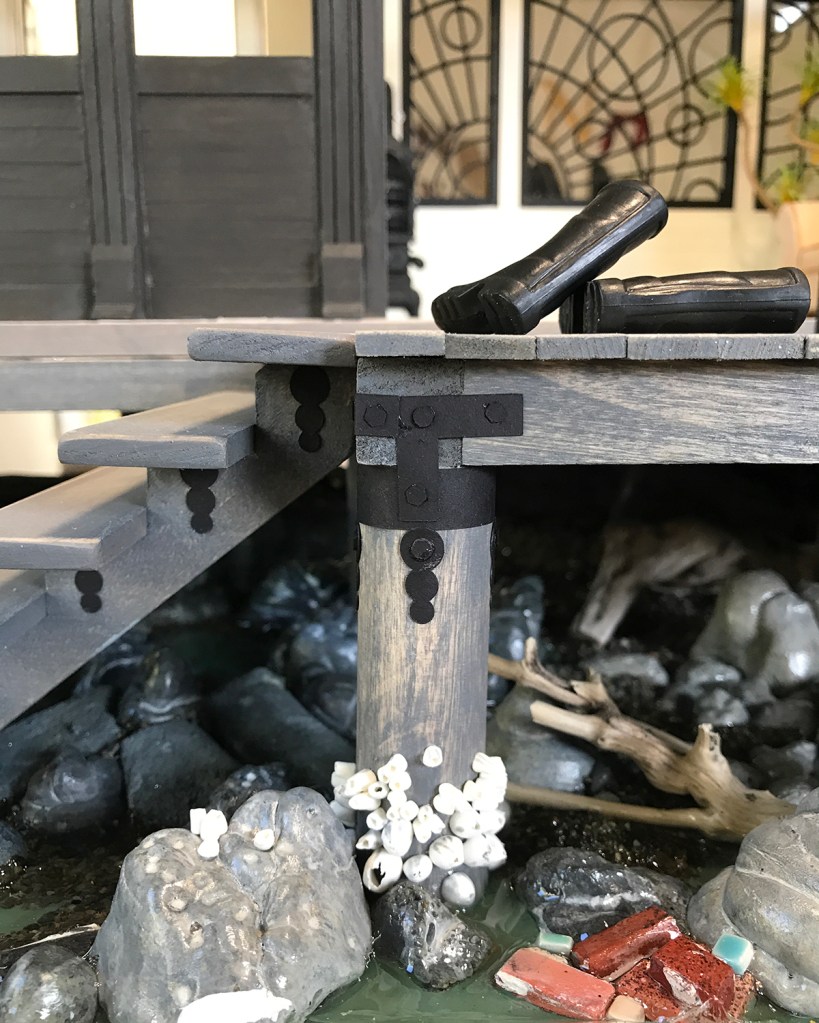
Here’s a glimpse of the under-pier, under-stair Sea House Conservatory setting. Barnacles by Keli, air-dry clay boulders, and flotsam from the natural and manufactured worlds.
Sea House Conservatory bioluminescence
When I saw just how much of the low tide water is in the shadow of the Conservatory structure, I thought some bioluminescence might add charm. This is four flickering LEDs set in the back corner, under the pier.
More Sea House Conservatory bioluminescence
The effect is subtle, but smile-worthy, especially in the dark.
Sea House Conservatory light trickery
Here’s a shot of preliminary bulb placement. You can see some of just how much is unseen.
Thar be monsters
A night view of the mystery.
I indulged the rare decorative impulse to design pier piling hardware that echoes the Conservatory finials.
Oh wait, another what-lies-beneath shot.
Looking west from Point Montara Lighthouse, 07 March 2020
This was one of my birthday views, taken from Point Montara Lighthouse in early March, on a day-long field trip with my Greater Farallones Naturalist class. There was a large pod of dolphins cavorting not far offshore, visible through the very many pairs of binoculars and spotting scopes.
The pandemic was already getting real, but that was the last time I sat by the ocean, side by side with my classmates, eating our bag lunches together in the intermittent sun and light rain.
Here’s an image from a series Keli and I have been punting about. It started when Keli found a scale model canoe builder in Maine who makes these beautiful 1:8 paddles. We each bought one and the challenge is on Instagram #littlepaddletales and #paddlehomage. It’s been fun.






















 nancyland.com